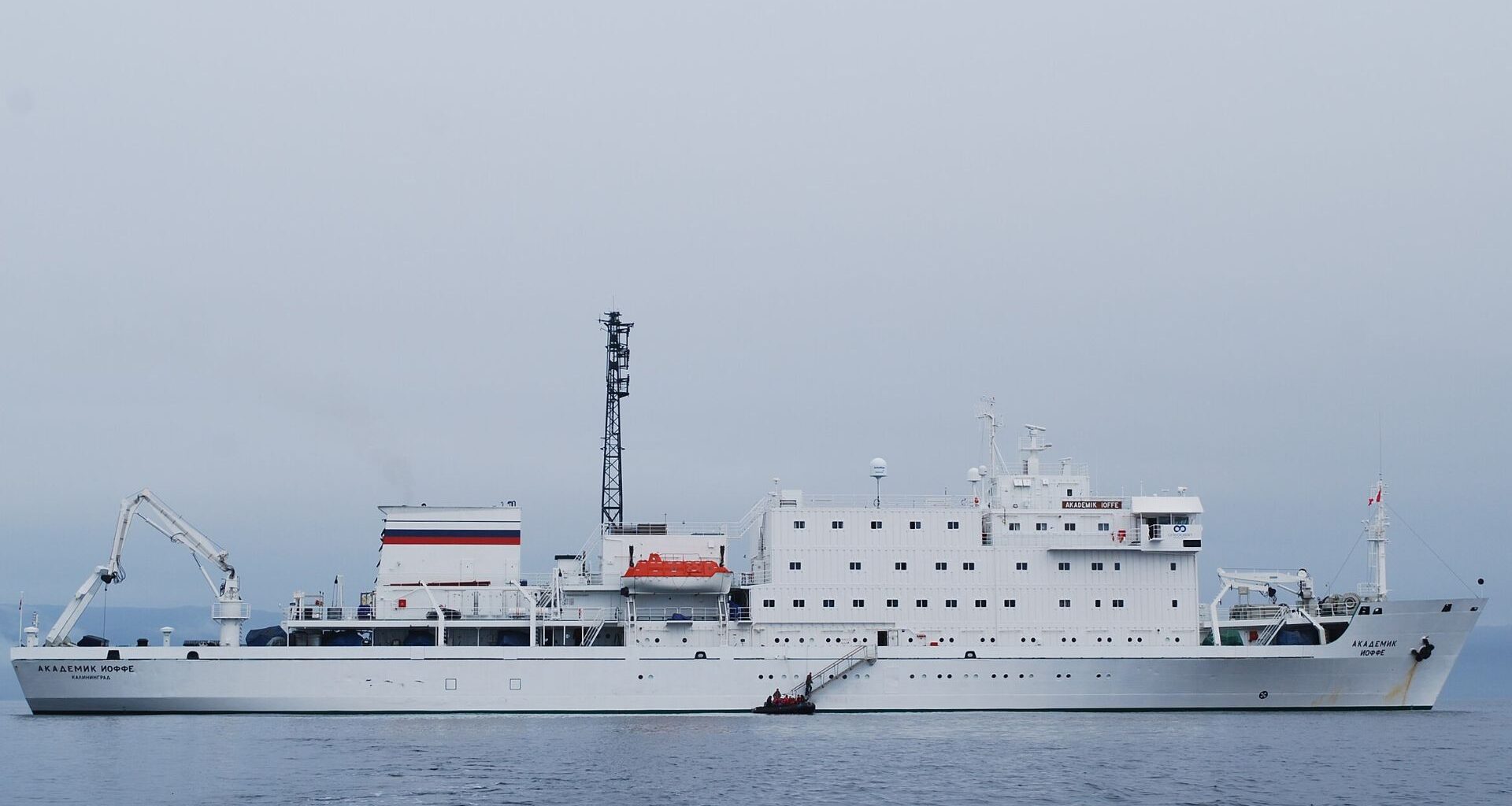
The Russian research vessel Akademik Ioffe has identified an undocumented burial site of radioactive waste in the Barents Sea.
This discovery occurred during a recent expedition focused on the rehabilitation of the Arctic region from submerged objects containing spent nuclear fuel.
The newly found site is located in the Bay of Currents, a position not listed in public sources or available Soviet-era inventories regarding nuclear legacy objects in the Arctic.
Search for Likhter-4 vessel
A primary focus of the expedition was the vessel Likhter-4, which was scuttled in 1988.
Archival data indicated that this vessel, along with 146 containers of solid radioactive waste generated during the operation of submarine nuclear power plants, was dumped in the area during the 1980s.
The Likhter-4 holds two reactor vessels from the K-22 submarine, encased in lead with their fuel unloaded. Previous attempts to locate these objects were made during voyages in 2007, 2023, and 2024 aboard the Akademik Mstislav Keldysh.
Those missions faced limited time and adverse weather, preventing definitive identification.
Successful localization and identification of the Nikel barge
The Akademik Ioffe team succeeded where previous attempts failed. Utilizing favorable weather conditions, the researchers deployed underwater remotely operated submersibles, including the GNOM “X,” GNOM “Vector,” and “Argus.”
These units were equipped with gamma spectrometers developed by the Kurchatov Institute National Research Center. Surveys revealed that the Likhter-4 was not at the coordinates indicated in the archives near the Roze Glacier. Instead, bathymetric analysis suggested the sinking occurred in a local depression with a depth exceeding 100 meters.
The team successfully mapped the exact position and conducted partial radiation surveys of the hull and surrounding seabed.
In addition to the Likhter-4, the expedition confirmed the precise coordinates of the Nikel barge for the first time in two decades. Resting near Kolguyev Island, this barge contains approximately 580 tonnes of solid radioactive waste. Its location had been known only approximately until this mission mapped it with meter-level accuracy.
The expedition also conducted a comprehensive inspection of the nuclear submarine K-27 in Stepovoy Bay near Novaya Zemlya. Sunk in 1981, the K-27 features two nuclear reactors with liquid-metal coolant based on a lead-bismuth eutectic.
Following a 1968 accident and 13 years in reserve, it was scuttled with its spent nuclear fuel intact. It is considered potentially the most nuclear-hazardous object in the world’s oceans.
Radiation findings for future monitoring
Data collected using a REM-4-50 spectrometer mounted on an ROV indicated that the protective barriers remain effective. No radioactivity was detected leaking from the reactor compartment into the marine environment.
The presence of Cesium-137 in the spectra was attributed solely to surface contamination of the hull. Specialists concluded that the primary influence on the radiation situation in Stepovoy Bay likely stems from other sunken containers of solid waste rather than the submarine itself.
Based on these findings, a coastal area has been selected for a future underwater station to provide continuous 24/7 radiation monitoring of the K-27 reactors.