William Brangham:
On this Christmas Eve, with the new year rapidly approaching, many are gathering to reflect on the past year and look towards the next.
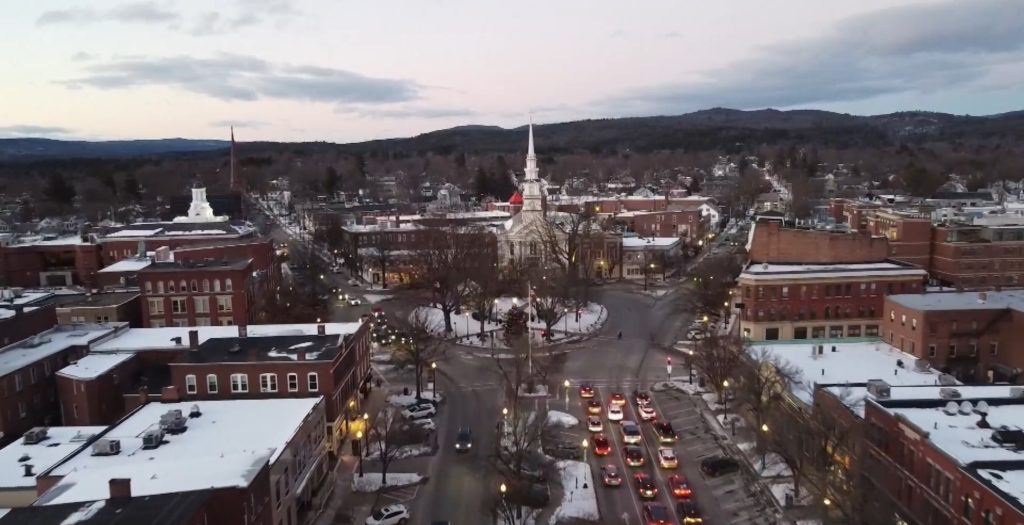
For her series America at a Crossroads, our Judy Woodruff has been traveling around the country this year talking with grassroots groups that are working on solutions to our nation’s deepest divides. For her last piece of the year, she reports from New Hampshire on how some believe the answer to many of our challenges may begin right at home.
Judy Woodruff:
Winter has come again to New Hampshire and, with it, snow, ice, freezing temperatures and the need for plenty of firewood to keep stoves roaring for the next several months.
In the small town of Richmond, Tom Tague spent many years chopping his own wood, but after receiving a pacemaker now has to rely on others for help.
Tom Tague, Richmond, New Hampshire, Resident:
Most of my life, I have been on the side where I’m serving and helping. And now I’m on the other side where sometimes I need help.
Judy Woodruff:
He found help from some volunteers from the Church of Jesus Christ of Latter Day Saints. He’s been a member for 40 years, including from 20-year-old Peter Brown, who’s new to all of this. Brown says before joining the church this year, he struggled with loneliness.
Peter Brown, Member, Church of Jesus Christ of Latter Day Saints: Since I was in school, I never really had any friends, to be honest. There was a generic friend where I would wave and say hi in the classroom. But when school was over, there’s no really ever opportunity for me to get to know someone.
Judy Woodruff:
Through the church and its service projects like this one, he says he’s found new community and purpose.
Peter Brown:
It makes me feel like I’m valued, I’m able to help others, and I’m able to just be myself, and able to be outdoors and talk to some people that I wouldn’t normally have been before. I probably would be playing some sort of video game. But this really opens you up to others, I guess. It might make me emotional, but I’m happy to have these people to support me.
Shaylyn Romney Garrett, Co-Author, “The Upswing: How America Came Together a Century Ago and How We Can Do It Again”: As human beings, one of our deepest, deepest needs is to feel a sense of belonging.
Judy Woodruff:
Shaylyn Romney Garrett belongs to the same church in Keene.
Shaylyn Romney Garrett:
And when we don’t have that sense of belonging, our nervous system is literally on fire. We are vulnerable to extreme views and to extreme behaviors, because we feel so unsafe. And I really think that that’s what’s happening in America. We have so many people who just don’t feel that their basic need for connection is being met.
Judy Woodruff:
A writer and speaker, Garrett co-wrote the 2020 book “The Upswing” with political scientist Robert Putnam featured in our first crossroads report this year.
That book described the many parallels between our own time and the Gilded Age, that late 19th century period marked by technological change and Industrial Revolution, widespread dislocation, growing inequality and political corruption, and tells how those earlier Americans found their way out of those challenges.
Putnam told us in February that he had assumed the economy would change first.
Robert Putnam, Harvard University:
The one thing that data show is, that’s not true. Economics was the last thing to change. So then what was the first thing to change? And to my shock, it was cultural change. It was a moral revival, is the way I want to put it.
People began to say, wait a minute, it’s not all about us. We have obligations to other people.
Judy Woodruff:
We have spent much of this past year examining so-called bridging groups, which attempt to connect people from across lines of division to try to rebuild civic health.
As the year closes, we wanted to ask Garrett whether she sees the kind of cultural change she and Putnam think is needed.
Shaylyn Romney Garrett:
One of the things that I see when I look at a lot of the bridging initiatives that are out there is that they’re really these sort of head-centered exercises.
First of all, they have this way of foregrounding political identity as if it’s defining. So we say we need to bridge Republicans with Democrats. But I wonder if we’re really hitting people in the heart, if we’re actually changing their feelings toward other people, because so much of the political violence, so much of the sort of extreme end of this polarization is about the way we’re behaving toward one another, the sort of dehumanization of the other side.
And so I have begun to wonder, as I have thought and watched this over time, are we doing enough to help people have a morally formative experience when they’re interacting with someone who’s unlike themselves, rather than just an intellectual exercise to try and find sort of ideological common ground?
Judy Woodruff:
And what does it take to address the moral piece of this, the heart?
Shaylyn Romney Garrett:
One of the things that we need to be able to do is give people experiences that help them feel genuine unity and genuine camaraderie with people in ways that have nothing to do with politics.
And that’s why, for me, I have really started to lean into those kinds of communities that I can find right outside my doorstep. Instead of saying, OK, I need to seek out someone who’s of a different political stripe, let’s just leave politics out of the conversation entirely and approach each other as human beings who are engaged in trying to get by in the world, who all have problems, who have ways to relate to one another on a human level.
And I think finding ways to serve one another and really be in relationship on a much more human level is what we need more of.
Judy Woodruff:
Garrett says that, rather than looking to new groups and institutions to help us out of this multifaceted crisis, groups that often depend on philanthropic dollars, which are now in greater demand due to government cuts to programs, people should look to themselves, to their neighbors, and to their own communities to figure out how they can give back.
Shaylyn Romney Garrett:
We have to teach our children that succeeding is not just about maximizing economic interest, that succeeding is about creating communities that thrive, which means giving, serving, thinking about something bigger than myself. We’re not doing enough of that.
Judy Woodruff:
At the LDS Church that evening, Brattleboro, Vermont, resident Carol Buffum joined a women’s group for food and conversation…
Woman:
We had your granddaughter a couple weeks ago.
Carol Buffum, Church of Jesus Christ of Latter Day Saints: Yes.
Judy Woodruff:
… to help pack hygiene kits for the homeless and for an ornament swap, a tradition here.
Woman:
Nutcracker. Don’t look too closely.
(Laughter)
Judy Woodruff:
Like Peter Brown, Carol joined the church this year after struggling for many other years with loneliness and isolation, in her case, following an infection that altered her appearance.
Carol Buffum:
I didn’t leave my house for five years after my staph infection that I got. People looked at me differently, pointed at me, whispered. And it bothered me a lot. And then I met the missionaries and a couple other people too helped. But they said, Carol, don’t hide behind your mask, because I wore the mask for years.
And then COVID happened.
And then everybody…
Judy Woodruff:
Everybody was lonely.
Carol Buffum:
Everybody was. So I was just like everyone else. And then I went back outside, and I saw it wasn’t as bad as I thought it was.
Judy Woodruff:
She says she’s so grateful for the community she’s found here, she wants to bring that sense of connection back to her apartment building to help others who might be struggling.
Carol Buffum:
I have a community room in my building. And it’s free to all the tenants. And I have been talking about starting up a group for people to just come and talk. It’s just something to start. If we don’t do something, it’s not going to get better. And I just want to make it better.
Judy Woodruff:
The point, Shaylyn Romney Garrett says, is not that everyone needs to join the Mormon Church or even a church. But it’s an example of a mutual aid network that already exists and strengthens the bonds of community, alongside things like neighborhood associations and schools, bonds that override our differences…
Man:
You have much left of your school this semester?
Judy Woodruff:
… and, at this time of year, the darkest in our hemisphere, helping people like Carol and Peter find the light.
Shaylyn Romney Garrett:
If you’re one of the majority of Americans who don’t know your neighbor, why don’t you start by going and meet your neighbor? Introduce yourself. Ask them if there’s anything that you can do for them. You might find that, living on your block, you have an elderly woman who doesn’t have any family support.
You might find that you have a 20-something young man who spends most of his time in the basement playing video games. What can you do as a neighbor to address those things? I don’t think we need to wait for a church to tell us that we should do that. I can actually just ask myself, what kind of world do I want to live in? And how do I enact that right now with the person across the street?
Judy Woodruff:
As we look to another year, when our country marks 250 years since the Declaration of Independence, I will continue to report on how those original ideals are measuring up to our present and how we might continue our search for a more perfect union.
For the “PBS News Hour,” I’m Judy Woodruff in Keene, New Hampshire.