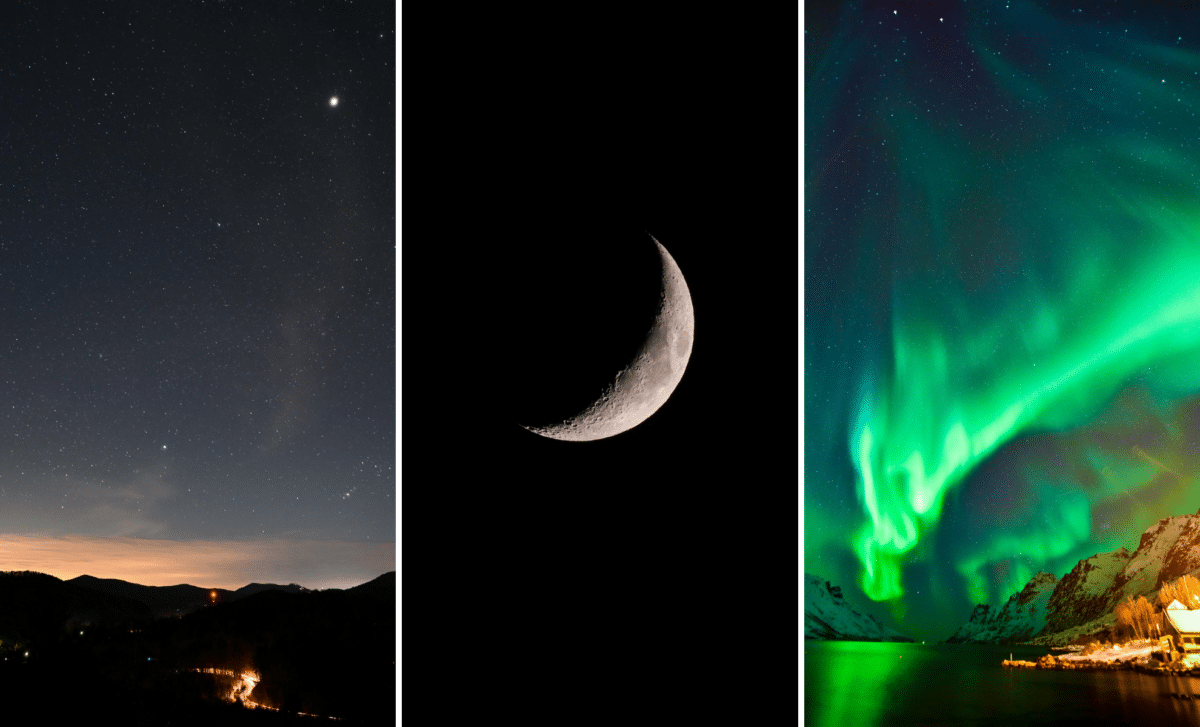
This holiday season, the night sky turns into a stage for a weeklong celestial performance. The evenings around Christmas 2025 will be filled with planetary alignments, moon phases, and even the potential for auroras. Whether you’re stepping out into the cold with binoculars or simply gazing up after dinner, this week offers remarkable cosmic sights that require no special equipment.
A Crescent Moon Begins The Week’s Sky Show
On Tuesday, December 23, a delicate 14%-lit crescent moon appears low in the southwestern sky during twilight. Nearby shines Fomalhaut, one of the brightest autumn stars, forming a striking visual pairing as both descend toward the horizon. This combination makes for an ideal photo opportunity or quiet moment of reflection under the early winter sky.
The next evening, Christmas Eve, brings an even brighter 21% illuminated moon, still low in the same part of the sky. What makes it special is the glow of Earthshine sunlight reflecting off Earth’s surface and gently lighting the moon’s darkened side. This effect gives the moon a ghostly outline, a subtle but captivating detail for anyone watching just after sunset.
Christmas Night Brings The ‘Holiday Star’
On December 25, as families gather indoors, a bright light climbs above the eastern horizon Jupiter, the so-called “Christmas Planet.” About an hour after sunset, the gas giant makes its evening entrance, shining unmistakably bright. According to Forbes, this appearance is especially significant because Jupiter is nearing opposition, which will occur on January 10, 2026. That’s when Earth will be directly between Jupiter and the Sun, making the planet reach its maximum brightness.
As Jupiter rises, the constellation Orion appears in the southeast. Its familiar three-star belt and bright stars like Betelgeuse and Rigel add depth to the evening display. Jupiter’s close proximity to the twin stars Castor and Pollux in Gemini forms a bold triangle that can be easily spotted with the naked eye; a celestial landmark for anyone venturing outside after dark.
Saturn And The Moon Align In A Post-Holiday Pairing
On Friday, December 26, Saturn takes the spotlight as it passes close to the moon in what’s known as a conjunction. As dusk falls, look high in the southern sky to spot the moon, now 41% illuminated, sitting less than three degrees from the ringed planet. This visual closeness is striking even without a telescope, with Saturn glowing steadily above the horizon.
Below this pairing, Fomalhaut once again reappears near the horizon, subtly anchoring the scene. As Forbes notes, Saturn is beginning to fade as it moves lower each night, meaning this may be one of the final easy sightings of the planet before it disappears into the twilight of early 2026.
A Half Moon Marks The Midpoint Of The Week
By Saturday, December 27, the moon reaches its first quarter phase, now 50% illuminated and bright in the southwest sky. This is one of the best phases for lunar observation, as the contrast between light and shadow makes craters and ridges appear sharper through binoculars or small telescopes. It’s also a great time for beginners to explore lunar details without needing advanced equipment.
The moon’s glow doesn’t outshine everything else, though. High above in the northeast, the constellation Auriga shines prominently. Anchored by the golden star Capella, Auriga forms a recognizable five-pointed pattern that stands out even in light-polluted skies. It’s one of winter’s finest constellations and adds to the richness of the night’s backdrop.
Auriga And The Winter Sky’s Hidden Geometry
Auriga earns its place as the constellation of the week, both for its beauty and its accessibility. Visible from early evening throughout the night, this winter pattern includes several star clusters that can be explored with binoculars. Its brightest star, Capella, rarely dips below the horizon in North America, giving it a reliable place in the northern sky.
As highlighted by Forbes, spotting Auriga can help viewers orient themselves to the winter sky. It also serves as a gateway to neighboring constellations like Taurus and Perseus, making it a useful reference for those wanting to go deeper into stargazing over the holiday break. Auriga’s geometry, five main stars forming a pentagon, gives it a clean and easy-to-follow outline.
Auroras May Also Light Up Northern Skies
While the Moon and planets draw most of the attention this week, there’s also a chance for something more unpredictable auroras. With heightened solar activity expected through the current solar cycle, northern regions across Canada, Scandinavia, and parts of the northern U.S. may see faint green and red lights dancing across the horizon.
Although no major geomagnetic storm is forecast at the moment, minor solar flares can still spark aurora borealis displays on short notice. Checking local aurora alerts and apps like AuroraWatch can help night sky watchers determine if conditions are favorable. For those in high-latitude areas, the holiday season might come with a flash of unexpected color overhead.