Matt Taylor,Leicesterand
Ben Jackson,BBC Radio Leicester
 BBC
BBC

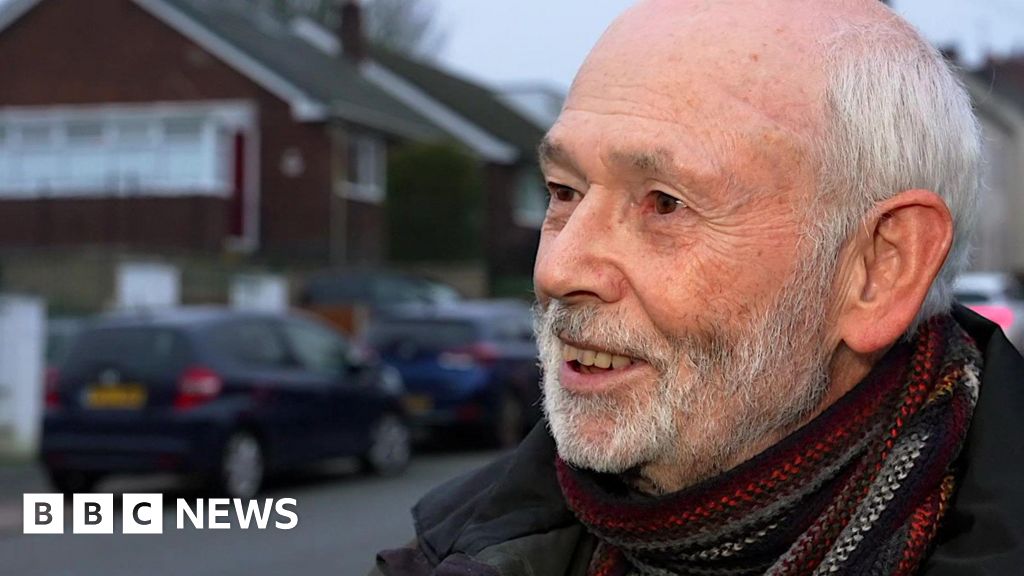
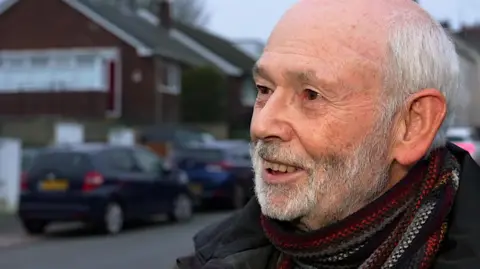
David Radford said he bought a new bike with the money he gained from selling a meteorite fragment 60 years ago
“I think I’m the only person that can say their racing bike fell from the sky.”
When a meteorite the size of a Christmas turkey broke up over a small village 60 years ago, David Radford was a teenager who had a second-hand bike.
This changed after he found a fragment of the largest meteorite to hit the UK in Barwell, Leicestershire, on Christmas Eve 1965.
David said he was playing with friends at the park when his foot fell down a hole made by falling debris. It was in that hole where he found the 4.5 billion-year-old piece of space rock.
“We took it round to my friend’s house and we weighed it on his mother’s cake scales,” David said.
“And she was not amused. It weighed two pound and 14 ounces (1.3kg).
“I took it back home, showed my parents, never told a soul.”
A week later, there was a knock at David’s front door.
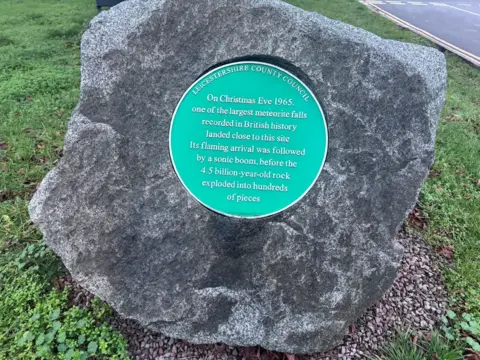
A plaque is in place in Barwell to mark the meteorite falling there in 1965
It was the late British astronomer Sir Patrick Moore, who presented the BBC programme The Sky at Night.
He was joined by an official from one of the museums in London, David added.
“They just turned up, they asked to see me and the meteorite and they wanted to see if it was real and authenticate it,” he said.
David believed word had spread around the village about his discovery.
After the two visitors confirmed it was a meteorite, David said the official asked if the museum could buy it from him.
He said he was given £23 (£393 when adjusted for inflation), as the going rate was 10 shillings per ounce of meteorite.
Eyewitness Joseph Grewcock describes the moment a meteorite landed in Barwell in a news report from 6 January 1965
“I was wanting a new bicycle, and I’d got the family hand-me-down, so I wanted to replace that,” David said.
He bought a 10-speed Raleigh racing bike, but said his mother made him set up a bank account with the remaining money.
“I was over the moon, literally,” David added.
“I love space, I love astronomy, and I’m into sci-fi, and if I ever got the chance, I’d like to go up there.”
David went hunting for more fragments after this, with the use of a magnet, as the meteorite had iron in.
He found another piece of rock and has kept it for 60 years, but it is likely slag, a material left over when iron has been smelted.
 Graham Ensor
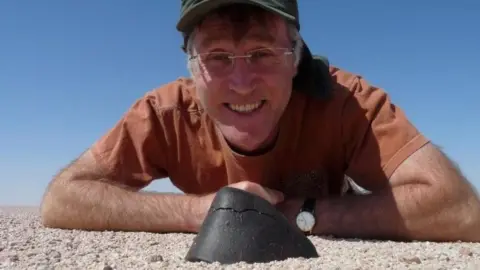
Graham Ensor, posing here with a meteorite he found in Oman, has travelled all over the world pursuing his hobby
The arrival of meteorite to Barwell was followed by a sonic boom and a frantic search for the hundreds of scattered fragments began.
Graham Ensor was nine at the time and lived nearby, and the event sparked a passion in him for space rocks.
He said: “It’s taken me all over the world. And this very meteorite has taken me to America. They did a special exhibition over there about meteorites that hit things.”
Graham said meteorites are not easy to identify but offered some tips.
“What you need to look for is this fusion crust, which is a black melted exterior that’s formed when it’s doing 30,000 miles an hour as it comes in,” he said.
“If you find a piece of rock that’s got lots of little thumbprints all over it, that is a good indicator, and especially if it’s black on the outside and light on the inside, that it could be a meteorite.”