Astronomers have identified a distant, slow-moving object in historical sky surveys that may represent a previously unknown ninth planet orbiting far beyond Neptune. The object, observed at an extreme distance from the Sun, aligns with long-standing theories predicting a massive planetary body influencing the outer solar system.
Initial findings are based on infrared data collected more than two decades apart. The signal appears consistent with a Neptune-sized planet that could take thousands of years to complete a single orbit. Researchers caution that further observations are required before the object’s status can be confirmed.
The detection builds on years of indirect evidence from the Kuiper Belt, a region beyond Neptune filled with icy debris. Irregularities in the orbits of Kuiper Belt Objects (KBOs) have suggested the gravitational influence of an as-yet-undiscovered planet. This candidate, if verified, would help explain those anomalies.
Infrared Sky Surveys Reveal Slow-Moving Object
The research team at National Central University in Taiwan analysed data from the Infrared Astronomical Satellite (IRAS) in 1983 and Japan’s AKARI infrared mission in 2006. These space-based telescopes captured faint thermal emissions from cold, remote objects that would not appear in visible-light surveys.
By comparing both datasets, the team detected a faint source with subtle but consistent motion over 23 years. That shift suggests a potential orbital path around the Sun. Based on its trajectory and apparent distance, the object is estimated to lie between 46.5 and 65.1 billion miles (500 to 700 astronomical units) from the Sun.
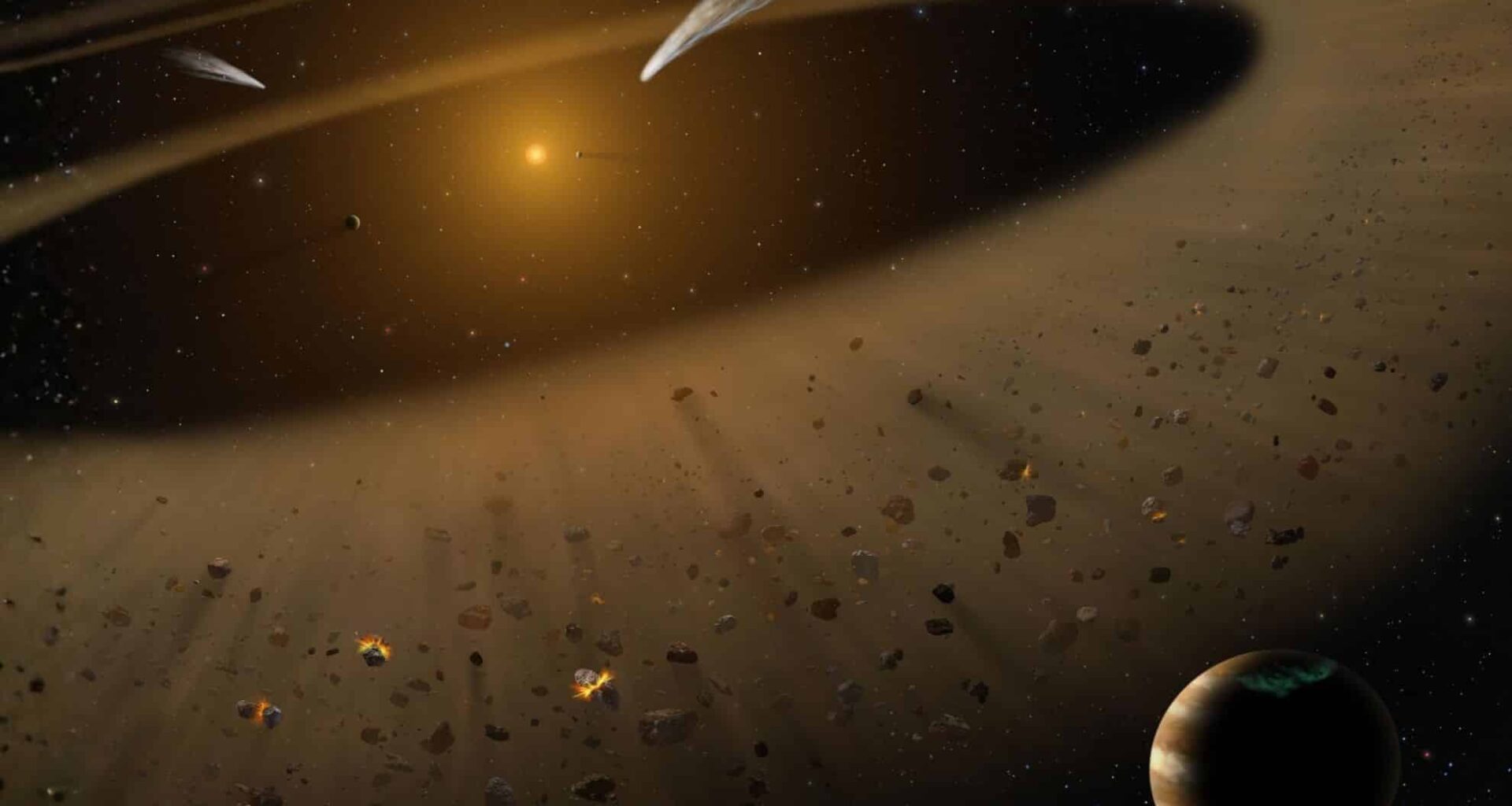
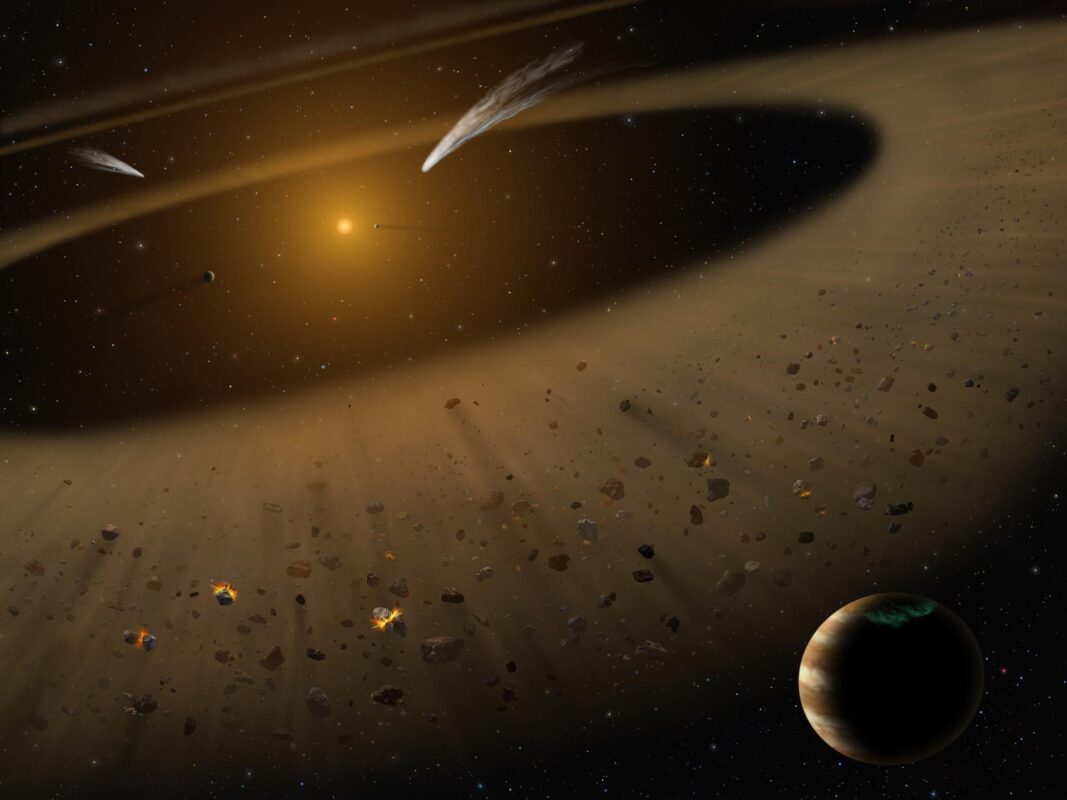 Artist’s illustration of the Epsilon Eridani system showing Epsilon Eridani b, right foreground, a Jupiter-mass planet orbiting its parent star at the outside edge of an asteroid belt. Credit: NASA/SOFIA/Lynette Cook
If the signal represents a planetary body, it would fall into the category of ice giants, with a mass between seven and seventeen times that of Earth. Its temperature, estimated between –370°F and –360°F, implies it reflects minimal sunlight, making it difficult to detect using traditional telescopes.
These preliminary findings are detailed in the Publications of the Astronomical Society of Australia. A preprint version of the study is available via arXiv, offering initial evidence for what researchers describe as a possible Planet Nine candidate.
Gravitational Patterns in the Kuiper Belt Suggest Hidden Mass
The Kuiper Belt extends beyond Neptune’s orbit and contains millions of icy bodies, including Pluto and Arrokoth. Over the past decade, astronomers have observed unusual clustering among Kuiper Belt Objects—highly elliptical or inclined orbits that suggest the gravitational pull of an unknown massive object.
These patterns have long intrigued researchers. Some KBOs even move in retrograde orbits, opposite the general flow of planetary motion. NASA has reported that this behaviour may indicate the presence of a large, distant body altering orbital dynamics.
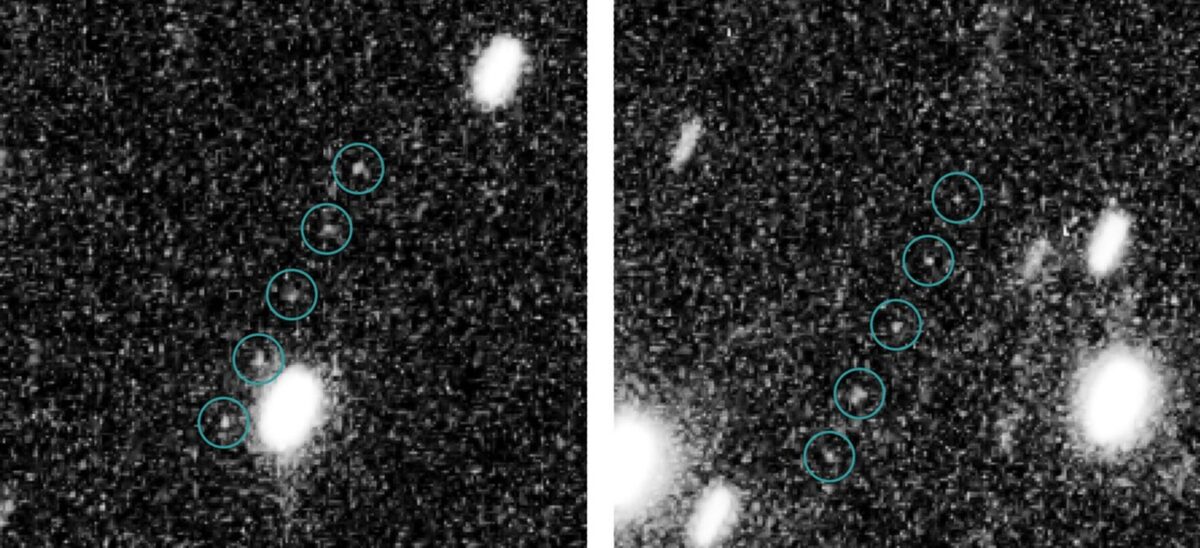 These two multiple-exposure images from NASA’s Hubble Space Telescope show Kuiper Belt objects, or KBOs, against a background of stars in the constellation Sagittarius. The two KBOs are roughly 4 billion miles from Earth. Credit: NASA, ESA, SwRI, JHU/APL, New Horizons KBO Search Team
Support for this theory increased following a 2016 model from Caltech, which proposed a distant planet ten times Earth’s mass, orbiting far beyond Neptune, to explain the clustering of distant objects. While that model remains hypothetical, the new infrared detection offers a rare observational data point that may fit those parameters.
Planet Characteristics Match Known Ice Giants
The potential ninth planet’s inferred mass and composition resemble Uranus and Neptune, the solar system’s known ice giants. These planets have dense atmospheres composed of hydrogen, helium, and methane, and contain icy cores likely formed under colder, more remote conditions than those of Jupiter or Saturn.
Detection of such bodies in the far solar system is challenging. Their distance reduces reflected sunlight, while cold temperatures limit visible-light emissions. Infrared telescopes are therefore essential for identifying objects at such scales and distances.
The James Webb Space Telescope (JWST) is currently being used to study Uranus and Neptune in greater detail. By mapping their atmospheric composition, temperature patterns, and circulation, JWST is helping refine the criteria for identifying similar bodies beyond Neptune.
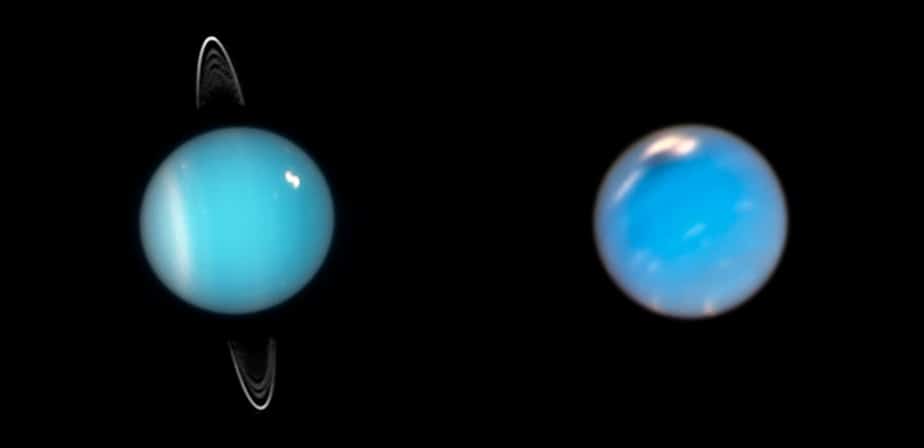 The Hubble Space Telescope captured these images of the mysterious ice giants Uranus, left, and Neptune, right. Shortly after launch in 2021, the James Webb Space Telescope will unlock secrets of the atmospheres of both planets. Credit: M. Showalter /SETI Institute and J. Lissauer/NASA Ames Research Cente
As described by planetary scientist Leigh Fletcher in NASA’s reporting, researchers expect the climate and atmospheric dynamics of these ice giants to differ significantly from gas giants like Jupiter. These differences are influenced by their size, rotation, and the unique mix of gases present in their upper atmospheres.
Next Steps Focus On Confirmation Through Observation
Despite the compelling nature of the signal, experts stress that confirmation requires additional evidence. The object was observed in just two sets of images, separated by 23 years. Follow-up observations using modern infrared instruments will be necessary to track its motion and establish a stable orbital path.
Targeted monitoring of the same region of sky over multiple years could determine whether the signal moves in a manner consistent with a planetary orbit. If it does, that would strengthen the case for a new planet in the solar system. If not, the object may prove to be a more distant background source or another type of celestial body.
Recent developments in exoplanet research, including atmospheric studies of planets like K2-18 b, show that large, Neptune-sized planets are common around other stars. These findings raise the possibility that cold, slow-orbiting planets may be present in many planetary systems—including our own—but remain undetected due to observational limitations.