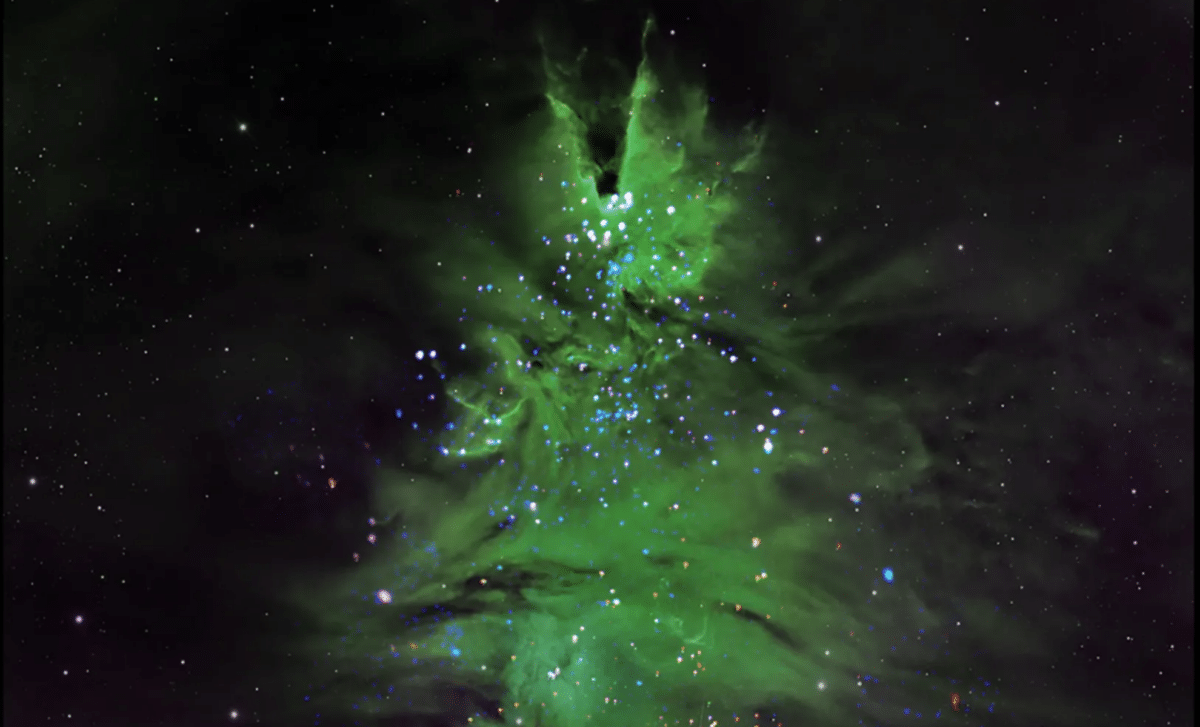
Stargazers are in for a treat this December with the Christmas Tree Cluster (NGC 2264), a stunning formation of young stars that resemble an evergreen tree. Visible between the constellations Orion and Gemini, the cluster offers a festive astronomical spectacle just in time for the holidays.
The Christmas Tree Cluster, located in the constellation Monoceros, is also a significant star-forming region. This open cluster and its surrounding nebulae are part of a broader cosmic structure that contributes to our understanding of stellar evolution. Visible to the naked eye under clear skies with minimal light pollution, it presents a striking formation of bright stars that resemble the triangular shape of a Christmas tree.
A Stellar Holiday Tree in the Sky
The Christmas Tree Cluster, cataloged as NGC 2264, is a unique combination of an open star cluster and a star-forming region located in the constellation Monoceros. According to NASA, the stars within the cluster flicker with blue and white light, while the optical data from the National Science Foundation’s WIYN Observatory contributes the green tint that resembles pine needles.
The cluster is situated approximately 6.5° south of the bright star Gamma (γ) Geminorum in the constellation Gemini and about 11.5° east of Betelgeuse in Orion. For optimal viewing, stargazers should aim to observe the cluster between 9 and 10 P.M. local time, when it reaches an altitude of 40° above the horizon. The star pattern forms a triangle or arrowhead, with the brightest star, 15 Monocerotis, marking the base of the tree.
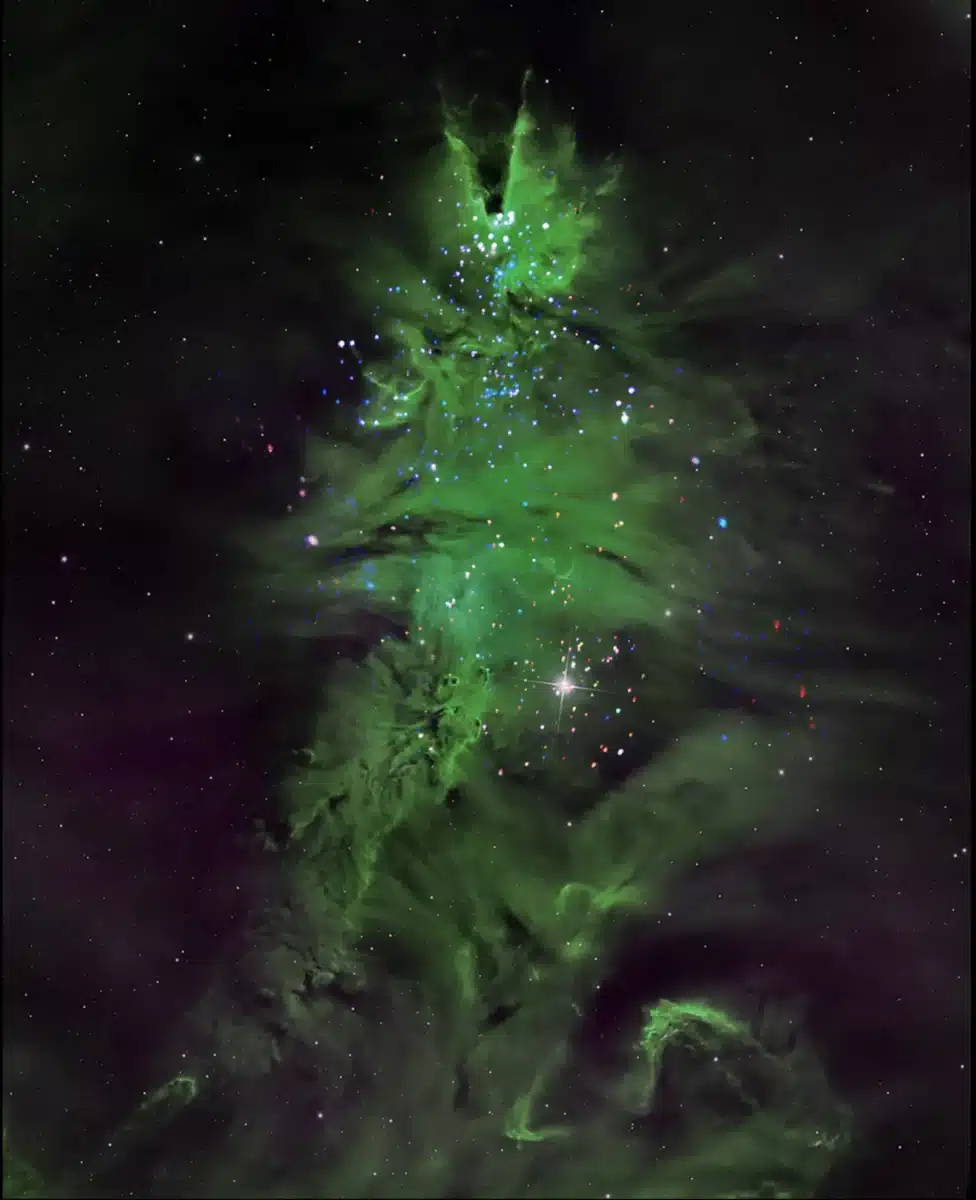 “Christmas tree cluster” NGC 2264. Credit: NASA
The Cone Nebula: A Hidden Celestial Feature
While the Christmas Tree Cluster is stunning on its own, it’s the surrounding region, particularly the Cone Nebula, that adds an extra layer of intrigue. The Cone Nebula, located near the top of the Christmas Tree Cluster, appears as a dark and dense patch of gas and dust, signifying an area where new stars are forming. This nebulosity can be difficult to detect without a telescope of at least 12 inches in aperture, but it provides an excellent challenge for those with more advanced equipment.
The Cone Nebula’s proximity to the Christmas Tree Cluster makes it a key feature of the region. As noted in Astronomy Magazine, observers using larger telescopes will be able to detect this nebula’s faint glow, revealing the complex processes at work in this area of the sky.
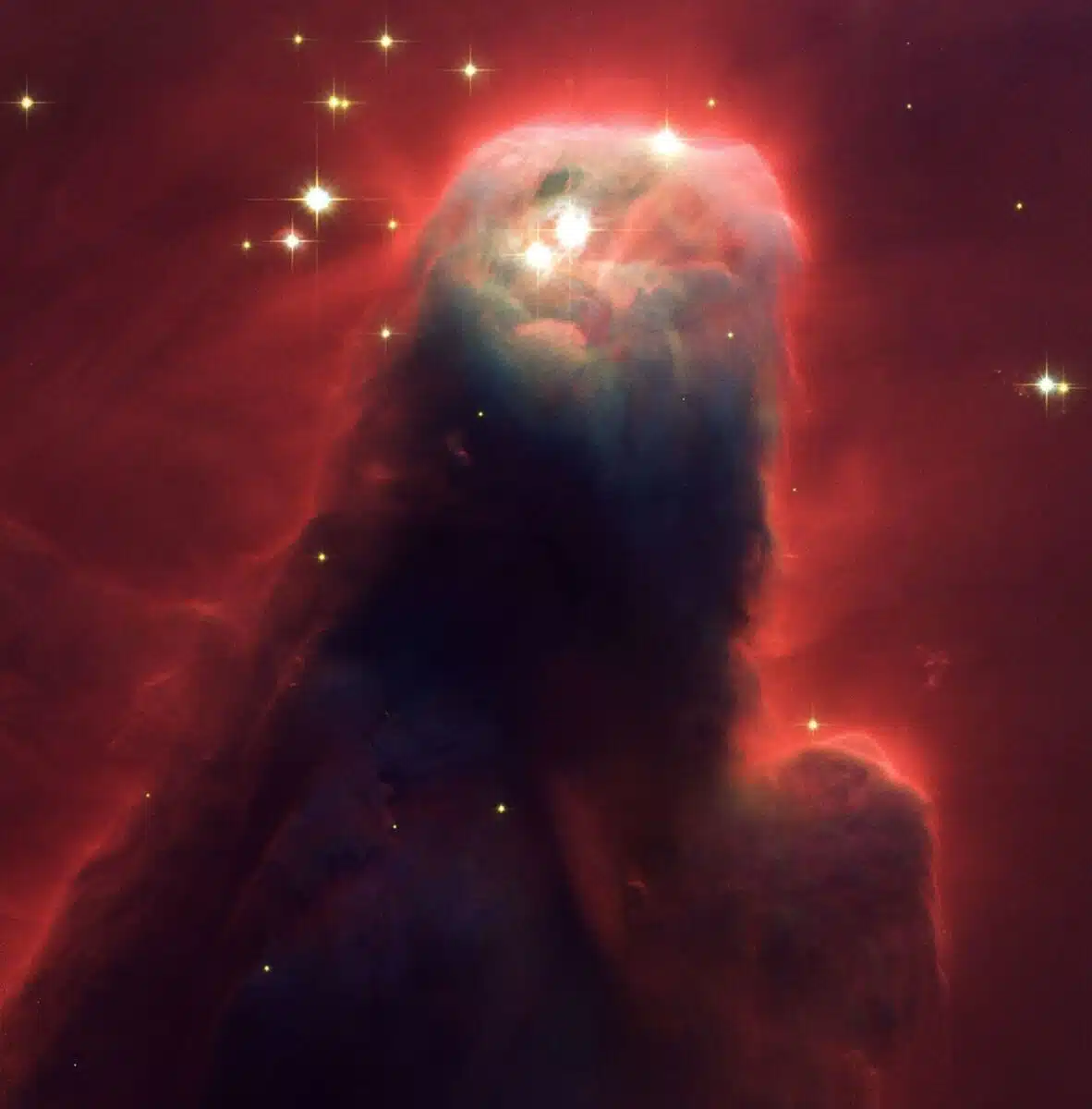 Cone Nebula, NGC 2264. Credit: NASA
Ideal Viewing Conditions for December 25
For those hoping to catch a glimpse of the Christmas Tree Cluster on December 25, the evening hours offer the best viewing window. The cluster is at its highest point in the sky around 9-10 P.M., making it visible to the naked eye and through binoculars or telescopes. As the cluster reaches an altitude of 40° above the horizon, the triangular star formation becomes clear.
Additionally, with the moon in its waxing crescent phase at 33% illumination, the evening sky will remain dark enough for clear views. The moon rises at 10:53 A.M. and sets at 11:23 P.M., leaving the later hours free for stargazing.