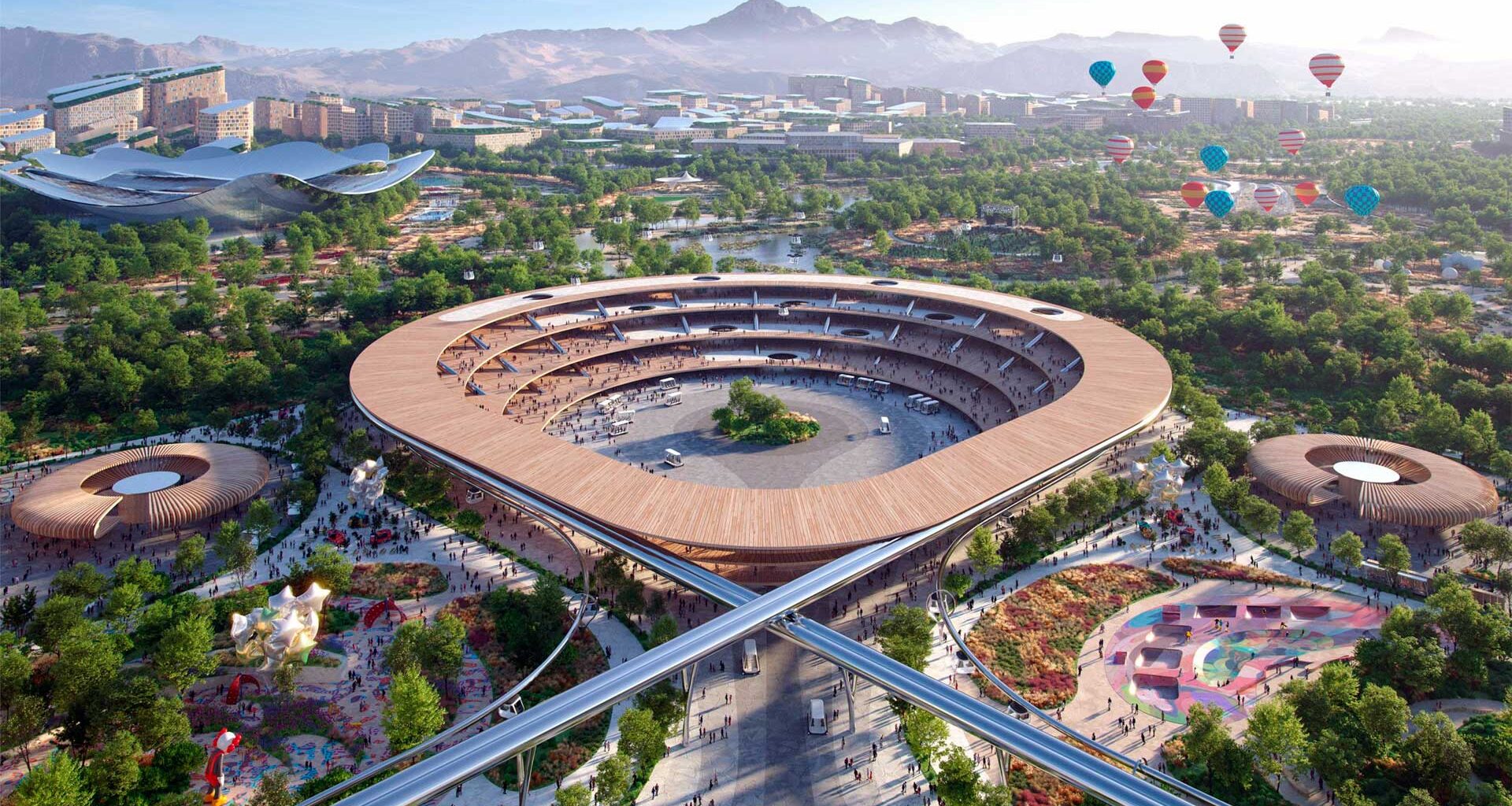
Telosa is a proposed sustainable city for up to 5 million people, still without a defined site and with an estimated cost exceeding US$400 billion. The plan is resurfacing with new images and raises questions about viability, water supply, and governance.
Telosa has returned to the radar as one of the most ambitious proposals of sustainable urban planning already disclosed by a private project in United StatesConceived by billionaire Marc Lore, the city was presented as a model built from scratch that would combine environmental sustainability, robust public services, and a people-centered urban design.
The promise is big, and so is the number. The estimated cost to bring the idea to life is… US $ 400 billion, with the goal of achieving 5 million population over decades, in a territory that would be chosen from a desert region or areas with cheaper land.
Despite the talk of climate urgency, the project itself still depends on the most basic step: defining where Telosa would be built and who would put enough money on the table. In architectural publications that revisited the topic in 2025, Telosa appears explicitly as a conceptual plan, with detailed renderings, but no announcement of work having begun.
— ARTICLE CONTINUES BELOW —
See also other features
-
South Korea reclaimed over 600 hectares of sea, invested approximately US$40 billion, and built an entire smart city from scratch on artificial land where only ocean previously existed.

-
An easy, mess-free way to plaster walls with a fine finish, without using sand and cement, achieving results identical to professional plaster.
-
A man single-handedly digs an underground hut in the middle of the forest, building mud walls, a stone stove, and an earthen roof using only ancestral techniques.
-
The Brazilian state will transform two federal highways with millions in investment, using concrete and whitetopping in projects that will double the BR-222 and BR-116 highways, reduce accidents, and boost the economy.


The discussion gained momentum because Telosa emerges in a context of urban megaprojects that promise to “reinvent the city.” And that’s where the controversy arises: does it make more sense to create a green megacity from scratch, or would it be more efficient to invest that effort in… cities that already exist And where do they concentrate the real problems?
What is Telosa and why did the proposal become news?
Telosa was announced in 2021 as a “city of the future” project conceived by Marc Lore, known for his career in e-commerce and for having held relevant executive positions in retail. At the time, media outlets in the US reported that he would leave corporate roles to dedicate himself, among other things, to the idea of building a city.
The masterplan was developed with the Bjarke Ingels Group, BIG, which describes Telosa as a city vision capable of establishing a global standard for urban living. The proposal includes a total area in the house of 150 thousand acres, with growth occurring in stages over decades.
A central point of the narrative is that Telosa would not be “just another city,” but rather a prototype of sustainable urbanism. The promise involves renewable energy, ecological architecture, low-emission mobility, and a design based on the concept of… 15 minute city, where work, school, and services are located close to home.
Where could Telosa be built and why does that affect the project?
Since the announcement, the location has remained an open question. Reports and analyses from that period cited states in the American West and also the Appalachian region as possibilities, precisely because they offer extensive and relatively inexpensive areas for a plan of this size.
The uncertainty surrounding the land is not a mere bureaucratic detail; it changes the entire feasibility calculation. In a proposal for a desert project, the inevitable question is how to guarantee water, infrastructure, and thermal comfort without increasing the environmental footprint, since large-scale construction usually requires enormous volumes of materials, energy, and logistics.
Furthermore, choosing an area means entering into negotiations with state governments, local communities, environmental agencies and, depending on the case, specific land use regulations. This is one of the reasons why critics often classify planned megacities as projects that can remain in “presentation mode” for years.
What would the city look like inside according to the renderings and the master plan?
At the heart of the urban design, BIG highlights the Equitism Tower, a wooden skyscraper conceived as a symbolic and functional landmark. The tower is presented with elements such as high water storage, cultivation areas with aeroponic agriculture and rooftop photovoltaic energy generation.
The design also prioritizes integrated public spaces and green areas, with parks and native vegetation distributed throughout the urban fabric. The logic is that open space should not be “leftovers,” but part of the system of environmental comfort, mobility, and social interaction.
In terms of mobility, the plan emphasizes that Vehicles powered by fossil fuels would be banned. within urban limits. Instead, circulation would be based on walking, bicycles, scooters and autonomous electric vehicles, with public transportation options designed to reduce emissions and car dependency.
The master plan also relies on the idea of climate resilience, with measures aimed at reducing heat islands and increasing soil permeability. In practice, the proposal attempts to answer the most obvious criticism of a city in the desert: how to be “green” in an environment naturally hostile to large urban agglomerations.
How much would it cost and why is financing the biggest bottleneck?
The figures released since 2021 place Telosa at a very rare level. first phase, designed to house approximately 50 thousand residents in approximately 1.500 acres, was estimated at US $ 25 billion, with the expectation of new residents arriving around 2030.
The full plan would exceed US $ 400 billion Over the course of decades, on a trajectory that would aim to reach millions of inhabitants by the middle of the century. This type of timeline is important because it spreads part of the investment over time, but it also increases the risk, since it depends on political, economic, and regulatory stability for many years.
Regarding funding sources, reports and analyses cite a mix of private investors, philanthropy, incentives, and federal and state public funds, as well as economic development subsidies. The problem is that, so far, there is no public sign of a consolidated financial structure compatible with the size of the plan.
In practice, Telosa needs to resolve a dilemma common to urban megaprojects: renderings attract attention, but contracts, licenses, infrastructure, and financing are usually the bottleneck that separates the “concept” from the “construction site.”
Why Telosa divides opinions and what could decide the future of the plan.
The most frequent criticism is that creating a city from scratch may be less sustainable than reforming and decarbonizing existing cities. The argument is that construction on a monumental scale has a significant environmental impact, and that urgent urban problems are already concentrated where people live today.
There is also the political debate. Telosa promises. transparent governance and citizen participation, but critics question how this would work when the initial impetus, vision, and some of the coordinating power come from a private group with enormous financial capacity and influence.
Comparisons with other projects help to understand the scenario. Toyota, for example, moved forward with Woven City in Japan on a much smaller scale, with the initial phase completed and occupancy and technological testing schedules officially released, which shows that “laboratory cities” can become a reality when scope and funding are more controlled.
In the case of Telosa, the outcome tends to depend on three very objective factors: the announcement of the land, a local political agreement, and a verifiable financing plan. Without these, the city may continue to exist primarily as a symbol, an idea, and a narrative dispute about what a sustainable city actually is.
Telosa is transformative vision or Green marketing that looks like a billion-dollar utopia.Do you think projects like this accelerate solutions or divert attention from real cities? Leave a comment with your opinion and say what convinces you most, or bothers you, about this proposal.