When Winter Becomes a Canvas for Design
Each winter, ice and snow become building materials. From vernacular structures such as igloos and temporary snow shelters to snowmen shaped by hand, frozen water has long been used to form space, mark presence, and test the limits of climate and material. In contemporary practice, architects and artists work against time and temperature, shaping environments that last only as long as the cold allows. In Sweden, the ICEHOTEL has been rebuilt every year since 1989 using ice cut from the Torne River, combining architectural construction with immersive, artist-designed rooms. In Quebec, Canada, Hôtel de Glace, North America’s only seasonal full-scale ice hotel, rises each winter from thousands of tonnes of snow and carved ice, following a new theme each season. In China, the Harbin Ice and Snow Festival uses ice and snow to create walls, vaults, and large-scale structures, often illuminated with LED lighting to form an extensive winter environment.
Beyond hotels and festivals, smaller-scale works show how frozen materials can operate between architecture and art. Finland’s Snow Show in 2004 brought together architects and artists including Zaha Hadid, Tadao Ando, and Morphosis to create spatial works made entirely from snow and ice. In Stockholm, Ulf Mejergren Architects built a temporary ‘primitive hut’ from 4,000 snowballs, while Japanese floral artist Azuma Makoto has explored cold as a creative condition, freezing floral arrangements in ice and staging large pine tree installations within snowy landscapes.
In this deep dive, designboom looks at how designers build with cold, from large-scale ice hotels to experimental installations and sculptural works, and how ice and snow shape spaces that exist only briefly, before melting back into the environment.

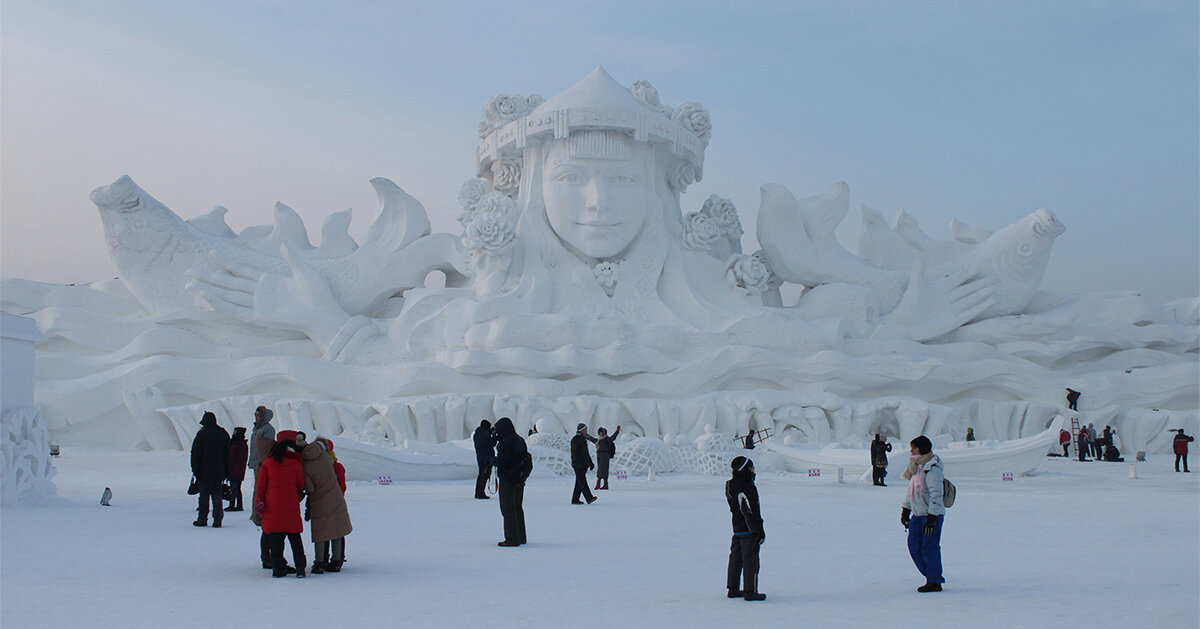
structures in the Harbin Ice and Snow Festival | image by Joy Ru via Unsplash (head image by Miguel Baixauli via Unsplash)
ICEHOTEL in Jukkasjärvi, Sweden
Each winter, when the Torne River freezes, creators from around the world gather in Jukkasjärvi to build the ICEHOTEL. Ever since 1989, the hotel has been reconstructed annually, taking on entirely new forms each season. What began as a single ice gallery by founder Yngve Bergqvist has grown into a globally recognized Arctic destination, where architecture and art are shaped directly by the elements.
The hotel is built almost entirely from ice harvested from the Torne River, one of Sweden’s last untouched waterways. Massive ice blocks are cut in spring, stored through summer, and combined with ‘snice’, a durable mix of snow and ice, to construct walls, floors, and ceilings. Molds shape the ice into stable arches and corridors, allowing artists to create intricate designs safely. The construction process takes about six weeks, after which artists transform each room into a unique work of art. When spring arrives, the hotel and its artworks melt back into the river, continuing a cycle of creation and return. Each year, ICEHOTEL invites artists from around the world to submit proposals. About 15 are selected from roughly 150 applications. Lighting is carefully integrated into each suite, highlighting textures and enhancing the sculptural qualities of the ice.
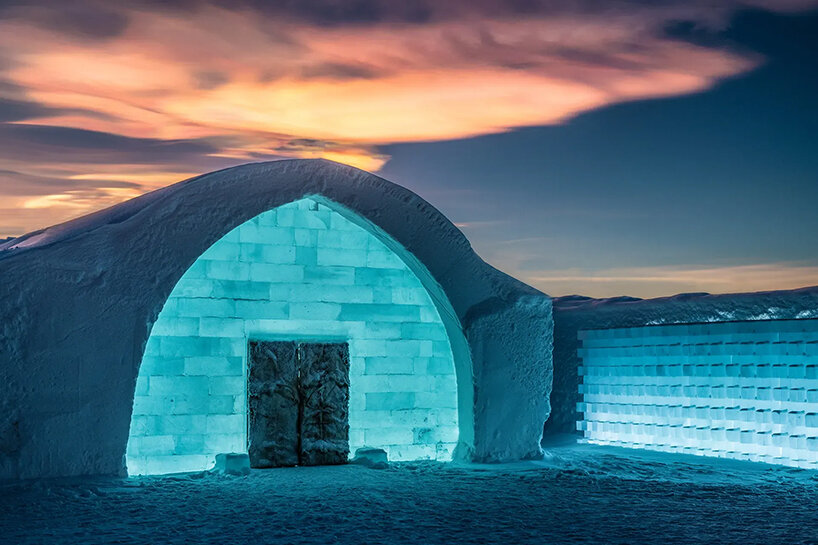
the exterior of ICEHOTEL | image courtesy of ICEHOTEL
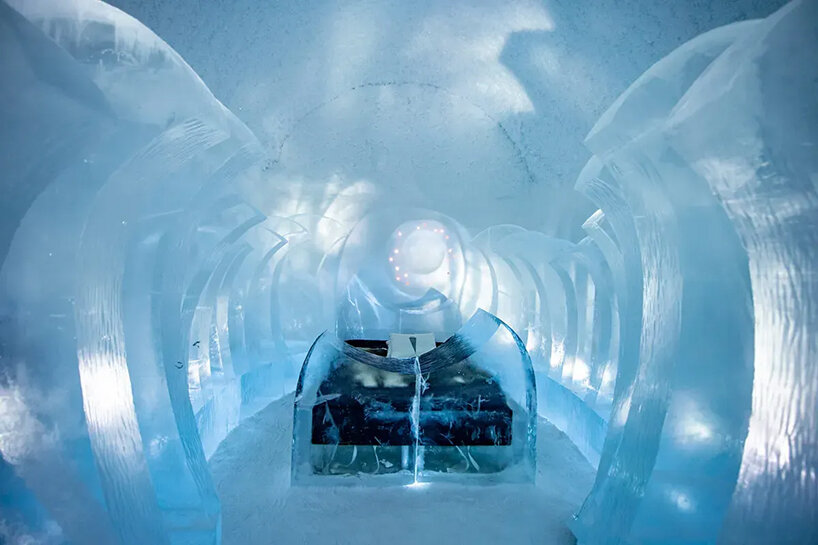
the Art Suite 365 interior | image courtesy of ICEHOTEL
Hôtel de Glace in Valcartier Vacation Village, Canada
Hôtel de Glace, North America’s only full-scale seasonal ice hotel, opens each year from January to mid-March. Constructed entirely from snow and ice, the hotel is rebuilt annually, introducing new spatial compositions and design elements each season. The complex includes a Grand Hall, Ice Chapel, ice slide, and themed suites, as well as the Ice Bar, where drinks are served in glasses made of ice. The suites feature beds and furniture carved from ice, set on insulated wooden platforms and paired with high-performance Arctic sleeping bags designed for temperatures between -3°C and -5°C. Throughout the hotel, carved surfaces and sculptural details demonstrate the technical precision required to work with frozen materials at an architectural scale. Each edition is organized around a guiding theme that brings together art, light, and atmosphere. Lighting plays a central role, shifting the perception of space between day and night and animating the ice after dark. Designed to be experienced both during the day and overnight, Hôtel de Glace exists as a temporary architectural environment that explores how ice and snow can shape space, structure, and sensory experience within a limited timeframe.
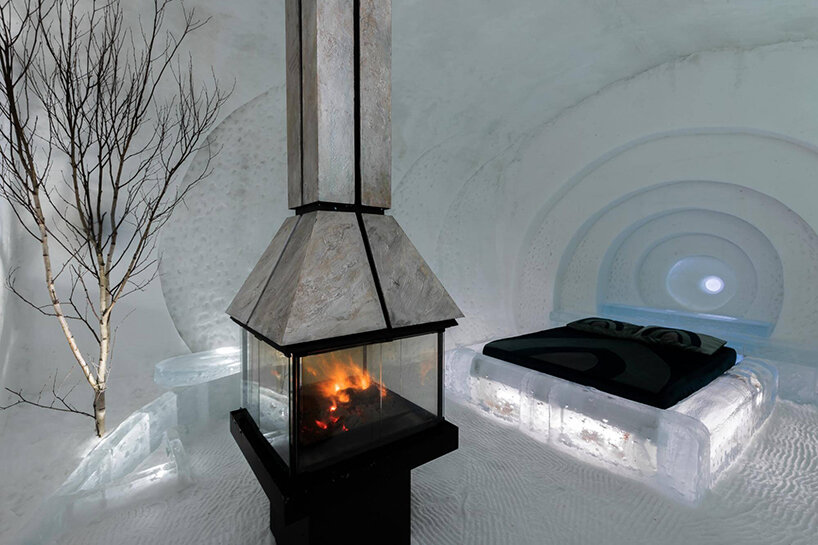
the suites feature beds and furniture carved from ice | image courtesy of Hôtel de Glace

carved surfaces and sculptural details can be found throughout the rooms | image courtesy of Hôtel de Glace
Harbin Ice and Snow Festival in Harbin, China
Held from late December to mid-February, the Harbin International Ice and Snow Festival is the largest ice and snow festival in the world. Taking place in Harbin, northeastern China, the event transforms the city into a vast landscape of temporary architecture and sculpture built entirely from ice and snow harvested from the frozen Songhua River. The festival includes two main exhibition areas. On Sun Island, enormous snow sculptures form a large-scale outdoor exhibition. Ice and Snow World, the festival’s most prominent site, features full-scale buildings and urban ensembles constructed from thick blocks of ice, many illuminated with multicolored lighting and open to visitors from afternoon into the night. Rebuilt every year with new designs, the site has reached up to 800,000 square meters in recent editions, making it one of the largest temporary architectural environments in the world.
Construction relies on industrial-scale ice harvesting and carving techniques, using saws, chisels, and molds to create walls, vaults, towers, and bridges. Deionized water is often used to produce ice with high transparency, enhancing the visual effect of light and color after dark. The resulting structures reference a wide range of architectural typologies, from monumental landmarks to abstract and fantastical forms.