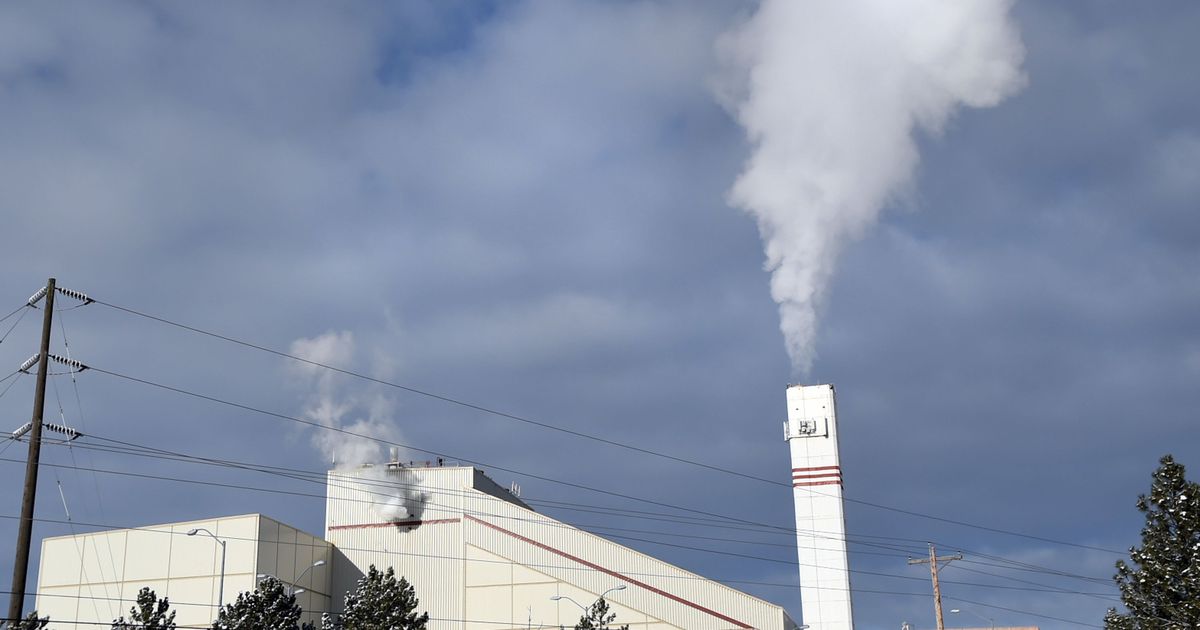
Spokane has one last chance for grace from a state program that penalizes the city’s solid waste emissions unlike anywhere else in Washington. Without action from the state, the city could be forced to shell out millions annually because of the carbon emissions from its energy-generating trash incinerator.
The Waste-to-Energy Facility is the only of its kind in the state, burning the city’s garbage and using the heat produced to generate enough electricity to power 11,000 homes. The greenhouse gas cap-and-trade program of the Climate Commitment Act exempts landfills, which produce emissions as waste decomposes, but the Waste-to-Energy facility received no such grace from lawmakers.
After years of failing to get the state to waive major fees from the Climate Commitment Act, the city is pivoting to ask for a multiyear phase-in to buy time to figure out how to capture the carbon coming off the incinerator’s flue – itself a project that by one projection could cost as much as $210 million. Analysts from the Spokane Valley-based company carbon capture company CarbonQuest predict the city could store enough carbon dioxide to pay for the investment by selling carbon credits – but these predictions rely in part on stable markets and in some cases, political winds in the other Washington.
If the city has to pay into the cap-and-trade program for the facility’s emissions in 2027, it could come with a cost of $2.5 million to $8 million each year. Costs vary widely due in part to wide swings in the cost for carbon credits through the state market in a given quarter.
One path the city could take would also guzzle up to 18 megawatts of electricity to run the carbon capture systems, which would effectively eliminate all excess energy produced by the plant – potentially making the facility’s Waste-to-Energy name a functional misnomer. The facility can produce up to 26 megawatts, but for practical reasons only creates around 22, of which 3 or 4 megawatts are used to operate the facility itself.
The facility produced more than 234,000 metric tons of carbon dioxide equivalents in 2019, of which roughly 60% are “biogenic emissions” from biological sources – if a tree is burned, so the theory goes, those emissions shouldn’t be worried about because a new tree growing in its place will naturally remove those emissions. But in 2027, the city could soon pay for the remainder of the facility’s roughly 100,000 metric tons of annual emissions, purchasing credits or allowances from a state-managed auction.
Those extra costs would have to be borne by ratepayers and the city’s other customers, if it would even still pencil out, said Marlene Feist, director of the city’s Public Works division.
“If it’s too costly to run the facility, at some point, we have to run the numbers,” she said. “It would be difficult to keep operating with the burden of the (Climate Commitment Act) costs.”
The city successfully lobbied the Legislature in 2023 to fund an analysis comparing the facility’s emissions to comparable landfills, which showed burning the garbage releases more carbon dioxide than burying it – but not when factoring in the electricity generated, recyclable metals pulled from the ash and other factors.
In the last two legislative sessions, Spokane’s lawmakers attempted to use this data to argue the facility should be treated no differently than the countless landfills throughout the state. Their colleagues in Olympia showed no appetite for the proposal.
Instead, the state provided $650,000 to Spokane to fund a study on capturing the facility’s carbon in January. In September, Michael Laucius, vice president of business development at Carbon Quest, presented the results of that study.
CarbonQuest’s proposal is to retrofit carbon-capture devices onto the flue of the Waste-to-Energy facility, store the carbon temporarily in water, take that carbonate water off-site somewhere in central Washington, and then injecting it into a deep, thick layer of underground basalt. Unlike sequestration systems, the carbon would chemically react with the basalt and turn into a mineral, locking it there theoretically forever without needing long-term monitoring.
The problem is complicated by those aforementioned “biogenic emissions.” The city will have to purchase credits to offset all of the facility’s nonbiogenic emissions – primarily the burning of petroleum-based products like plastics – but CO2 is CO2. If it captures a ton of CO2 off the facility’s flues, it can’t decide which ton is biogenic and which ton is nonbiogenic. Every ton is considered by the state to by 60% the former and 40% the latter.
That means that if the city wants to avoid having to purchase a single credit, it doesn’t need to capture 100,000 tons of CO2 from the flue, it needs to capture every last drop.
The plus side is that captured and stored biogenic emissions are, as far as the carbon credit market is concerned, a premium product that can command a premium price. Laucius projected the carbon capturing technology his company sells could pay for itself in a decade of operations, even with annual operating costs of $21.4 million, bringing in more than $41.4 million annually in revenue from the credits.
A large enough carbon-capturing retrofit to cover 100% of the facility’s emissions, however, would also require all of the facility’s excess energy. That’s probably a step too far, Feist said.
“It becomes problematic, because the electricity is a community benefit, but it’s also a financial benefit to the system,” Feist said. “Using up the bulk or all of the electricity produced at the facility isn’t reasonable for us, because it would just be too expensive to operate.”
A smaller retrofit proposed by CarbonQuest wouldn’t let the city avoid paying for credits, but it could still theoretically pencil out overall, according to Laucius. Revenue from selling biogenic emissions credits would bring in $24.4 million in annual revenue, with lower operating costs at $13.3 million including the cost of the state’s carbon credits.
The city isn’t committed yet to taking either path offered by CarbonQuest, Feist noted. It’s exploring technology being implemented in Scandinavia and Japan, places where trash incinerators are more common.
It ’s clear the city needs more time.
“Even in the best of circumstances, it could take half a dozen years to get this done,” Feist said. “We don’t have that.”