
In the Tir Cluain estate Daithi and Christina Conway were anticipating heavy rain but were completely unprepared for what happened when the Owenacurra River, less than 100 metres away, burst its banks. Soon nearly three feet of dirty, brown water was coursing through their home.
“I didn’t even know that the house was getting flooded. It was raining heavily and I’m working in the cabin [in the garden]. And my mom rang me and she said there’s water coming through the front door. I’m like, okay, so I’ll get some towels and then I turn around and I saw that the garden was a swimming pool already. I forgot about work and I just came in and started lifting everything up. At one stage I said we might have to evacuate because it was rising so hard,” Christina told the Irish Independent.
“It was just about 20 minutes from no water to almost 3 feet,” Daithi recalled.
The self-employed carpenter had left for work but returned home when Christina called him.
“When I drove around the corner there was a wall of water like a metre high so I backed the van out and I started wading through the water.”
It took four or five hours for the water to recede from the 100 or so houses flooded in the estate but the damage done was extensive. The Conways and their two children had to move out for a month while Daithi closed his business and worked flat-out to replace ruined kitchen units, wooden floors and plasterboard.
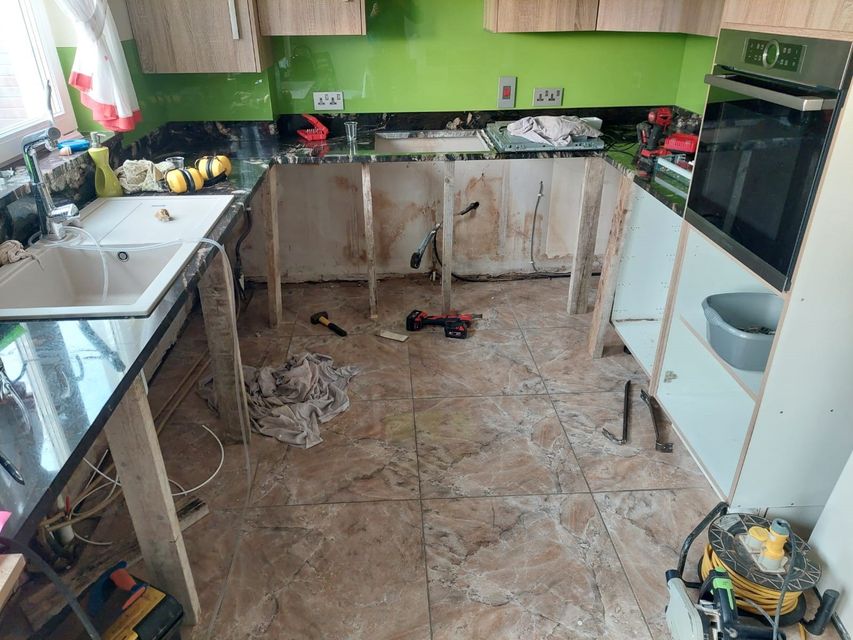
The aftermath of the flooding
Two years on, the fear that it could happen again is always there. “You can’t move on. The problem we have now is our house is no longer a safe place, like it’s no longer our home that protects you because you just don’t feel safe anymore. Every time it rains heavily you’re anxious,” Daithi said.
A major flood relief scheme for Midleton is in the planning stage but won’t be completed until 2032 at the earliest while work on an embankment for the Tir Cluain estate is planned for the second half of next year.
In the meantime the OPW and Cork County Council have committed to providing an interim solution in Midleton and other East Cork communities that were flooded during Babet – barriers to stop the water getting in through a property’s external doors. There are two types of barrier – expandable and slot-in.
The Conways received an expandable barrier for their front door but are not overly impressed by it. It’s a metal frame covered by a membrane with a car jack-type mechanism used to apply outward pressure to form a water-tight seal. One issue is the barrier’s weight – almost 35 kg.
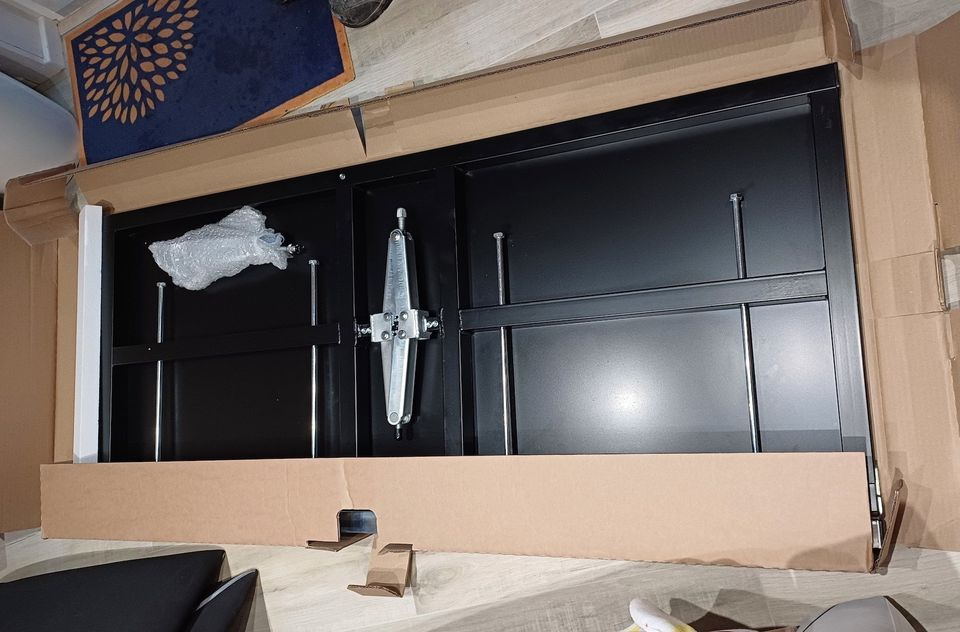
One of the expandable flood barriers
“I think it’s not practical for the majority of people. I’m used to handling heavy stuff as a carpenter so it’s alright for the likes of me but imagine an old woman living on her own. It means she has to have someone on call [if there’s a flood] and all her neighbours will hardly be on call because they’ll be putting up their own barriers,” he says.
Then there’s the barrier’s height – around 640 mm when the flooding in the Conways’ house was over 800 mm. “The first time they [the council] came, I said, okay, the water was up to here, so make sure that the flood barrier is higher than one metre, right? Yeah, just a little bit extra, just in case the next time it’s higher or whatever. And then they came with the flood gate, just down to here, and it’s like, what’s the point?” Christina said.
The family also has yet to receive a barrier for the back door. “They supplied us with the [front door] barrier. And we were asking, “What about the back door?” Because it’s not much good having one just at the front door. And they said “Oh, we’re not sure when that will be now, it could be two months’ time.” That was August,” Daithi said.
Midleton residents appreciate that the barriers would at best only buy time in serious flooding and their priority is to see the major scheme progressing faster. However, they are critical of how the barrier scheme is progressing.
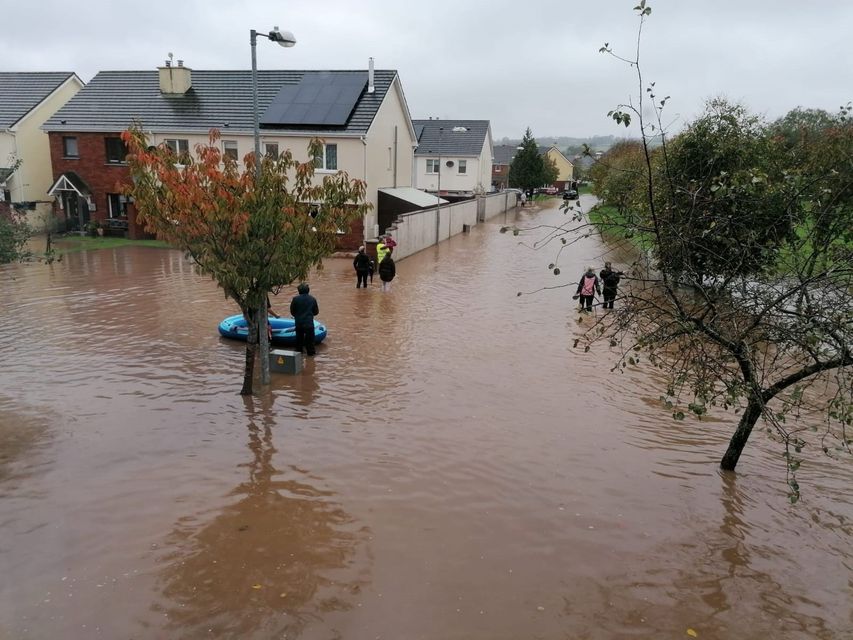
The Tir Cluain estate was extensively flooded.
“The rollout is terrible. It’s very disappointing. And what they’re delivering isn’t great to be honest,” says Mona Stromsoe, chair of the Midleton and East Cork Flood Protection Group. She favours the slot-in barriers over the expandable ones. These slide into a fixed frame on the wall and come in sections so are lighter and easier to install. However, Cork County Council has said it is finding it hard to source them and to get tradespeople willing to do the required building works.
Ms Stromsoe says that if the council can’t obtain enough barriers it would make sense if people could go and buy them themselves and then get recouped by the state but that isn’t an option at the moment.
“I just feel there’s no sense of urgency there. I don’t think they understand the fear that people have. When you’ve been through this and your home is destroyed and your business is destroyed, the fear that it’s going to happen again is constant. And in a country like ours where we get so much rain all the time, it’s always there,” she says.
In a response to the Irish Independent, Cork County Council (CCC) said there are 1,885 openings identified as requiring barriers under the Midleton and East Cork Individual Property Protection Scheme.
To date, 983 barriers have been delivered. There are 1,599 openings requiring civil/building works, of which works have been completed on 518.
“To date, 152 out of 721 properties have been fully closed out. i.e. all barriers approved for these properties are with the property owners, and any civil works required completed. While 100% of the expandable barriers have been acquired, and 90% of these delivered to property owners, the procurement of the barriers required for the larger and more complex openings has proven more challenging. CCC is currently tendering for procurement of these barriers, with tenders due to be returned in the coming days and into early January,” the Council said.
Funded by the Local Democracy Reporting Scheme.