Published December 26, 2025 04:00AM
At a recent trade show, I had the opportunity to sit down with product managers from close to 30 running shoe brands to get inside information on what is coming in 2026. Amid lots of exciting models, a few stood out as harbingers of a subtle shift in shoe design toward setting feet free and respecting the individuality of each stride. I believe in foot freedom, not only because biomechanists and podiatrists tell me it strengthens feet and helps optimize stride mechanics, but also because it makes shoes more comfortable and fun to run in for me.
Here are five running shoes I’m most excited to take out for a spin in the new year.
Brooks Glycerin Flex
 (Photo: 101 Degrees West)
Available: February 2026
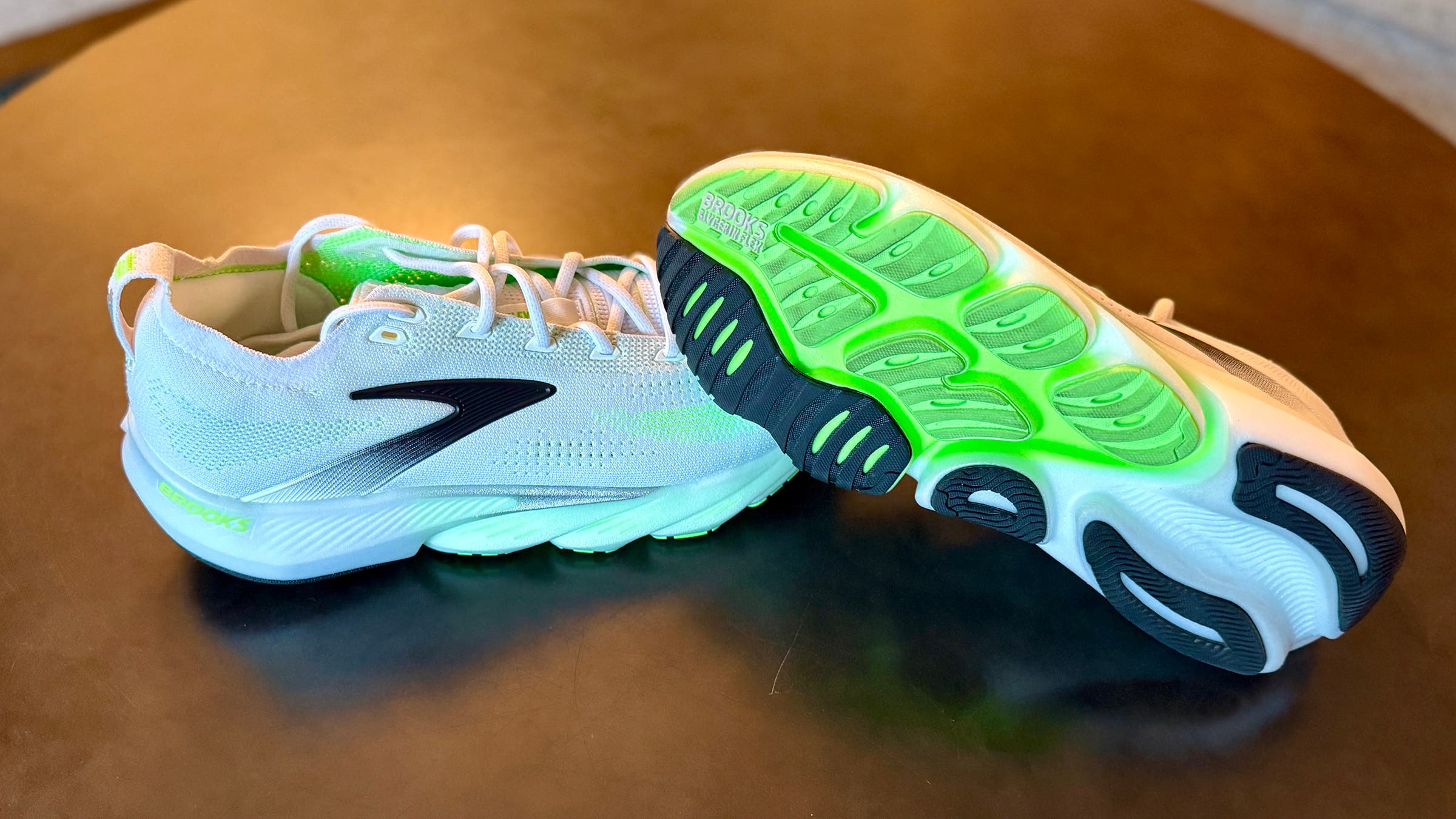
Brooks is touting its newest shoe as what comes after maximalism, and I’m hoping they are right. Some runners, the brand’s research has revealed, are not enamored with ever higher and softer shoes. These runners feel the shoes are doing too much, and they’ve lost the feeling of control. Brooks’ response is an innovative shoe that combines design concepts the brand has been working on for a decade.
“In order to create that maximal ride, you really have to lock the midfoot up to create a rocker effect to transition you through,” Carson Caprara, senior vice president of footwear and apparel at Brooks, says. “And that’s great in some instances and for some people, but it’s the opposite of what many people’s foot actually wants to do naturally.” The new Glycerin Flex aims to keep the cushioning and support but allow full foot flexibility.
To understand the Glycerin Flex you need to go back to 2015 when biomechanist Benno Nigg introduced the concept that, rather than there being one standard or ideal stride, each runner has a unique stride pattern in which they are most efficient. “People have a preferred movement path, the path of least resistance, where energy demand is at its lowest,” Nigg explained to me at the time. “If you start to fiddle around and control movements, these elements may want to throw you out of your preferred movement paths. That means your muscles work against that, and that costs energy. That’s not desirable.” Nigg’s paradigm shift meant that one of the first priorities of a running shoe is not to interfere with the foot’s preferred path.
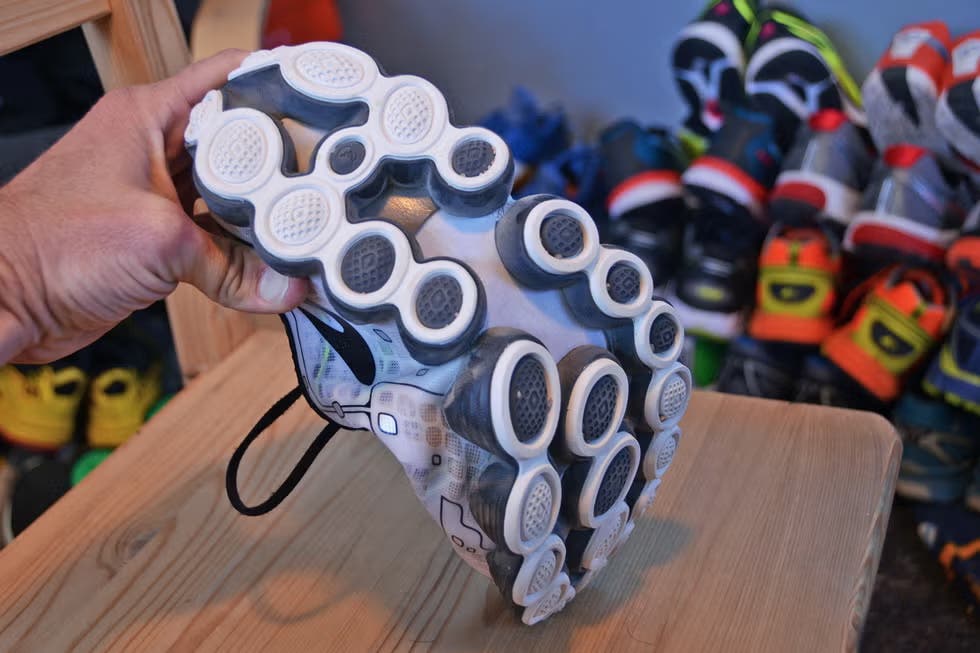 The 2016 Neuro debuted the independent pods that show up in next year’s Glycerin Flex. (Photo: 101 Degrees West)
Brooks took this priority seriously and, a year later, released a novel shoe called the Neuro that resembled a deep-sea creature with circular pods covering the sole. These pods weren’t for suction, however, but to allow parts of the foot to move freely and independently while still providing protection and rebound. The shoe fit and flexed remarkably well, but the pods were quite firm, and the world was moving towards softer soles, so the Neuro got little traction.
In the ensuing years, while the preferred movement path concept transformed the stability shoe category, the majority of new running shoes prioritized cushioning and propulsion ahead of foot movement. The running shoe world fully embraced not only thick, stiff max cushioning but also rocker plates that would further force the foot into the shoe’s movement path.
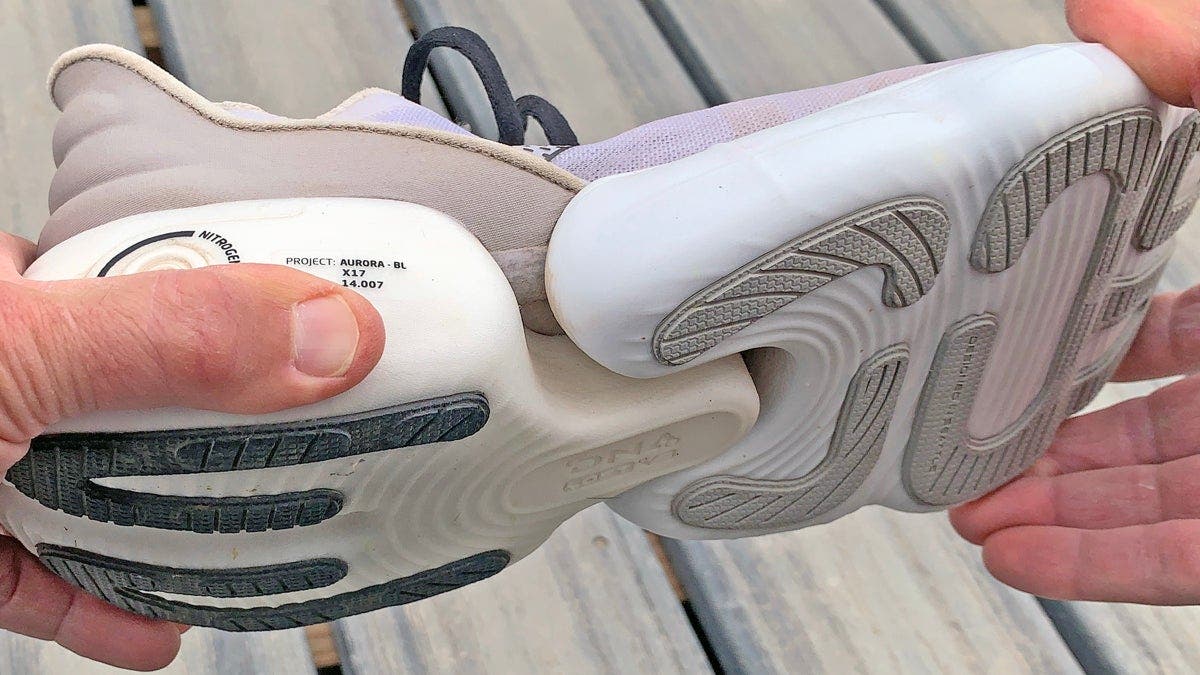 Brooks’ 2011 Aurora BL had a thick layer of cushioning and decoupled heel and forefoot but limited full-foot flex. (Photo: 101 Degrees West)
Brooks joined the maximal migration along with everyone else, but didn’t fully forget the need for foot mobility. The 2021 Aurora BL took a stab at allowing more foot movement in a higher-stack shoe, but it had only a limited heel/forefoot decoupling with a linear flex groove across the midfoot.
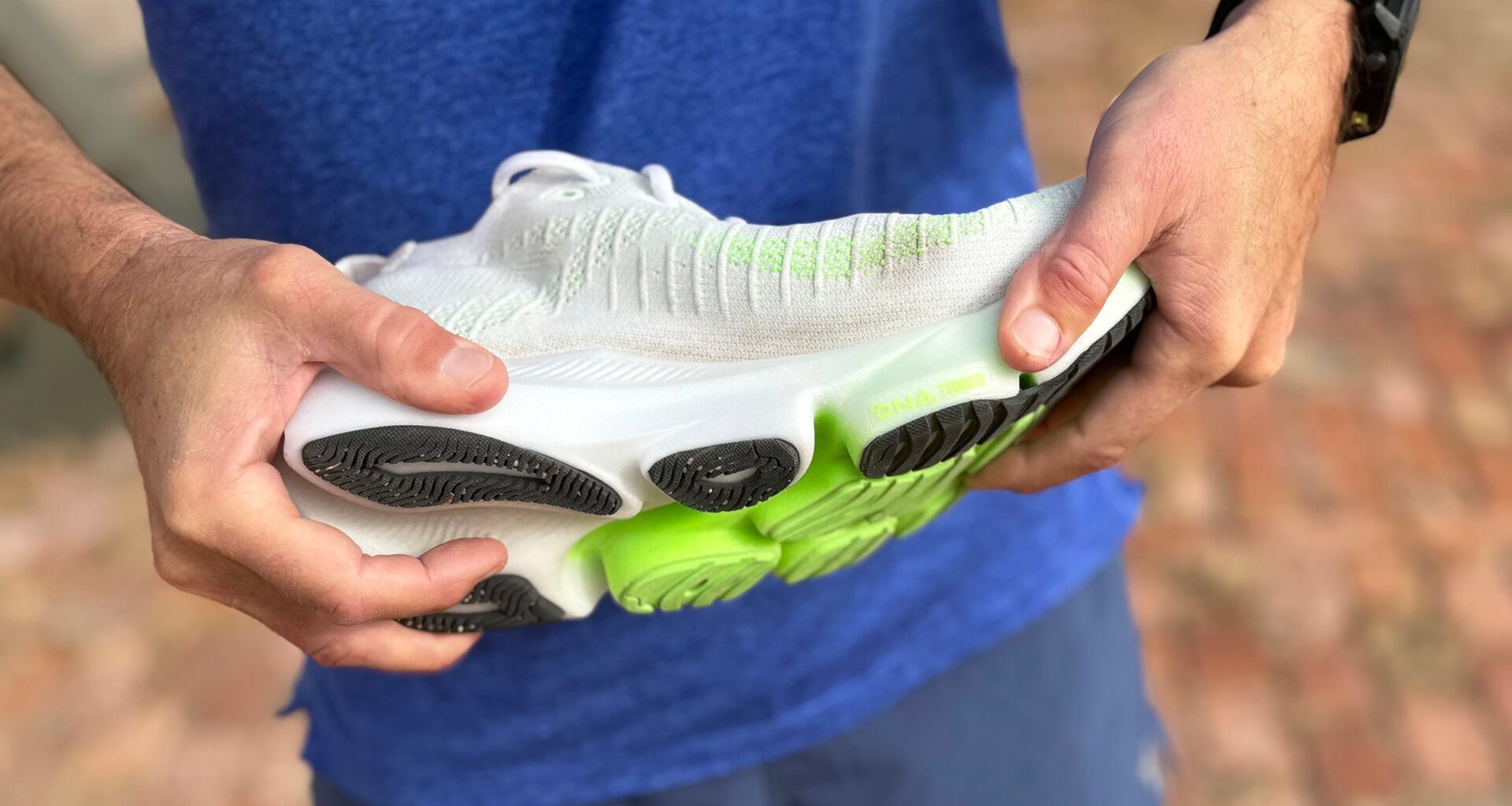
The Glycerin Flex combines elements of the Neuro and the Aurora BL, delivering both foot freedom and protection with smart flex grooves and advanced foam in a 36–30 millimeter stack height. As you land, Carpara explains, the sole opens up in a diagonal s-curve across the midfoot, and then as you get to mid-stance, it closes back up and locks in on itself, making the stance stable. Grooves throughout the forefoot create pods that echo the bones in the foot, flexing and supporting independently. Adding to the shoe’s strategic support throughout the stride is a DNA Tuned foam midsole, with larger, softer cells in the heel, smaller, explosive cells in the forefoot, and a smooth transition between the two.
The result promises to be a shoe that defies the conventional wisdom that running shoes must be either neutral or supportive, stable or flexible. This shoe is meant to be an extension of your foot, and like your foot, able to deliver cushioning, stability, and propulsion. Time will tell if this radical design is the direction of the future, but I welcome the innovation and can’t wait to run in the shoes.
Saucony Endorphin Azura
 (Photo: Ali Nolan)
Available: February 2026
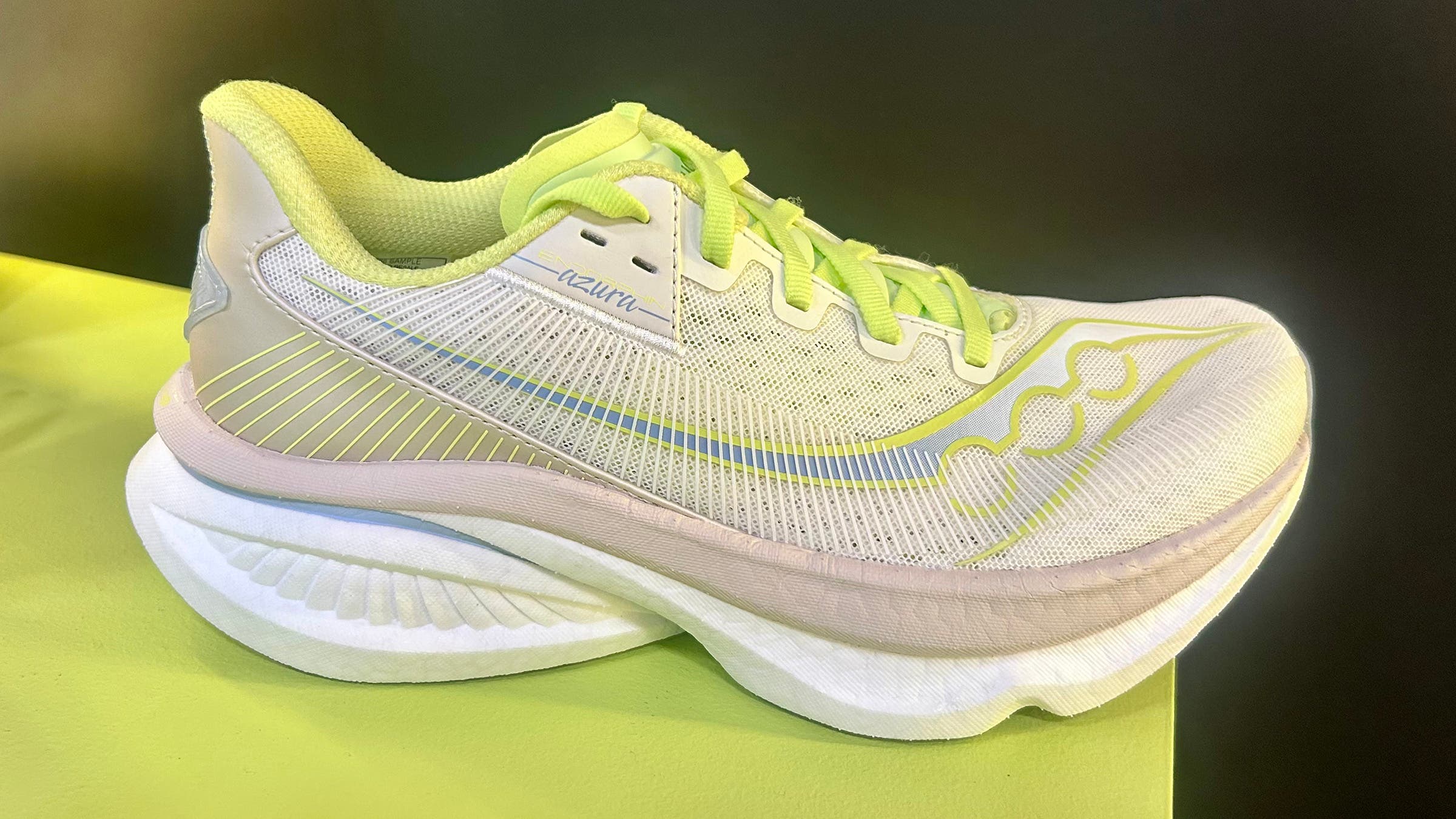
In 2020, when Saucony rolled out its first super shoe, the Endorphin Pro, it also launched a trainer that shared the racer’s advanced foam and geometry but had a more flexible nylon plate to better accommodate different strides and paces. That trainer, the Endorphin Speed, became the benchmark for a burgeoning category of what has become known as super trainers.
This year, the brand will go one step further in freeing the foot with a non-plated trainer that shares the same soft, light, and bouncy, Peba-based foam as the Speed and Pro and the same speedy rocker geometry.
“This is a great option for that athlete who just wants to pick up the tempo—and doesn’t want to deal with a plate,” Katie Pyle, senior product line manager at Saucony, says. “The geometry allows you to get up on your toes and really go.”
That geometry bodes well for the Azura, as I’ve always appreciated the rocker on the Endorphin line. I find it falls right at the ball of my foot, allowing a quick stance before rolling smoothly forward as soon as my weight shifts onto it. It feels fast but not aggressive.
The Azura will have a stack height of 40–36 millimeters, but weigh in at just 8.5 ounces for men and 7.5 ounces for women. While that’s higher than I usually feel comfortable in, I’ve been pleasantly surprised by several other max-cushioned, non-plated models with advanced foams, like the Asics Megablast and the Brooks Glycerin Max, that provide some stability and ground connection despite their tall midsoles.
I’m excited to see how the Azura will treat my stride and glad to see another top-end trainer without a plate, a trend that should lead to healthier feet.
Notace Yama T1
 (Photo: 101 Degrees West)
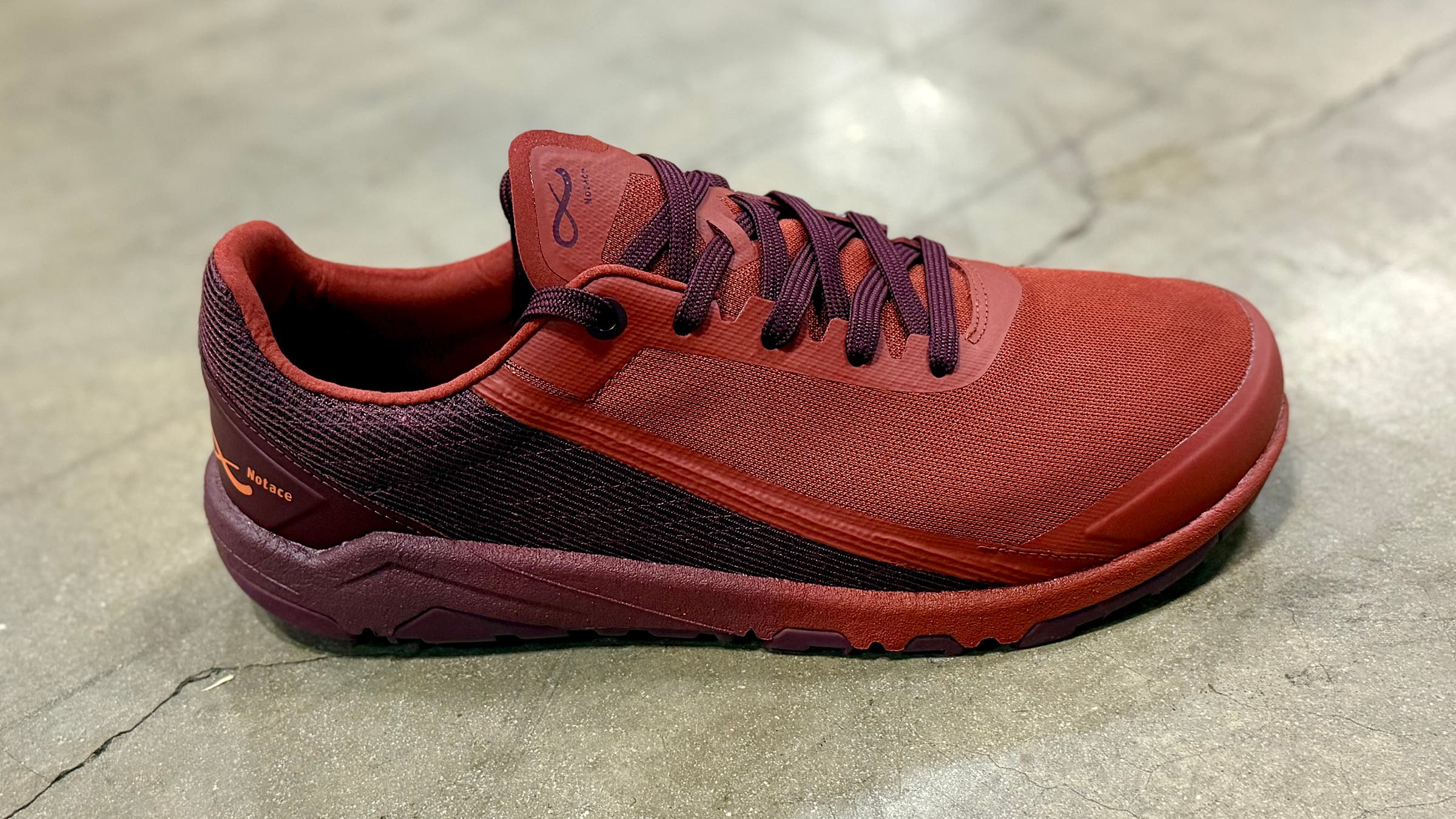
As someone who never completely turned my back on minimalism (I know too many podiatrists who recommend every runner have a minimalist shoe as part of their quiver), I’m happy to see more options emerging on the thin end of the spectrum. Notace is a new brand that aims to bridge the gap between the ubiquitous high-stack, maximal shoes and zero-cushioned barefoot models like Xero and Vivobarefoot.
The Yama T1 trail shoe has only 15 millimeters of stack height, so it will undoubtedly provide proprioception-enhancing ground feel, but it promises not to be harsh underfoot. “I wanted someone to be able to put their feet in it, and it still has a little bit of that familiar cushion to it,” founder Cedric Scotto says. That cushion is provided by ETPU foam (think an advanced version of Boost) that is light, flexible, and lively, while also durable, bouncing back consistently over time.
Throw in a zero-drop platform, a wide forefoot that lets your toes splay, and a light, breathable, flexible upper, and you’ve got what promises to be a simple shoe that stays out of the way and makes the run feel fun, while strengthening your feet. It likely won’t be an everyday shoe for most, but accessible enough many could take it on a 5K run once or twice a week without feeling too beat up to run the next day.
I’ve known Scotto since he was a grad student in biomechanics and through stints at Altra, Xero, and Vivobarefoot—he knows shoes and stride, and his expertise bodes well for the brand.
Avelo Supertrainer 1
 (Photo: 101 Degrees West)
Available: Spring 2026
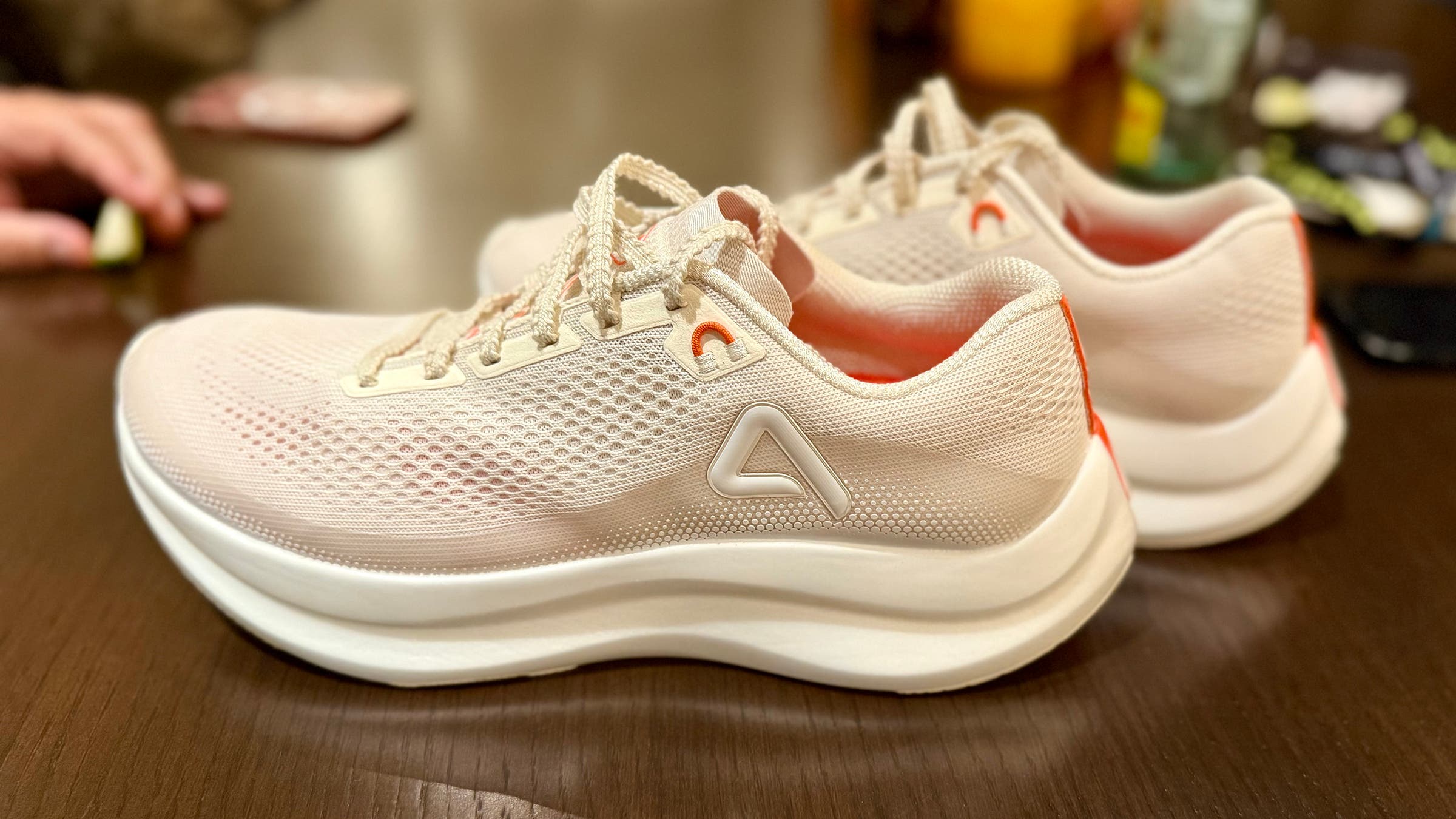
I like the looks of this supertrainer from new brand Avelo, with its 38–30 millimeter stack of highly responsive TPEE foam, flexible Pebax plate, and forefoot with room for splay. And I like what co-founder Peter Ruppe says was a design priority for the bouncy ride: “We want to make sure you feel the ground—your feet should be working.”
But what is most exciting about the shoe is the pod nestled beneath the sock liner and what it measures. A key metric will be the impact of each step. “Runners today understand so much about our physiology because we’re able to measure our heart rate and our HRV, but that’s only one part of the picture in terms of the training stress that your body is under,” co-founder Royi Metser says. “Running is an impact sport. Every time you hit the ground, there’s a force that your body’s experiencing, and until now, runners have not been able to quantify the magnitude of that force.”
The Avelo system will measure impact forces, calculate an impact score for each run, then combine that with other data to provide a resiliency score that assesses your workout readiness. The Avelo sensor will also measure myriad form metrics. Significantly, however, it will not prescribe form changes to match a generic ideal, but rather will respect each runner’s preferred movement path.
“We’re not going to tell you that there is a certain way that you need to be running and to change your running form, because we know that most times that can do more harm than good,” Metzer says. “We’re developing analytics to model how you usually run, and then we’re developing what’s called a form radar, which is designed to alert you any time we observe a deviation from your typical run pattern—due to fatigue, due to injury, due to any reason.”
The founders say that both the impact and form data will feed into analytics that can suggest supplemental activities you can do to support your running, such as personalized strength training, mobility exercises, and drills.
While the app is still in development and I’ve yet to assess the quality of Avelo’s measurements, analysis, and recommendations, everything the founders say agrees with the many experts I talked to while working on my book, Your Best Stride. I’m eager to see it applied and hopeful it will help a lot of runners train smarter and understand more about how they run and how to improve their mechanics.
Skechers Aero Razor
 (Photo: 101 Degrees West)
Available: February 2026
For a decade, the Razor has epitomized Skechers’ ethos of creating lightweight, comfortable, high-performing shoes at reasonable prices. The Razor 3, which came out in 2018, introduced one of the first midsoles made with supercritical foam, now standard in high-performance models across the industry. Weighing in at just 6.4 ounces with unprecedented underfoot responsiveness, it was widely popular with the speedy set.
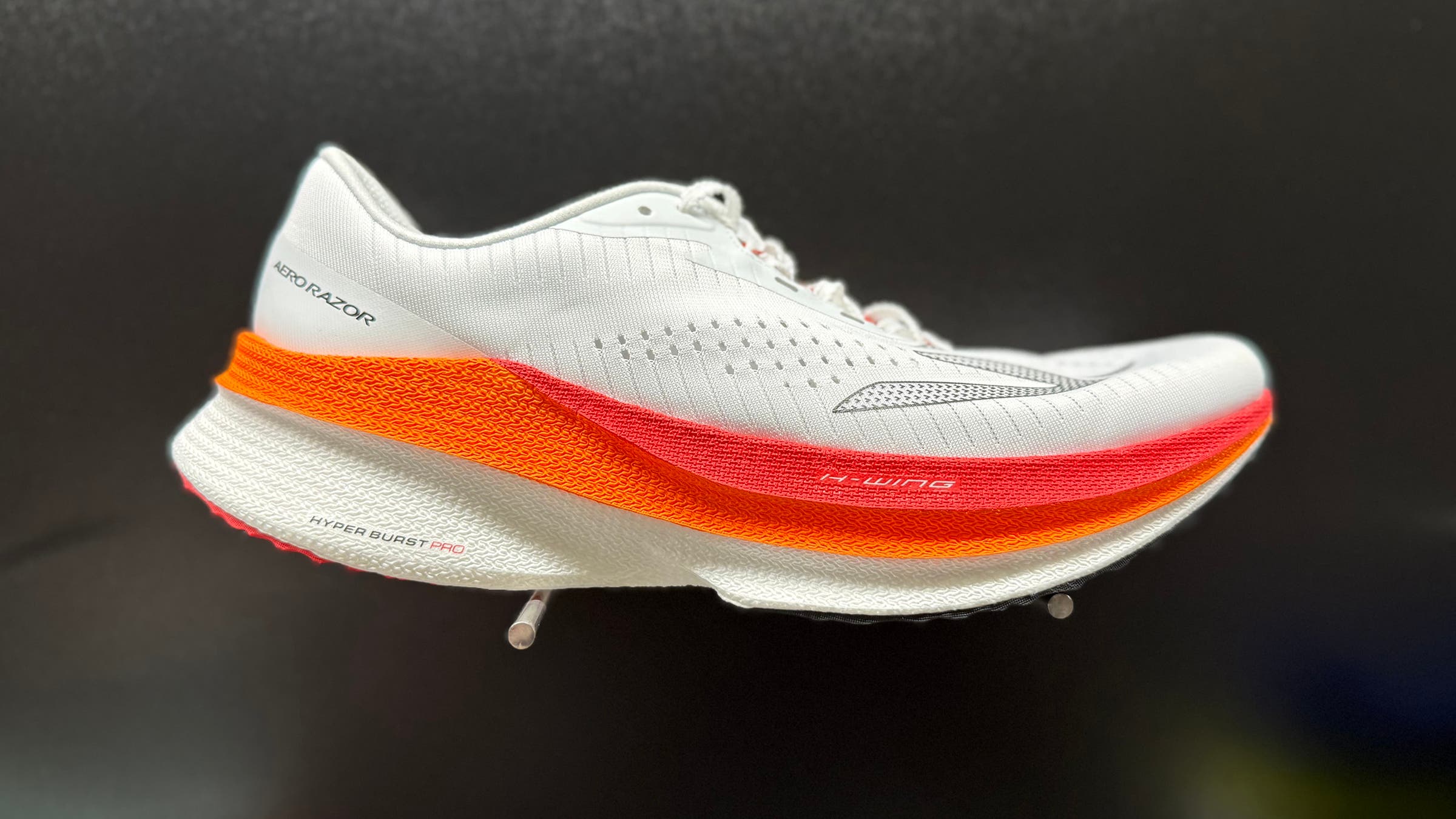
But the brand felt that the shoe, which had always teetered between being a trainer and a racer, had become too svelte, making it unsuitable as a trainer for most. The Razor 4 was designed to correct that drift. Tipping the scale at 8.0 ounces, it had a thicker, softer, and bouncier midsole, a more relaxed upper, increased outsole coverage, and an H-shape winglet plate for stability. It was a comfortable, cushioned shoe that bordered on super-trainer feel. But it wasn’t the Razor 3, for better or worse. The Razor 5 followed suit with the 4 and gained a bit more weight.
Now the pendulum has swung the other way. “With the 4 and the 5, I think we got a little too heavy, and the ride wasn’t quite as fun,” Ben Stewart, vice president of performance footwear at Skechers, says. “So the Aero Razor is really trying to go back to what we had here that made the Razor 3 so special.”
Toward that end, the designers introduced a new, A-TPU foam midsole that reduced the weight to 6.9 ounces and promises to restore the snappy ground feel and responsiveness of previous versions. Curiously, they increased the stack height six millimeters, but Stewart says the foam’s compliancy makes up for that. “It just gives a little bit more underfoot,” he says. “It’s a very fun ride.” The winglet plate remains to moderate the squish of the thicker foam.
I was a fan of both the Razor 3 and the 4—for different reasons. The Aero Razor seems to combine properties of both. While I’m a bit leery of the increased stack, I’ve been impressed with the responsive feel of A-TPU midsoles and, at 36–30 millimeters, it is only moderately high by today’s standards. I’m hopeful for a quick-rebounding, flexible ride that makes me feel as comfortable as I did in the Razor 4 and as light-footed and free as I did in the Razor 3.