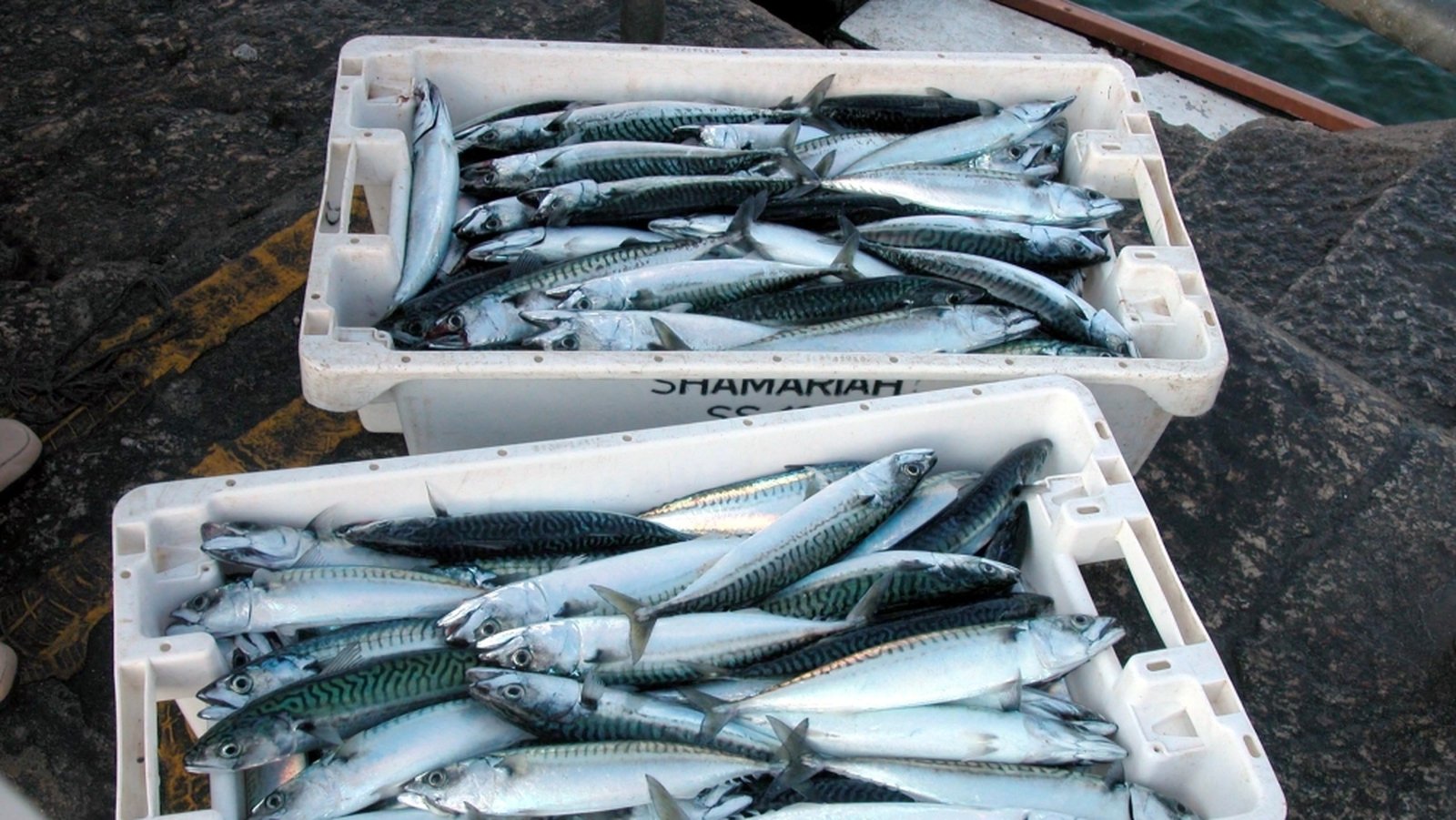
The EU fishing quota agreement in Brussels before Christmas brought little festive cheer to coastal communities.
The impact of scientific advice and resulting reductions in quota, combined with the blocking of the Hague Preferences, resulted in the loss of one third of Ireland’s fish quota next year.
The cuts represent a direct loss of €100-€105m, based on the estimated value of the 2025 quota. Fishing and seafood organisations say that 2,300 jobs are at risk.
A stark situation was compounded by four member states – France, Netherlands, Germany and Poland – who blocked a long-standing protection mechanism for Ireland.
The Hague Preferences were introduced in 1976 to counter the impact of access to Irish waters provided to vessels of other EU nations and to account for Ireland’s underdeveloped fleet.
Often the subject of late-night negotiations, the Hague Preferences granted Ireland a larger share of certain stocks when total allowable catches fall below a specific level.
Minister of State with Responsibility for Fisheries Timmy Dooley, who sought to invoke the Hague Preferences, described it as an “act of betrayal” led by those that benefited most from access to Irish waters.
Mr Dooley told European counterparts that what transpired was comparable to an act of betrayal of the fundamental terms and conditions of an insurance policy, paid for in fish by Ireland for more than 40 years.
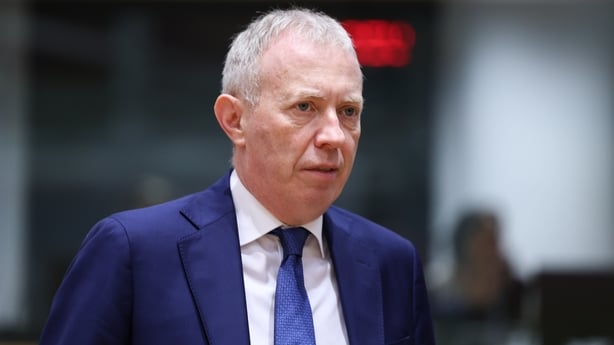
Minister of State Timmy Dooley described the blocking of the Hague Preferences as an ‘act of betrayal’
The day after the negotiations, Chairperson of the Killybegs Fishermen’s Organisation Ciarán Doherty described the outcome as “an absolute disaster for the Irish fishing industry”.
“We will have about 14-20 days at sea next year. Meanwhile, we will be looking at other EU member states fishing in our waters all year round,” Mr Doherty said.
Member states set catch limits for commercial fish stocks in the Atlantic Ocean and the North Sea during the December Fisheries Council meeting.
Total allowable catch limits, known as TACs, are based on independent scientific advice.
These cover stocks in EU waters and stocks fished by EU vessels in certain non-EU waters. They are divided into national quotas using historical fishing activity.
The EU negotiates fishing quotas or catch limits with non-member coastal states such as the UK, Norway, Iceland and the Faroe Islands for shared stocks in the north-east Atlantic.
Tensions have arisen as coastal states recently excluded the EU to set catch limits well in excess of the recommended scientific advice.
Mr Dooley said that some of the fish stocks important from an Irish perspective were at a very low level and the scientific advice was to reduce the allowable catch for fishermen across Europe.
Fears of major cuts since October
The International Council for the Exploration of the Seas (ICES), which provides scientific advice on sustainable management of shared fish stock to the European Commission, issued a grave warning in early October.
ICES said the sum of the unilateral quotas for mackerel “resulted in catches that have exceeded the scientific advice by, on average, 39% since 2010,” putting mackerel spawning under significant pressure.
Some non-EU coastal states set their own quotas for mackerel, known as unilateral quotas, in recent years.
To ensure stock sustainability, ICES recommended a 70% reduction in the EU’s mackerel quota, a 41% reduction in the blue whiting quota, and a 22% reduction in the boarfish quota in 2026.
The quota for Ireland’s most valuable stock – mackerel – would fall from more than 100,000 tonnes in 2014 to less than 11,000 tonnes in 2026.
A sector at ‘a cliff-edge’ in ‘an hour of need’
On the morning of Sunday 5 October in Killybegs, Mr Dooley attended a meeting with fishermen, processors, auxiliary businesses and those employed within the sector.
The harbour, in south-west Donegal, is Ireland’s seafood port, with the highest volume and value of seafood landed annually.
A Bord Iascaigh Mhara report published this year found that 88% of people employed within the seafood sector in Killybegs are from Co Donegal.
Karl McHugh, of the Atlantic Dawn Group, described the mackerel fishery as the “economic sustenance of south-west Donegal”.
David Gallagher, of Gallagher Brothers Fish Merchants, said that while Ireland was in the spawning grounds of mackerel, the stock had been decimated in international zones.
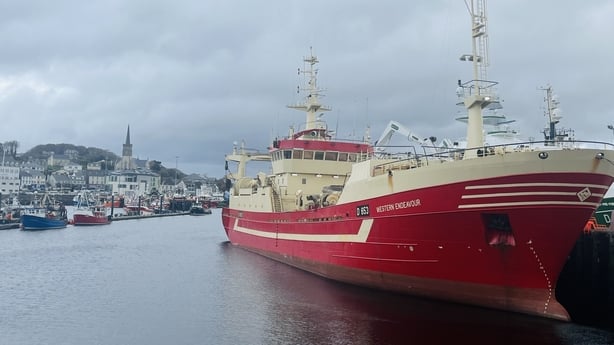
88% of people employed within the seafood sector in Killybegs are from Donegal
The meeting heard the sector was at a cliff-edge in an hour of need and it was inevitable that there “would be casualties in the room” in respect of job losses.
A common theme reappeared.
Calls were made for political intervention to address overfishing of shared stocks by non-EU states. Those calls have been repeated on numerous occasions.
When leaders in the seafood sector met Taoiseach Micheál Martin, Minister for Agriculture Martin Heydon and Minister Dooley, ahead of the December Fisheries Council, they called for the invocation of the Hague Preferences, action against non-sustainable fishing and emergency financial support.
Fish producers and processors said the meeting delivered a “powerful signal of national unity” before the council meeting.
‘A betrayal of Ireland’s fishing industry’
The outcome of the meeting resulted in approximately 57,000 less tonnes of fish for Irish fishers next year.
Mr Dooley said the outcome would result in severely reduced fishing opportunities for 2026.
He said the scientific advice upon which the council’s decisions were based reflect the impact of overfishing of the mackerel stock by certain third countries.
“Given that Ireland holds the largest share of EU quota for mackerel in the western waters area, the devastating impact of the decline in this stock will be acutely felt”.
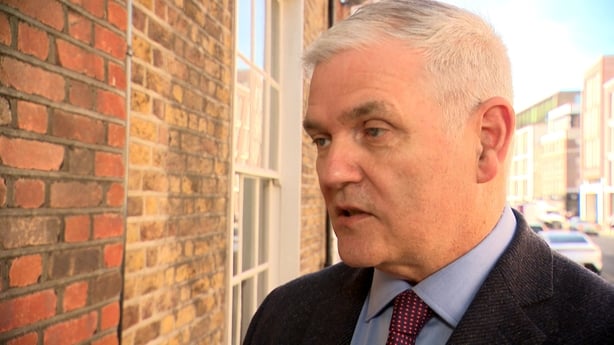
Aodh O’Donnell, of the Irish Fish Producers Organisation, said that member states failed to honour the Hague Preferences
In the hours following its conclusion, Seafood Ireland Alliance issued a statement saying the council’s deal was “a betrayal of Ireland’s fishing industry”.
Aodh O’Donnell, of the Irish Fish Producers Organisation, said that despite “the best efforts of Minister Dooley and the Government, the member states failed to honour the protection mechanism (Hague Preferences) created to support Ireland”.
John Lynch, of the Irish South and East Fish Producers Organisation, said that all sectors of the Irish fishing industry backed one position that was dismissed.
Forensic examination in Leinster House
What transpired in Brussels during the December Fisheries Council was subject to intense and detailed scrutiny and debate in Leinster House in the past fortnight.
Mr Dooley came before the Joint Oireachtas Committee on Fisheries and the Marine, and discussions in the Seanad and the Dáil delved into the detail of the deal.
Sinn Féin Spokesperson on Fisheries Pádraig Mac Lochlainn questioned the influence of certain corporations and their impact on quota distribution in the European Union.
Deputy Mac Lochlainn told the Dáil that the Common Fisheries Policy has been deeply unfair to Ireland’s fishing and coastal communities.
Also in the Dáil, Dublin TD Tom Brabazon said that responsibility for the mackerel dispute rested with coastal nations that set quotas in excess of their historical entitlements.
He accused the commission of having “repeatedly failed to address this situation by not leveraging access to EU markets as an effective means of enforcement”.
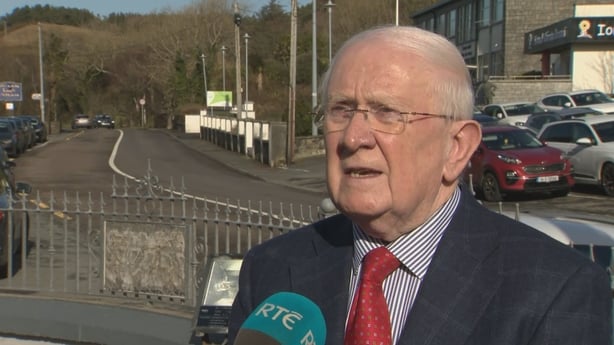
Donegal TD Pat the Cope Gallagher was also among the critics of those blocking the agreement
Former minister of state for fisheries Pat ‘the Cope’ Gallagher also named the states he believed were responsible.
Waterford TD Conor D McGuinness said that Ireland’s Presidency of the European Union next year must be “used deliberately to untangle and undo this injustice”.
Mr Dooley told the Dáil that legal advice has been sought on what further actions may be possible following the blocking of the Hague Preferences.
The minister said that concerted EU responses against sustained overfishing by third countries was discussed at the fisheries council.
The discussion, he said, included the triggering of the unsustainable fishing regulation.
That regulation has the capacity to impose restrictions on imports of fish and fishery products from third countries found to be engaged in unsustainable fishing.
Mr Dooley added it was a matter that he “will continue to pursue”.
A memo will come before Cabinet soon that will set out the establishment of a taskforce under the auspices of Food Vision 2030 to address challenges facing the sector.
It is expected that former chief executive of the Irish Farmers’ Association Michael Berkery will be appointed as the independent chair.
A first meeting of the taskforce will take place next month with an interim report expected in spring.
Recent coastal state agreement exacerbating overfishing
Hours before Christmas Eve, the European Commission issued a stark statement, saying it was deeply concerned about the arrangement on mackerel fishing quotas reached by the UK, Norway, Iceland, and the Faroe Islands on 15 December.
The commission said that it was signed without prior consultation with the European Union.
It said the four-state arrangement posed a serious risks for sustainability of the mackerel stock while undermining the legitimate interests of the EU.
The International Council for the Exploration of the Sea scientific advice, recommending a total allowable catch of no more than 174,357 mackerel tonnes for 2026, which the EU followed.
However, the arrangement sets a total allowable catches of 299,010 tonnes, 72% higher than the recommended scientific level.
The commission said the excessive exploitation exacerbates the problem in the north-east Atlantic while undermining the EU’s efforts to ensure a sustainable management of the shared stock.
“Since Russia’s annual catch in past years exceeded 100,000 tonnes, with this arrangement the overall fishing pressure on the stock in 2026 is expected to surpass 400,000 tonnes, far above the recommended scientific level,” the commission added.
The European Commission said it was ‘deeply concerned’ about the quota agreement reached by the UK, Norway, Iceland and the Faroe Islands
It said the EU has set a provisional total catch limit in line with the available scientific advice, as required by law and in line with the EU-UK Trade and Cooperation Agreement.
The commission said that it will seek further clarification from the four parties involved and will assess the compliance of this arrangement with international law, including with the TCA.
It urged all parties to reconsider their decision as it warned that this level of fishing pressure poses a significant risk of irreversible damage to the mackerel stocks and jeopardises the livelihoods of those who depend on it.
Following the December negotiations in Brussels, Mr Doherty did not see much hope across the horizon on Killybegs Harbour.
He said it was the second time in five years that the Irish fishing industry was dealt a “hammer blow” following the Brexit deal in 2020.
He asked: “What industry can survive on 10% of what it had about 10 years ago?”