The journey of Earth’s radio signals began over a century ago, following the first intentional broadcast by Reginald Aubrey Fessenden in 1906. These signals have been traveling across the Milky Way galaxy at the speed of light, slowly expanding into what scientists refer to as Earth’s “radio bubble.”
The Birth of Earth’s Radio Bubble: Fessenden’s First Broadcast
On December 24, 1906, Reginald Aubrey Fessenden made history by transmitting the first known broadcast meant for a general audience. Unlike previous radio communications that used Morse code, Fessenden’s broadcast included a violin performance of “O Holy Night” and a Bible reading, marking the dawn of modern radio. This broadcast, heard by ship operators in the Atlantic, was a revolutionary moment for communication. It set into motion the journey of Earth’s radio waves that would continue to travel across the cosmos.
Over 100 years later, those very radio waves, carrying the sounds of Fessenden’s violin, are still journeying through space. As EarthSky explains, these waves have already traveled 119 light-years, forming a bubble that continues to grow. The universe, vast and filled with billions of stars, may eventually detect these signals. Yet, the question remains: how far will Earth’s radio bubble expand, and what might we learn from this cosmic journey?
What Is Earth’s Radio Bubble?
The concept of Earth’s radio bubble refers to the space around our planet that is reached by radio waves emitted over time. Since radio waves travel at the speed of light, the 119 light-year radius of Earth’s radio bubble indicates how far our signals have traveled in the 119 years since Fessenden’s groundbreaking broadcast. This “bubble” isn’t a physical barrier but rather a thinning shell of increasingly weaker radio waves. These signals travel outward from Earth, gradually fading as they move through space.
The radio bubble, with a diameter of 238 light-years, is small compared to the size of our Milky Way galaxy, which spans about 100,000 light-years across. Earth’s radio signals are, in a sense, a tiny speck within this enormous galaxy. To put things into perspective, it would take Fessenden’s original broadcast approximately 23,000 years to reach the outer edge of the Milky Way and 77,000 years to reach the far side of the galaxy. This illustrates just how vast the cosmos truly is and how small our influence remains in the grand scale of the universe.
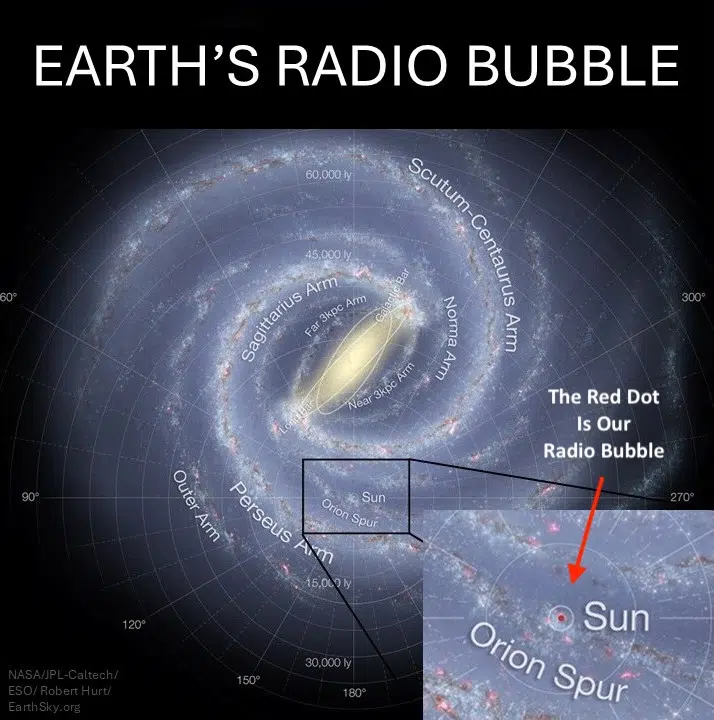 This image shows how far Earth’s radio broadcasts traveled across our Milky Way galaxy. No, not the width of the black box, or “inset.” Look closer. Look inside the inset. See the red dot? That dot marks the extent of Earth’s radio bubble. Image via NASA/ JPL-Caltech/ ESO/ Robert Hurt/ EarthSky.
Where Have Our Signals Reached?
The signals from Fessenden’s 1906 broadcast have already reached some of the nearest stars. For instance, they have traveled 4.24 light-years to Proxima Centauri, the closest known star to Earth. However, while these signals have crossed vast distances, they are so faint by the time they reach distant stars that they dissolve into background cosmic noise. Even if there were advanced civilizations in these distant star systems, they wouldn’t be able to hear the exact content of our broadcasts.
These signals are barely detectable, only serving as a whisper across the stars. For extraterrestrial civilizations, our radio signals would be an indication of the presence of technology, but the strength of those signals is so diminished that they wouldn’t provide much insight into the content being transmitted. Still, the idea that our radio waves are spreading across the galaxy is intriguing and raises interesting questions about the potential for contact with other civilizations in the future.
The Quest for Detection: How Many Stars Have Heard Us?
Interestingly, scientists are beginning to understand which stars might have received Earth’s radio broadcasts. A study by Lisa Kaltenegger and Jackie Faherty from Cornell University in 2019 identified 75 stars within 119 light-years of Earth that have been “touched” by our radio waves. These stars are not only within range of our broadcasts, but they also have the potential to observe Earth’s transits of the Sun, which could reveal the presence of a habitable planet. These stars represent a small but significant portion of the galaxy, showing that our signals have already encountered numerous celestial bodies.
However, EarthSky points out that while our radio signals have touched many stars, we still don’t fully know how many stars lie within this 119-light-year radius. The majority of stars in the Milky Way are dim red dwarfs, which are hard to detect, leaving a portion of the cosmic neighborhood unexplored in terms of receiving our broadcasts.
The Evolution of Earth’s Broadcasts: Are Our Signals Fading?
As technology has advanced, the nature of our broadcasts has changed. Today, fiber optics and digital communications emit far less radio energy than the analog signals Fessenden once sent out. This reduction in radio emissions means that while our radio bubble continues to expand, the signals are becoming increasingly sparse. The evolution of communications technology has made it more difficult for extraterrestrial civilizations, or even our future selves to detect these signals.
It raises an important question: Will future generations of human-made signals still radiate outward, or will they be constrained to Earth’s surface as we move further away from radio-based communication? This shift could have profound implications for the future of interstellar communication.