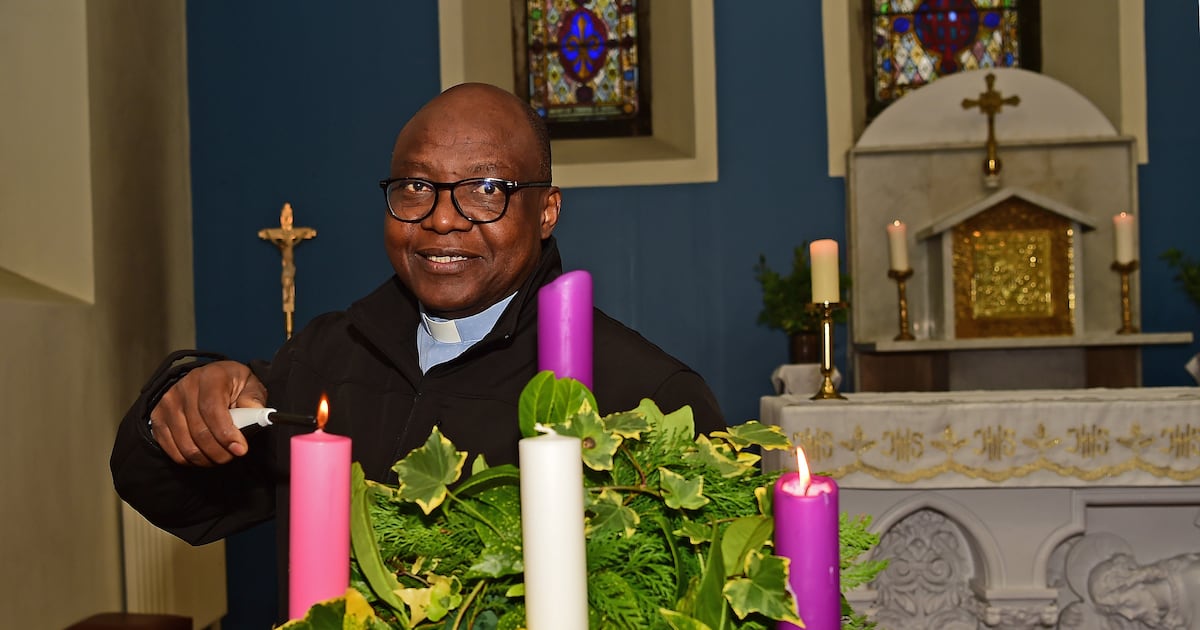
It is becoming ever more clear that Ireland’s 20th-century missionary Catholic Church is coming to the rescue of its distressed 21st-century counterpart.
Increasingly, priests from South America, Asia and in particular Africa are serving in dioceses throughout the island of Ireland.
No individual quite captures the symmetry of this story as perfectly as Fr Victor Akongwale, a priest of the diocese of Ogoja in southeastern Nigeria. He is now administrator at Carracastle, Co Mayo, in Achonry diocese.
A founder of Ogoja diocese was the late Fr Thomas McGettrick, who was a priest of Achonry diocese, sent to Africa in 1939, becoming bishop in Ogoja in 1955.
“In all his years in Africa, he built over 500 schools and was bishop of two dioceses: Ogoja and Abakaliki,” Fr Akongwale says of McGettrick.
“I see an arc, something that was designed by God. I am proud that I’m a priest and I am very proud that I’m in Ireland where my story started. My first teachers in becoming a priest were Irish, with a few Nigerians.”
Describing himself as “a Catholic of Irish descent, as Nigeria is”, he noted how in that country “we have more Patricks, and more Guinness is produced and consumed, than even in Ireland itself. St Patrick is the patron saint of Nigeria.”
Nigerian Catholics “are Irish Catholics”, he says.
“My father would say `my Lord and my God’. I never saw in any book where there was a response at any Mass of `my Lord and my God.’”
He came to Swinford, Co Mayo, in 2022 and told the people there: “I see where my father got his Catholicism from.”
He adds that he did not need to come to Ireland to learn “the Irish speed of the rosary” but that this was “a relic of his Irish Catholicism” via his father.
In 2002 Fr Akongwale visited Drogheda, from where the Medical Missionaries of Mary hail – a religious order that helped address the high infant mortality rate in Africa. Their work is remembered in Nigeria.
“Where I come from in Ogoja, when you get home and say you were in Ireland, they ask you: `How is Drogheda? They don’t ask you about Dublin,’” he says.
Irish ties in Nigeria run deep. In the early 1980s, before the nation’s soccer went professional, two large colleges founded by Irish missionaries in Lagos – St Finbar’s and St Greg’s – produced half the national football team.
They “did a lot for my country – in sports, education, health, my father,” he says.
The Irish church, he says, made “horrible mistakes” in Ireland but he wonders what Irish people would say if they could visit sub-Saharan Africa with him to see the work of Irish religious orders.
There was “a lot to celebrate about the Irish church if you look to Africa”, he says, believing the Irish church – if people look to the work in India, Korea and Australia as well – “has punched above her weight”.
Fr Akongwale’s father was educated by Irish teachers at primary school; seven children went to college.
The people look to the heart, and they even get my sense of humour now
The Co Mayo-based priest practised as a barrister in Nigeria and taught religion, government, history and theology.
He built two schools in a rural parish. The first he named after English theologian John Henry Newman, who was instrumental in the establishment of the Catholic University of Ireland, later UCD.
Last July he celebrated 25 years as a priest; he trained for priesthood at “the Maynooth of Africa”: Bigard Memorial Seminary, in Nigeria’s Enugu diocese, founded in 1922 by Spiritan priest and later bishop Joseph Shanahan.
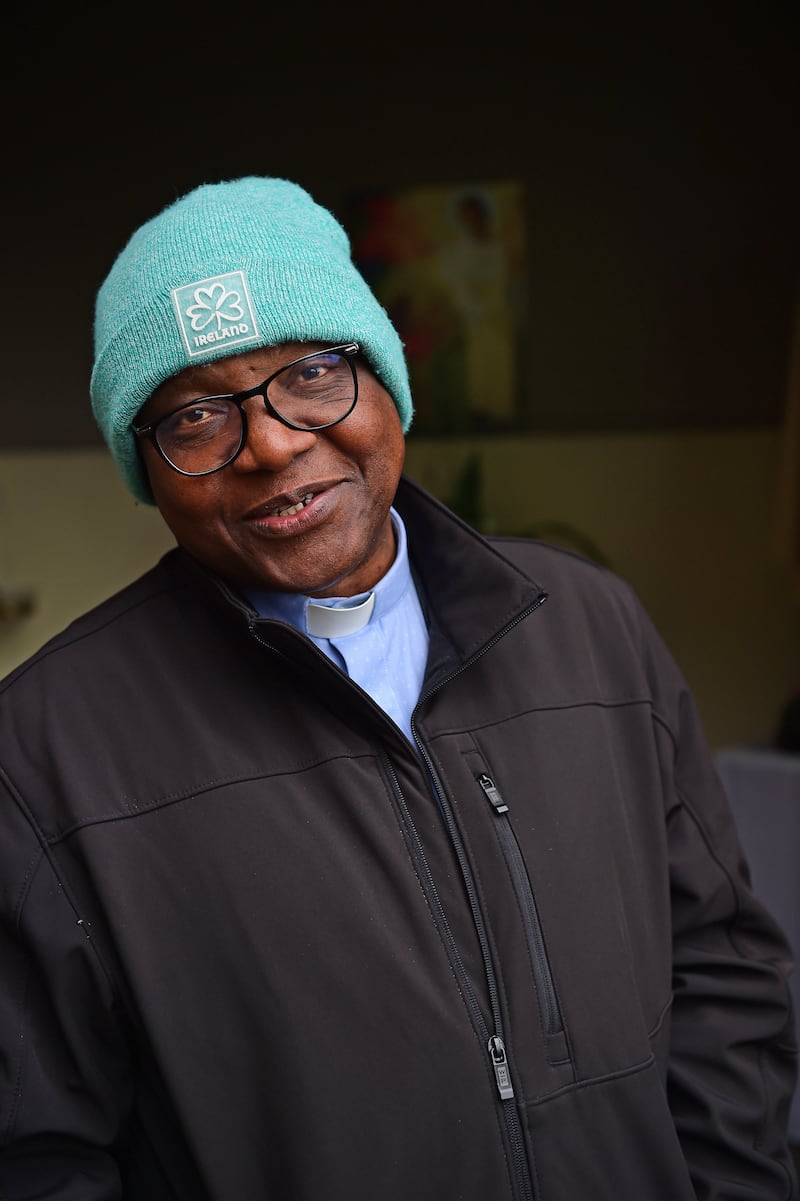 Fr Victor Akongwale. Photograph: Conor McKeown
Before his transfer to Co Mayo, Fr Akongwale served in Switzerland and Southwark in London.
An outgoing man, Fr Victor has proven popular in Swinford since his arrival there. Last March the town made him grand marshal of its St Patrick’s Day parade to honour his silver jubilee as a priest.
“People are kind; my vowels are all over the place and my consonants, but the people look to the heart, and they even get my sense of humour now,” he said.
Coming from Africa, Fr Akongwale has found the weather in the west of Ireland “challenging” but he is “happy in Ireland”.
“I’m an honorary Irishman now – a black Paddy,” he says.
He is not the only Nigerian serving in the diocese.
“I was one, then there were three. Now there are four, including two seminarians training for Achonry,” he says.
“It’s a reverse mission now.”