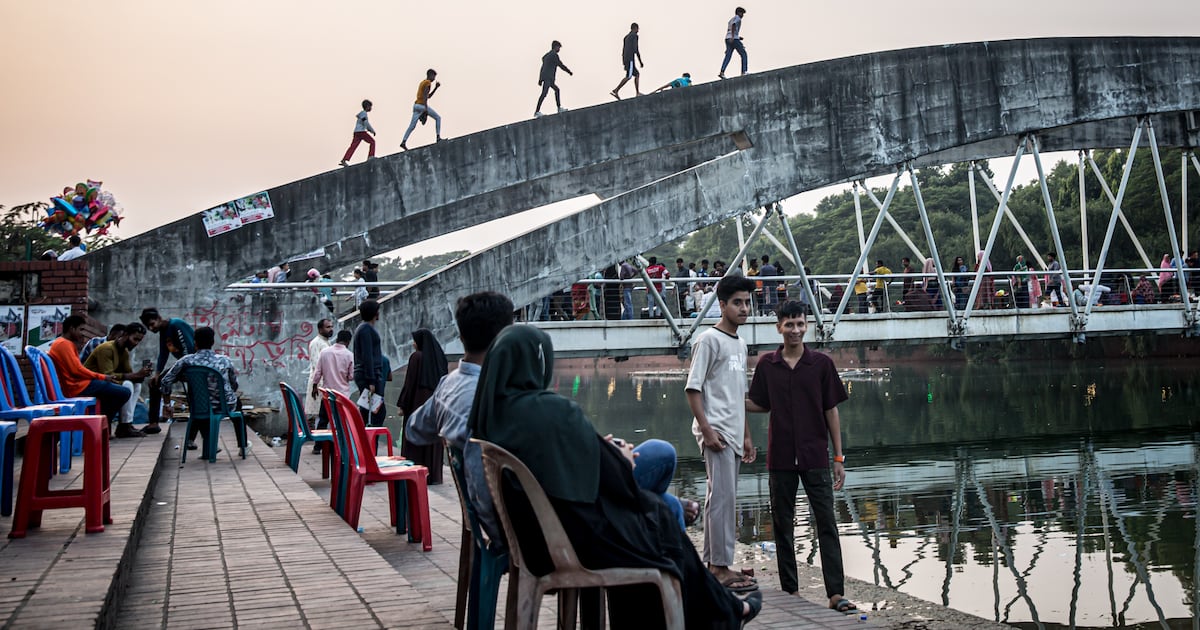
There are small stalls selling flower necklaces or head garlands, amra fruit and guava, jhal muri (dried rice mixed with spices), nuts, jewellery, cake, chickpeas with spices and fried potatoes, cigarettes and flasks of sugary tea.
Boys carry pink candyfloss on a pole. Young men with fancy cameras charge 10 taka (7 cent) to take a photo and send it straight to a phone: many of those posing will use it for their social media. Boys and young men swim in the adjoining Crescent Lake.
Zia Udyan – a park beside Bangladesh’s national parliament – is where thousands of Bangladeshis from all backgrounds in capital city Dhaka go to relax on Fridays. For many, this is their only day off. Young and old, rich and poor, gather to chat, stroll, play games, eat, drink and pass time together.
Dhaka is predicted to surpass Jakarta and become the world’s most populous city by 2050. It could be the largest of 37 megacities globally, according to the United Nations Department of Economic and Social Affairs’ World Urbanisation Prospects. The 2025 report said Dhaka has almost 37 million residents already.
“Taken together, India, Nigeria, Pakistan, Democratic Republic of the Congo, Egypt, Bangladesh and Ethiopia are expected to add more than 500 million city residents between 2025 and 2050, accounting for over half of the projected 986 million increase in the global number of city dwellers over that period,” the UN report said. “The success or failure of urbanisation in these key countries will shape global development outcomes.”
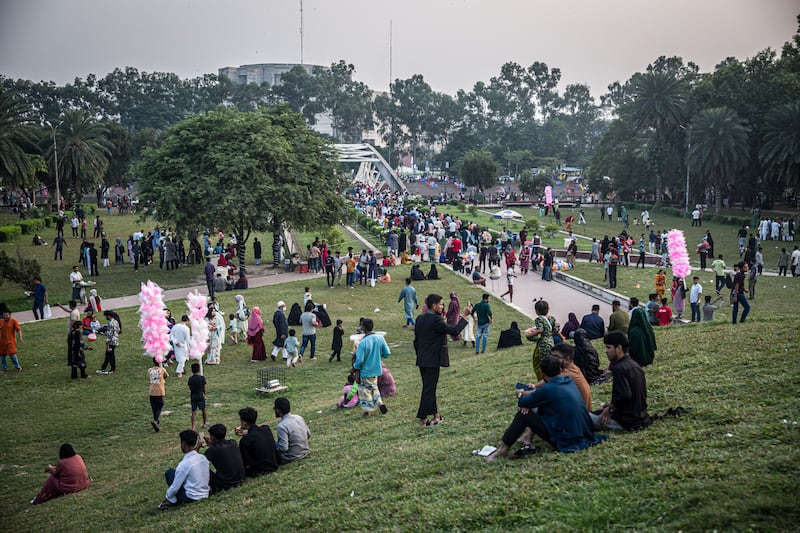 Thousands of people gather on Fridays at Zia Udyan in Dhaka. Photograph: Sally Hayden.
In total, Bangladesh has a population of about 174 million people. Many are moving towards cities, with reasons including climate change and weather disasters, which significantly influence internal migration. About 400,000 people are believed to move to Dhaka every year, raising questions about quality of life in the city.
Parks and green spaces offer some respite, though a 2020 academic paper found that Dhaka has only 54 green spaces, and that most residents do not have a park within a 20-minute walk of their homes.
Recent low-level political unrest, which has seen a spate of arson attacks and protests in recent months, has not stopped thousands of people from going to Zia Udyan on many Fridays, in the hours after prayers.
A newly married husband and wife – who just gave their first names – sat on a bench together, eating ice cream. Samia (25) says she and Hasib (20) are in their first year of marriage. They are both science and engineering students. They also read books and play badminton in front of their home when they want to relax. “It’s a beautiful city,” Samia says of Dhaka. .
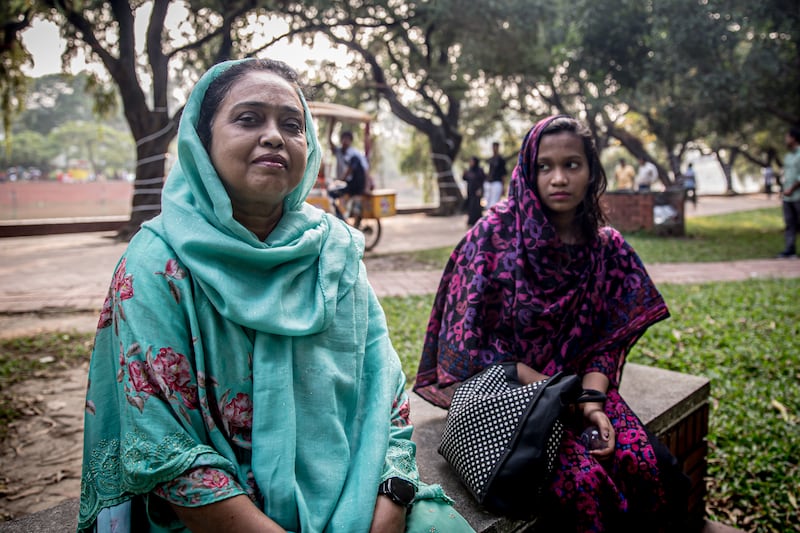 Retired high school teacher Nahid Shultana (60) and her ‘maid servant’. Photograph: Sally Hayden
Further along the path sat Nahid Shultana (60) and a woman she introduces as her maid servant. Shultana is a retired high schoolteacher of biology, home science and Bengali. She is a stroke patient. Doctor’s orders are that she should walk every day, though they drive to get to the park. In the rest of her free time she cooks and does physiotherapy.
Shultana says nothing to the extreme is good, including looking at your phone. Bangladeshis “are on their phones too much, it’s not necessary. There are a lot of other things to do,” she says.
“When I was coming here a big man scrolling on his mobile almost knocked me out. I try to get my maid servants from very remote places so they don’t have mobile phones.”
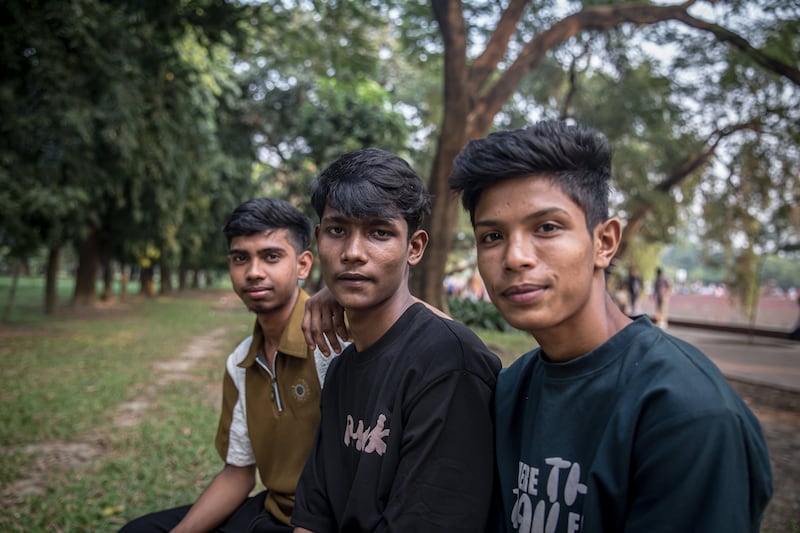 Ariful (16) and Bipul (18) are garment workers in an embroidery factory, while Shahidul (16) works for an ‘online’ company. Photograph: Sally Hayden
Nearby are three boys scrolling on their phones, who all live in the same neighbourhood. Ariful (16) and Bipul (18) are garment workers, and this is their only day off. Shahidul (16) works for an “online” company.
Bipul enjoys the free-to-play game Free Fire on his phone. “I don’t have time to play football on a pitch,” he says.
“Sometimes we stay home or sometimes come to the park or other places,” says Ariful, who likes looking at Facebook or watching videos. He used to play football, when he lived elsewhere in the country, but he moved to the capital city 18 months ago, where he stays with relatives and works.
“People shouldn’t come to Dhaka, the countryside is more refreshing. People come here just for jobs. The life is too busy and robotic,” he says.
Police trainee Md Aminul Islam (28) is strolling with his cousin, goldsmith Md Shishir (46), who is in Dhaka for the first time “to see the city”. Shishir says Dhaka residents with time off like visiting the zoo, botanical gardens and parks. He gets Fridays off, though other police have no free time at all, he says. “When we got recruited we took an oath that we are on 24/7.”
Rakib (30) sits on the grass with his wife Rini and 11-month-old baby girl Rafah. He works with the Coca Cola company, and always spends Fridays with his family.
He is originally from Kushtia, 210km away, but was posted to Dhaka eight years ago. “I didn’t like it here at first, but I’m coping.”
Rakib says rich people in Dhaka spend their time differently – for example “giving their children a car or a motorcycle to roam around and see things, but we can’t afford that”.
But inside the park, he says, there is “no discrimination. I bought my kid a football. The street kids come to play with it. My kids plays with other kids, whether poor or rich it doesn’t matter. I support this.”
Raahat Alam assisted with this report.
 simon cumbers
- This report was supported by the Simon Cumbers Media Fund