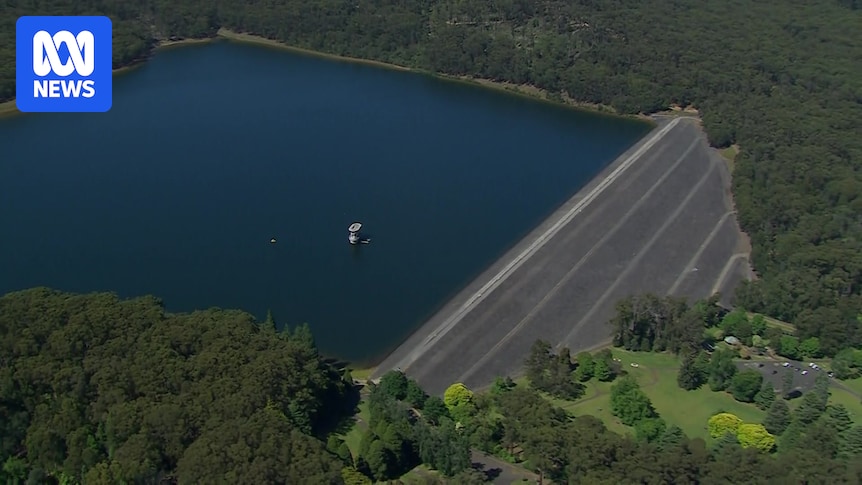
Melbourne and major regional cities across Victoria could be placed on water restrictions as dry conditions cause dam levels to plummet across the state.
Most of Victoria recorded below average rainfall in 2025 with parts of the north-west and central regions particularly dry, according to the Annual Water Outlook, released by the Department of Energy, Environment and Climate Change.
The report reveals Victoria’s water storage levels have dropped to 61 per cent capacity, which is down 19 per cent from this time last year.
It says there is an increased likelihood of urban water restrictions across most of Victoria in 2026, which would mean some metropolitan areas would have their water usage tightened for the first time since the Millennium Drought in the early 2000s.
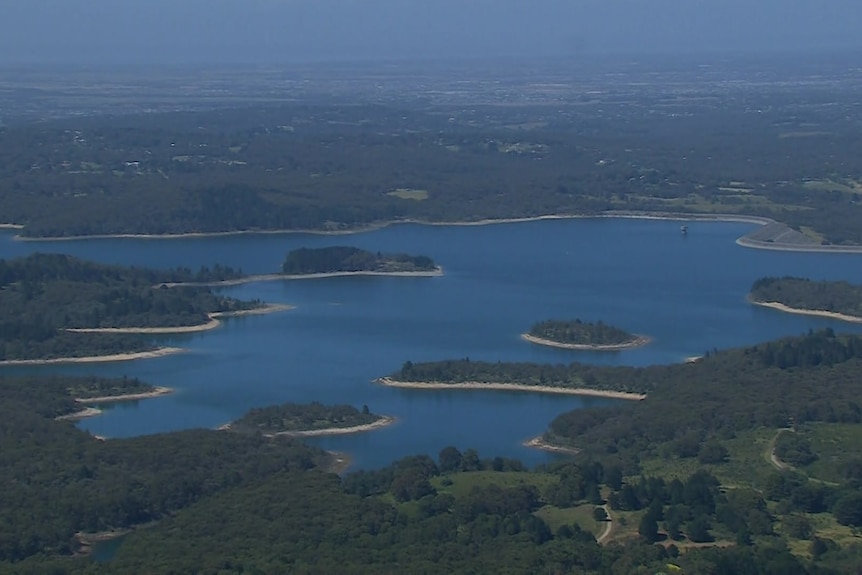
Victoria’s water storages have dropped to 61 per cent capacity, down 19 per cent in 2025. (ABC News)
“Despite the welcome late rain during November, major water storages across Victoria will be entering this summer at lower levels compared to previous years,” Water Minister Gayle Tierney wrote in the report.
“In the south-west and west Gippsland regions, our farmers have experienced significantly below average to lowest on record rainfall conditions over the last two years, which is having a significant impact on rural livelihoods, households and local communities.”
This year, water restrictions were introduced in Allendale, Broomfield, Newlyn, Kingston, Smeaton, Springmount, Apollo Bay, Marengo, Skenes Creek, Euroa, Violet Town, Daylesford, Hepburn and Hepburn Springs after the towns recorded significantly lower rainfall.
The report stated that parts of southern Victoria received their average total, and there was above average rainfall in Central Gippsland and East Gippsland.
While the report stated there was a rarer likelihood of Melbourne being placed under restrictions, it noted the city’s water storages had fallen 12 per cent to 76 per cent capacity, and that residents and businesses used 500 billion litres of water over the last financial year while the dams only received 305 billion litres of inflows.
As the same time, daily water consumption rose from 163 to 169 litres per person — the highest level since 2007.
“As a result of low inflows and higher water use, Melbourne’s storages saw the steepest January-June decline since the Millennium Drought,” the report stated.
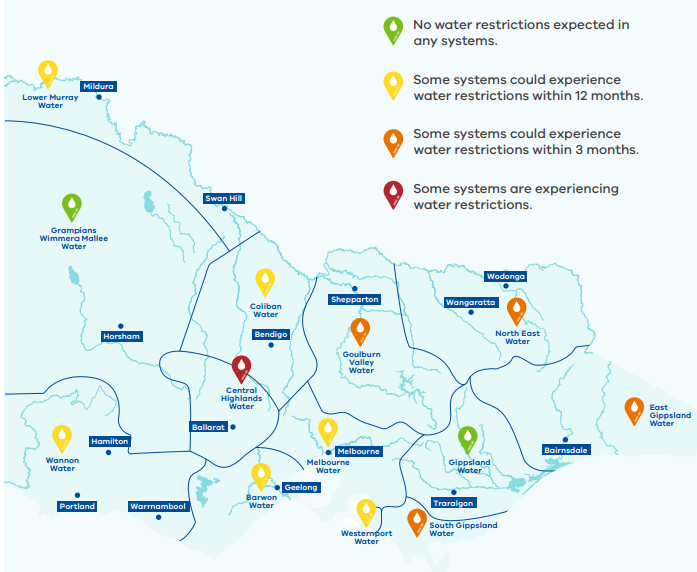
A map showing the likelihood of water restrictions in 2026, according to the Victorian Annual Water Outlook. (Supplied: Department of Energy, Environment and Climate Action)
The Bureau of Meteorology’s December to February outlook found it was likely Victoria would continue to receive below average rainfall while recording above average maximum temperatures this summer.
Forecaster Jonathan How said Melbourne had recorded 572 millimetres of rain this year.
“That’s against the average of 648mm but notably for Melbourne, only four out of the 12 months had above average rainfall, the rest were actually below average,” he said.
He said it was even drier in northern and western Victoria.
“For Shepparton, rainfall so far this year has been 356mm. That’s against the long-term average of 452mm.
“In Mildura, it was 160mm for the year against an average of 287[mm].”
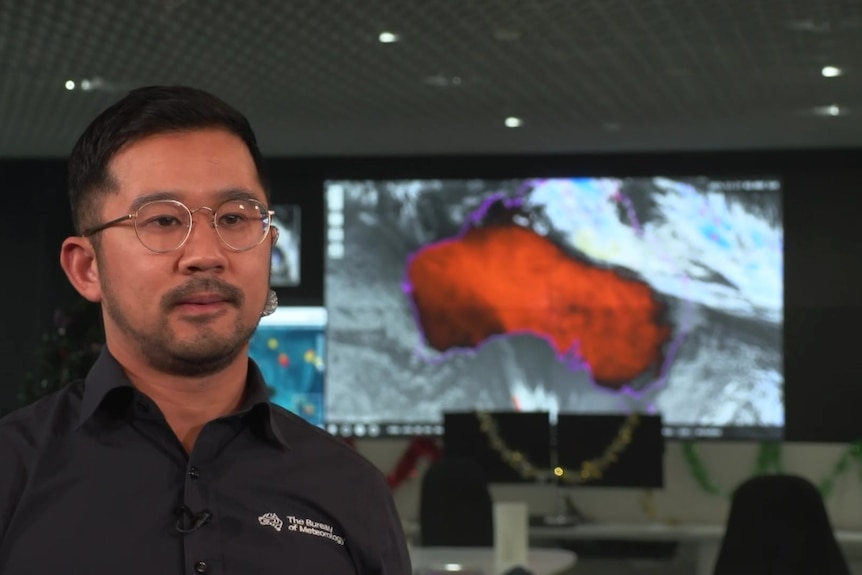
Forecaster Jonathan How says Victoria is not expecting any significant rainfall in the final days of 2025. (ABC News)
He said there were no strong indicators for whether Victoria could expect more rain next year.
“We’ll really need to wait and see what weather systems come through on a day to day, even week to week basis.”
Stronger case for restrictions in regional cities
Regional water storage levels had fallen to 57 per cent, down 21 per cent over the past year.
“Stage 1 water restrictions are in place for Central Highlands Water’s Forest Hill system,” the report said.
“This could escalate to Stage 2 if conditions remain dry.
“Regional towns which are the most at risk under a dry climate scenario during 2026 include Fish Creek (South Gippsland Water), Mansfield (Goulburn Valley Water), Bright (North East Water) and Westernport Water’s supply area.”
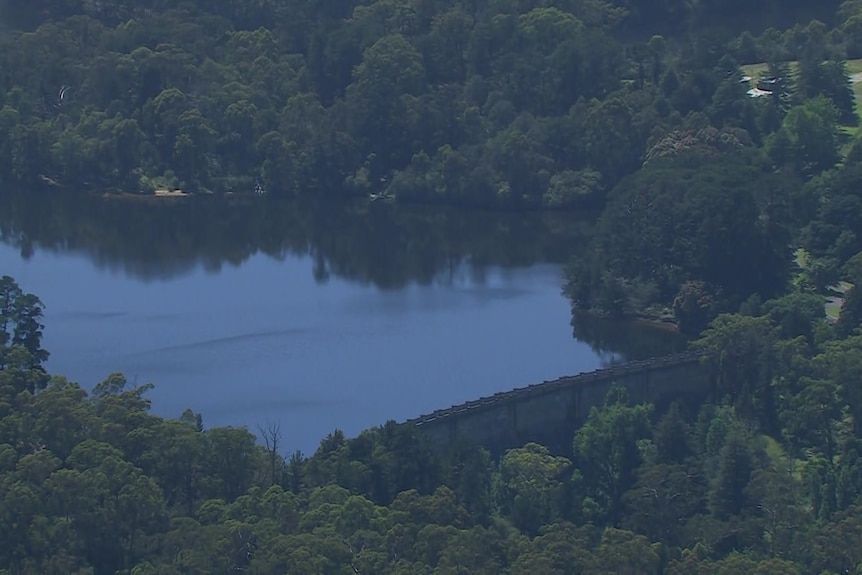
Victorians are now consuming an average of 169 litres of water per person each day, the highest level since 2007. (ABC News)
Yarra Valley Water is the largest of Victoria’s metropolitan water corporations, covering the north, east and north-east of Melbourne, or about a third of the city’s population.
It’s sitting at 75 per cent capacity which the corporation’s acting managing director Bridie Fennessy said was one of the lowest levels in a decade.
“During the Millennium Drought, we really got much lower than that where we had to put in quite severe restrictions in terms of how [customers] used water in their gardens and used water day to day,” she said.
“We’re not at that stage at the moment.
“We’re really at the stage of asking our community to think carefully about how they’re using water so we don’t need to get to that point with restrictions.”
Yarra Valley Water’s Bridie Fennessy is urging Victorians to abide by permanent water saving rules to help conserve supplies. (ABC News)
She said Victoria’s population had also grown substantially since that drought and many people were either unaware of or had forgotten that there were permanent water saving rules in place across the state.
Those rules include:
- Hand-held hoses must be fitted with a trigger nozzle and free from leaks
- Hand-held hoses, buckets or watering cans can be used at any time to water gardens and lawns
- Watering systems such as sprinklers and drips can only be used between 6pm and 10am
- Watering systems must be fitted with a rain or soil moisture sensor
- Water cannot be used to clean driveways, paths, concrete, tiles and timber decking, except if using a high-pressure cleaner. A hand-held hose or bucket can be used after an emergency such as accidents, fires, or health and safety hazards, once-a-year stain removal, or during construction or renovations
- Water fountains or water features must use recirculated water.
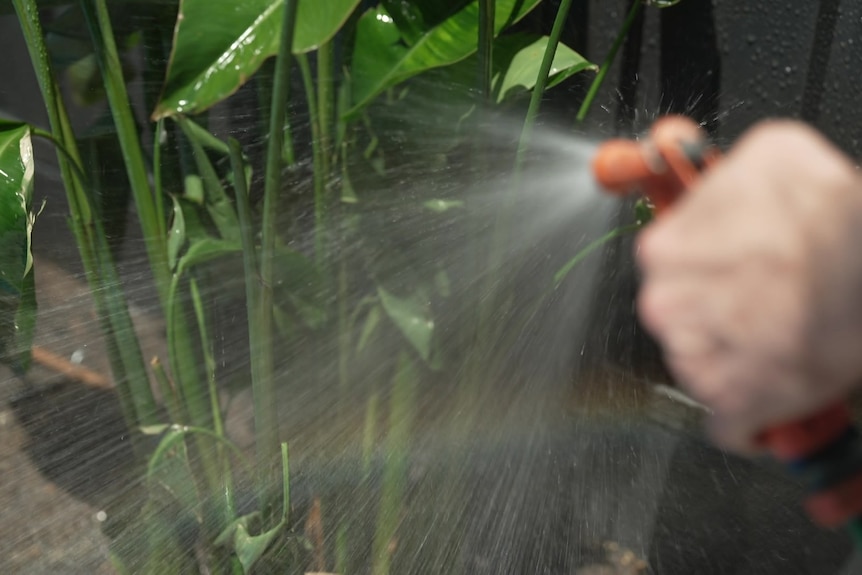
In Victoria, hoses must be fitted with a trigger nozzle but can be used at any time to water a garden. (ABC News)
“For those of us who went through the drought period of having buckets in the shower and really carefully thinking about how we’re using water, we haven’t been in that period for quite a long time,” Ms Fennessy said.
“I’ve got teenagers at home, they take really long showers so educating them about what a drought can feel like and look like is really, really important.”
She suggested Victorians limit their showers to four minutes, wait until washing machines and dishwashers are full before putting on a load and turn their taps off while brushing their teeth.
“Water is the most essential of essential services and we need to all think carefully about how we maintain it and how we protect it, not only for today but for future generations as well.”
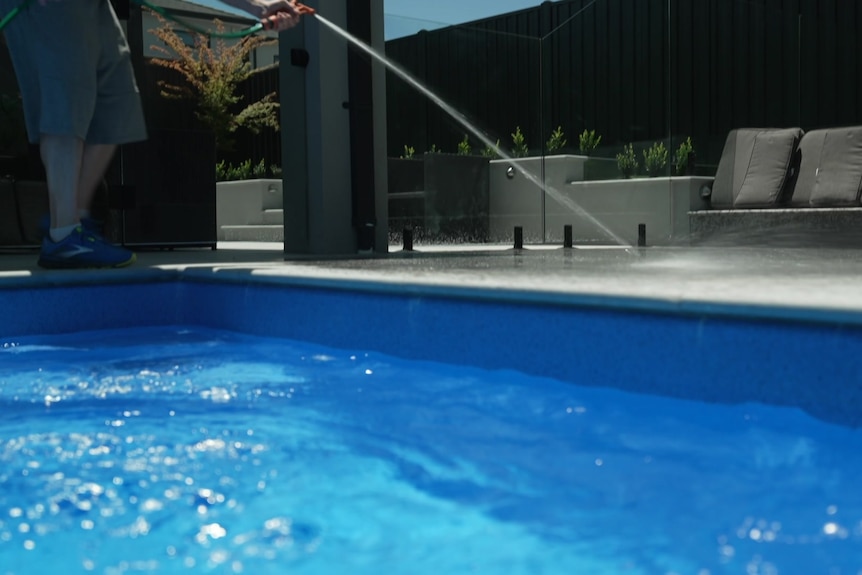
Under Victoria’s permanent water saving rules, hoses can no longer be used to clean hard surfaces like concrete and driveways. (ABC News)
The water minister said the state government was closely monitoring water reserves.
“Victoria’s Annual Water Outlook is a reminder of the complex challenges of water management in Victoria, and the importance of planning for growing water demand and a changing climate,” Ms Tierney said.
“Desalinated water is currently helping to deliver reliable supplies to more than 6 million people across Geelong, Melbourne, and parts of Gippsland.
“However, modelling estimates that over the next decade Victoria will need an extra 95 billion litres of water per year on top of the Victorian Desalination Plant running at full capacity.”