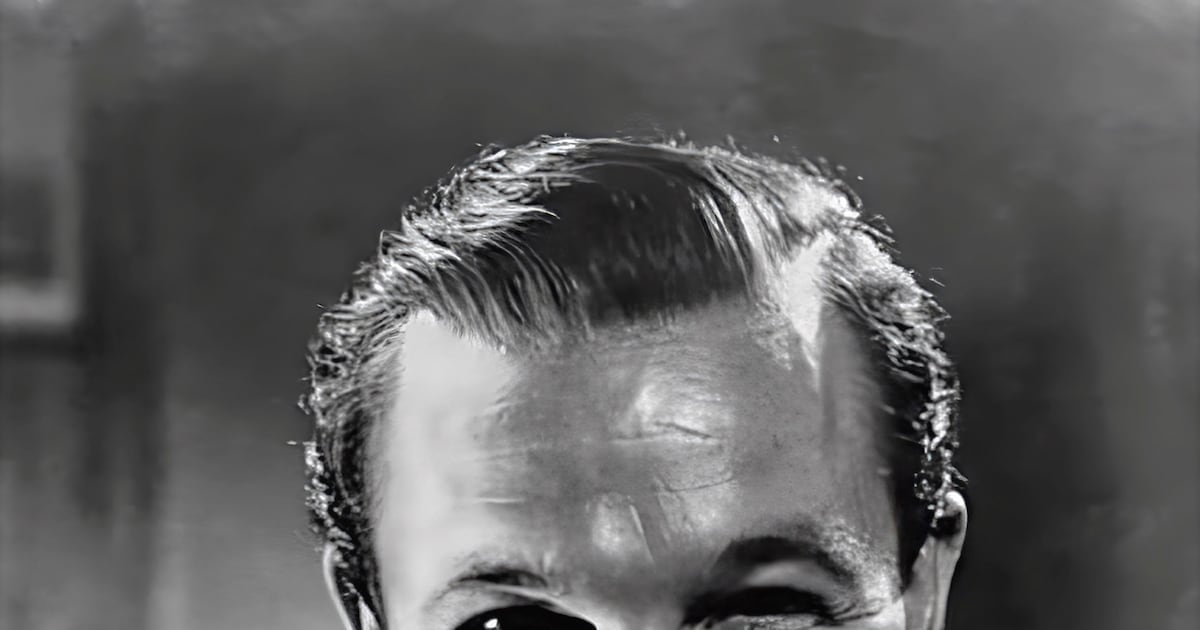
Christmas as we know it today is partly the creation of entertainers such as Gene Kelly: pre-rock ’n roll crooners and hoofers whose music was as wholesome as a yule log and as cosy as a seasonal jumper. Their jingle-all-the-way, 1950s Hollywood take on December 25th has helped shape the myth of the perfect white Christmas – an ideal towards which, consciously or not, we all aspire today.
But if Kelly’s folksy persona gave off a comforting glow of chestnuts roasting on an open fire, he was a significant figure in the history of 20th-century Irish America, too. Born Eugene Curran Kelly, he was the grandson of Irish immigrants, and the fascinating documentary Gene Kelly – Réalt an Rince (Christmas Day, TG4, 10.05pm) reveals that his love for the old country extended to holidaying in Tipperary and becoming a local at a village bar.
It is a revealing portrait of a figure who, going on for three decades since his death, risks slipping through the cracks. “A very friendly, warm man,” recalls Margaret Kennedy, who as a child remembers Kelly visiting her family pub in the village of Puckane, close to Lough Derg. “He was warm and welcoming to all the people who came to meet him.”
Kelly was more than a friendly American tourist and a lot more than an entertainer. With showstopping movies such as Singin’ in the Rain and An American in Paris, he revolutionised how dance was depicted on screen. He was also that rare, affable genius. Unlike the angsty Sinatra and the alcoholic Crosby, the folksy dad figure we saw on screen wasn’t all that far removed from the real Kelly.
Réalt an Rince draws a vivid picture of his hardscrabble upbringing in Pittsburgh and the film is almost as effective as a chronicling of the Irish-American experience as it is as a Hollywood biography. It was a tough town, especially for a kid of Irish heritage at a time when Hibernophobia was as thick as the smoke rolling in from the steel mills that dominated the city.
“He grew up in a social context of enormous discrimination and prejudice. He used to tell stories about how to get from their house to their primary school. They had to traverse a Polish neighbourhood, a Jewish neighbourhood, and an Italian neighbourhood,” recalls his daughter, Kerry Kelly Novick. “These were all population groups that were not friendly toward one another. Because they were all competing as immigrants for whatever labour was available, the way he described it, he fought his way to school every day and back.”
His talent was evident from an early age, and he felt no self-consciousness about being a boy who could dance. His story was a sort of Billy Elliot in reverse: far from being a source of embarrassment, he and his siblings were encouraged to dance and sing. They even went into business with their own Trapp Family-style troupe.
Gene was the most driven of the Kellys by far and was soon in New York, burning up a hot streak on Broadway. That led to Hollywood, where his career was interrupted by the second World War. He returned to civilian life as a has-been in the eyes of Tinseltown and had to claw his way back. But he never gave up, and with 1952’s Singin’ in the Rain, sealed his immortality. It influenced generations of dancers – including Michael Jackson, who sought Kelly’s advice before leaving The Jacksons for a solo career. He took to heart Kelly’s recommendation that he always wear white socks: “They’ll see your feet.”
Some of the most revealing segments in this engaging film are from an interview conducted in Tipperary in the early 1970s by RTÉ broadcaster Donncha Ó Dúlaing. Relaxed and chatty, Kelly talks about his ambitions to direct again and his love for Ireland.
[ Married to Gene Kelly: ‘He didn’t seem that old to me’Opens in new window ]
The story, in the eyes of his children, has a sad ending. In 1990, he married Patricia Kelly Ward, his third wife, who was 47 years his junior. When he died in 1996 at age 83, she cremated his body without a funeral, to the horror of his four children by his two previous marriages. Patricia insisted she was honouring his instructions, but the family does not see it that way. “She tried very hard to keep us from him,” says Kerry Kelly Novick. “It was really very tragic.”
Gene Kelly remains a prominent figure from 20th-century popular culture. Even if you know nothing about him, you can recall at will the signature scene in Singin’ in the Rain where he lolls around under a downpour – his dancing giving physical expression to the feeling of not having a care in the world. But behind the dancing was a fascinating life, and this absorbing documentary tells it with a light touch and a spring in its step.