With hindsight, 2025 wasn’t the disaster for Irish tourism that industry figures had first feared. Far from it in fact.
Although visitor numbers from certain key markets did fall – with those from Britain and the bigger European markets declining – the Americans still came to Ireland in numbers.
They could be seen in Dublin and smaller regional towns and cities sporting the colours of American football teams – drawn here by events like the NFL clash in Croke Park in September and the college football classic at Dublin’s Aviva Stadium the month before.
Despite renewed rhetoric from Donald Trump and the White House about America First, along with worries about a possible economic slowdown, hundreds of thousands of Americans still took their vacations in the old country.
On top of this, the tourism sector welcomed the reduction of the VAT rate on food services to 9 per cent that was included in October’s budget and will take effect next July.
As tourism operators now look ahead to the coming 12 months, concerns swirl around this possible over-reliance on the US market and whether efforts to create a more diversified customer base are making any headway.
American spending power is seen as a key vulnerability.
According to the Irish Tourism Industry Confederation, a 10 per cent drop in US tourists next year would equate to 124,000 fewer visitors and €191 million in less revenue.
A like-for-like boost from Europe or Britain would not replace the loss in revenue, it says. It would require an additional 216,000 more Europeans or 375,000 more Britons in order to make-up the loss in spending.
People from Britain traditionally book less time here and as a result spend fewer euro.
This kind of fall-off could easily happen, says the confederation. Winning the sort of compensatory growth needed from Europe and Britain in this scenario would “be a stretch”, it adds.
As a result, much emphasis within the industry has been placed on moving Irish tourism away from an over-reliance on American visitors – and diversifying our tourist offering.
“If somebody could explain to me how to do it – I would gladly do it,” says Gavan Woods, chief executive with St Patrick’s Cathedral in Dublin – one of the capital’s main visitor attractions.
“We track the origins of our visitors very closely and the strength of the North American market is extraordinary – it makes up 55 per cent of our total footfall.”
Woods says forward bookings from this sector remain strong into 2026 and early 2027 – while some other traditional markets have fallen away.
“Some EU markets, in particular Germany and Spain, have seen drops. In particular, we’ve seen a double-digit drop in German footfall – it’s unusual to see that in footfall – but it has been made up for by the North American market.”
Woods is baffled by the big drop in German visitors – and he worries it could be a warning of further things to come from Europe. He does note, however, that French numbers have been stronger.
The cathedral has actively gone after the Canadian market.
“There may be opportunities there – and we have put some effort into the Canadian market,” he says. “You now see direct flights from Toronto – there is a conurbation there of 10 million well-off people.
“I’ve been over there talking to very large operators trying to get the word out that we are here. And we have seen a 6 per cent increase in people coming from Canada this year.”
Your officials want tourists – but your future depends on travellers
— Peter Greenberg, travel editor with the US broadcaster CBS News
The cathedral has also been “putting its best foot forward” around the world, he says, by staging choir performances in the likes of New York, San Francisco and Madrid.
Woods has worked through the effects of foot and mouth disease, the 9/11 attacks in the United States, the global economic crisis and the disruption from the volcanic ash cloud incident – so he is well accustomed to unforeseen events.
Barring something similar, 2026 should be a solid year, he says.
A vulnerability he does see, which is routinely mentioned by people within the industry, is the general cost of holidaying in Ireland.
“I’m very concerned about value for money – we are not a cheap destination,” he says. “I’m sure for some markets that are price sensitive it is a concern for them”.
The cost of coming here for Americans has risen significantly in 2025 even when domestic inflation is set aside. The dollar has fallen from near parity with the euro at the start of the year to around a dollar being worth 85 cent.
 Pittsburgh Steelers fan Gerald Vaughan in Temple Bar ahead of the American football game between Pittsburgh Steelers and Minnesota Vikings in September. Photograph: Tom Honan
Peter Greenberg is travel editor with the US broadcaster CBS News and recently hosted and produced the Hidden Ireland TV programme for that network.
He has been coming here for 50 years, he says, and is in love with the country. “So much in fact that I want to buy a house on Cape Clear Island, (off the Cork coast) if only my wife would let me.”
Greenberg says Ireland is well positioned to continue attracting American visitors but like many other locations runs the risk of focusing on pure numbers.
“Ireland has always been high on the list for Americans for obvious reasons,” he says.
“But the real problem right now is that your ministers think they will sink or swim on numbers – total numbers – average spend etc. That’s not a recipe for success but a short term recipe for keeping your job as minister.
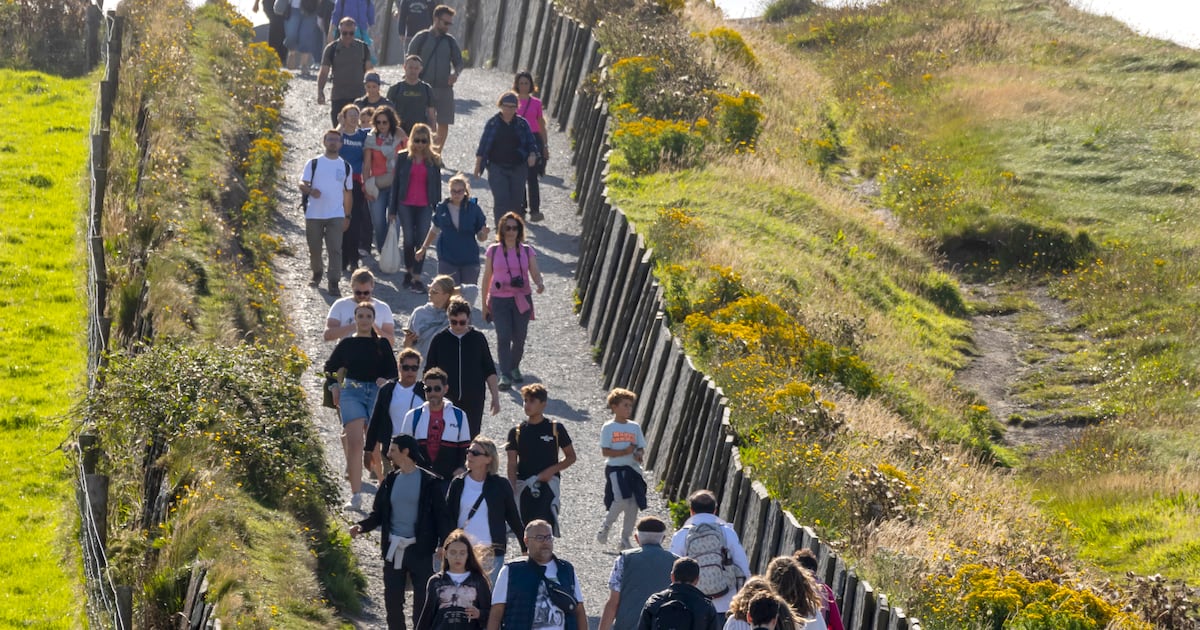
“The real numbers should be around the quality of the stay – the depth of the immersion. You run the danger of overselling a destination; 78 large tour buses cramming into the Cliffs of Moher at eight in the morning – for me – is not a quality experience.”
Greenberg says the better the experience is for visitors then the more money they will spend. He says Ireland needs to be attracting “travellers, not tourists” – people who are “curious, well-read and determined to immerse himself or herself in a culture”.
“Your officials want tourists – but your future depends on travellers.”
One way of widening the Irish tourism market lies in boosting the profile of nontraditional attractions – in particular those outside of Dublin.
Brendan Kenny is chief executive of Ireland’s Association for Adventure Tourism. With more than 250 members across the island of Ireland it promotes adventure centres, walking tours and zip-lining among other pursuits.
“Our sector makes people hungry, thirsty and tired,” he says. “When you are finished walking or kayaking – you will want somewhere to eat, somewhere to drink and somewhere to sleep.”
He agrees with Greenberg’s opinion that American visitors are increasingly seeking out an “immersive” experience when they come here.
“Because Americans tend to stay for longer – they want to participate in their activity alongside unique, local food options and so on,” he says.
“There is data coming through that Gen Z is a very different audience to previous ones. They are looking to achieve that immersive, authentic experience. While they are using AI to research and book their holidays, they are actually using it to find local experiences, whether it be things like self-catering or B&Bs.”
Kenny believes the recent addition of more cycling paths and walking trails has added to Ireland’s overall tourist appeal – along with a summer climate that is cooler than on the Continent.
Like Gavan Woods, he has noted the drop in British and Germans but also the relative resilience in the numbers coming from France. He says Irish cycling holidays are proving increasingly popular with the French and the Italians.
He is also relatively positive about the prospects for the coming months though he, too, worries about high running costs.
Given the rough and tumble nature of some activities, the adventure and outdoor pursuit sector is particularly exposed to expensive insurance premiums.
“Better access to competitive insurance is an ongoing challenge,” he says. “We are still to see the full benefit of the reforms delivered a few years ago and we are not a high-margin sector. It’s vital that insurance continues to be addressed.”
He says his organisation has put in a huge amount of work into ensuring its members have access to safety management programmes – in an effort to minimise those insurance bills.
Having noted all of the potential challenges ahead, the tourism confederation is very keen on the Government’s latest tourism action plan.
Launched earlier this month, the plan sets out measures the Government says will boost tourism numbers by a million a year, every year out to 2031. Central to this, it says, will be achieving a more balanced, regional spread of attractions and boosting the appeal of “less mature” tourism destinations.
“It’s great that there’s now a sense of purpose to how the Government is treating tourism,” says the confederation’s chief executive, Eoghan O’Mara Walsh.
“It was very welcome that at the launch – along with Minister Peter Burke – you had the Minister for Finance there as well as another Cabinet Minister in Norma Foley. It kind of showed that tourism is now at the heart of the Government’s economic policy, which is something [the confederation] has looked for, for some time.”
He says the targets “look good” but need to be net of inflation.
Hitting these, he claims, will depend on whether the 32 million a year annual passenger cap at Dublin Airport is lifted and if the Government can somehow boost the supply of tourism accommodation.
But everything in the short term still seems to hang on the Americans.
Despite the cautious optimism that they will continue to visit, the confederation points to two big events next year that might encourage more Americans to stay at home.
The country celebrates the 250th anniversary of its independence and will also host the Fifa World Cup in June and July along with Canada and Mexico. US president Donald Trump has given significant publicity to the upcoming tournament in a country that has traditionally taken slowly to soccer.
The Trump boost, along with planned patriotic events, could take the appeal out of foreign vacations.
When this is put to Peter Greenberg, however, he makes the opposite case. He believes airlines operating between the US and Europe could be looking to send more Americans this way in 2026.
“The number of foreign visitors to the US has been dropping dramatically because of immigration policy and tariffs, you name it. Foreign arrivals have dropped 6 per cent in 2025 – that number could drop even more with Visa requirements getting more crazy.”
He argues that this reluctance to travel to the US could leave many airlines with reduced bookings on their transatlantic routes – leading to special deals to get more Americans flying to Europe.
“A lot of people won’t be coming here – they’ll go to the World Cup games in Canada and Mexico. So you will have a lot of empty seats on planes coming over to the US, which means a lot of empty seats on the return to Europe. You could see unprecedented ticket sales – and more people travelling to Ireland and Europe.”
The concern around costs doesn’t strike Greenberg as a big deterrent at the moment and he notes that it has become an issue for lots of other competitor markets.
“Something happened five years ago that mitigates that,” he says.
“Covid forced everybody to get up close and personal with their own sense of mortality – it forced them to look at their own lives in a different way. They reassessed what their real needs were outside of travel. Do I need a new car, do I need expensive jewellery? And the answer came back quickly – no, they wanted experiences.
“When they came out the gate after Covid, they said, ‘We are less concerned about cost than experience’, and in that regard Ireland is in a good position.”