Back to Article List
Io follows its own shadow across Jupiter with only 20 minutes between them, highlighting how close we are to the gas giant’s opposition.
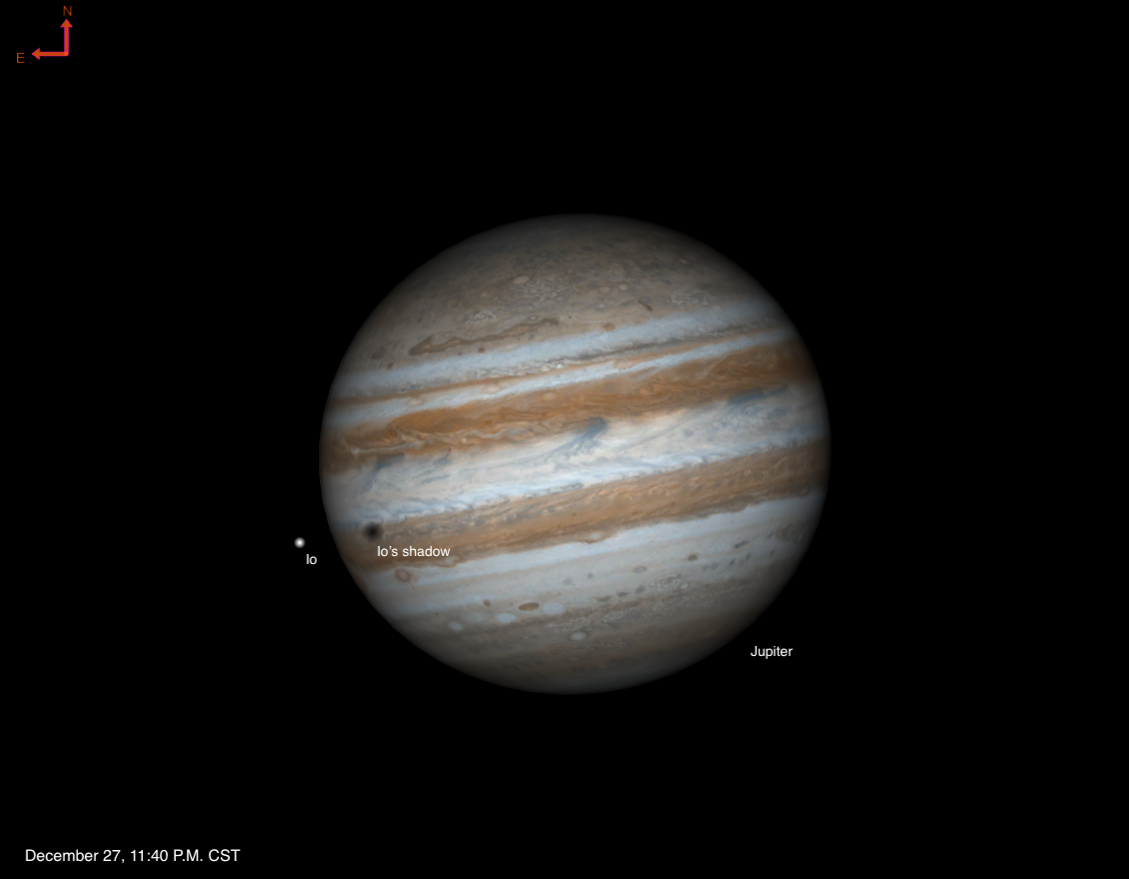
There is a brief period of time when Io’s shadow has crossed onto Jupiter but Io has not yet started its transit — note the time zone listed and convert to your local time zone if needed. Credit: Alison Klesman (via TheSkyX)
- The article details a significant astronomical event: the transit of Jupiter’s moon Io and its shadow across the gas giant’s disk, observed overnight from December 27th into December 28th.
- The ingress phase of this event commences with Io’s shadow appearing on Jupiter’s cloud tops at 12:28 A.M. EST, followed by Io itself approximately 20 minutes later at 12:48 A.M. EST, with both reaching a central position on the disk by 1:45 A.M. EST.
- The egress concludes with the shadow departing Jupiter’s western limb around 2:45 A.M. EST, and Io following at 3:05 A.M. EST, as observed from the Eastern time zone.
- Throughout the observation period, the configuration of Jupiter’s Galilean moons changes from Io, Europa, and Ganymede positioned east with Callisto west, to Io joining Callisto on the western side of the planet post-transit.
Looking for a sky event this week? Check out our full Sky This Week column.
December 26: The Moon shares the sky with Saturn
Io and its shadow cross Jupiter overnight tonight with only 20 minutes between them. Finding Jupiter is likely familiar by now, as the gas giant shines brightly in Gemini near the heads of the Twins. For most of the evening, there are three moons east of Jupiter’s disk: Io is closest, then Europa, with Ganymede farthest out. Callisto is alone west of the planet.
Io approaches the eastern limb as the hours pass, and its shadow appears first on the cloud tops at 12:28 A.M. EST (early on the 28th in EST only, late on the 27th in all time zones farther west). Io follows 20 minutes later, at 12:48 A.M. EST. The pair lies centrally on the disk around 1:45 A.M. EST, now the 28th in the Eastern and Central time zones.
The shadow maintains its lead and slips off the western limb of Jupiter around 2:45 A.M. EST on the 28th, with Io following by 3:05 A.M. EST. After that, there are two moons on either side of Jupiter, now that Io lies to the west with Callisto.
Sunrise: 7:21 A.M.
Sunset: 4:42 P.M.
Moonrise: 11:38 A.M.
Moonset: —
Moon Phase: Waxing gibbous (54%)
*Times for sunrise, sunset, moonrise, and moonset are given in local time from 40° N 90° W. The Moon’s illumination is given at 10 P.M. local time from the same location.