Stories we loved to tell | Learning about Gjoa Haven’s historic past and plans for the future
In this year-end series, Nunatsiaq News reporters look back on their most memorable stories from 2025.
I didn’t expect a hat to set the tone for my trip to Gjoa Haven this year, but that’s exactly what happened when I met Mayor Raymond Quqshuun in June.
Sporting a “Canada Is Not for Sale” cap and a “Built in the Fifties” T-shirt, Quqshuun gave me a sense of who he is: someone fiercely protective of Gjoa Haven, a hamlet of around 1,500 people on King William Island in the Kitikmeot Region of Nunavut.
This was Nunatsiaq News’ first assignment in Gjoa Haven and my first time reporting above the Arctic Circle.
The nerves started kicking in on the flight from Yellowknife but they quickly eased as I hit the ground running, straight to the Amundsen Inn.
My main story was to cover the opening of the expanded Nattilik Heritage Centre, the hamlet’s octagonal-shaped museum and cultural hub, but as I spoke to residents that quickly changed.
The following day, Nudrat Ihsan, Gjoa Haven’s innovation co-ordinator, and Jimmy Arqviq, the community’s clean-energy champion, became my unofficial tour guides.

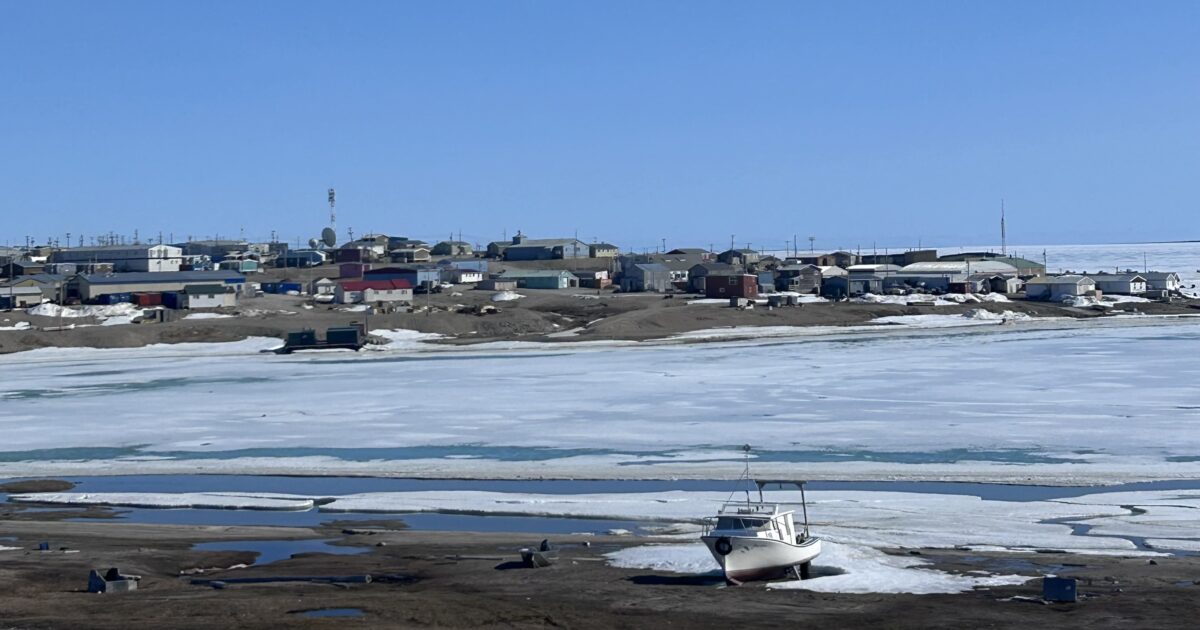
One moment I was photographing solar panels on rooftops; the next, Arqviq was pointing out the old boats docked near Gjoa Haven’s viewpoint, which looks out onto “finest little harbour in the world,” or so explorer Roald Amundsen once said.
One of the boats Arqviq showed me belonged to his mother, who had first sailed to Gjoa Haven from a trading outpost in the 1970s, where Jimmy and his siblings were born.
Ihsan would later invite me to a delicious Pakistani-Indian potluck dinner with two other women who, like her (and I), were far from home, making me feel very welcome.
I asked what brought them to Gjoa Haven. They said they were young, and if a career or life opportunity presented itself, even in the Canadian Arctic, they were ready to take the chance.
Hearing them talk about learning Inuktitut phrases, adjusting to long nights and first winters, and embracing local life made me better realize that home is wherever you make it, provided there’s housing.
Meeting Rick Dwyer, a 76-year-old Scottish former Hudson’s Bay Co. manager who has lived in Gjoa Haven for nearly 50 years, felt like fate.
He had called the Nunatsiaq News office in Ottawa right before I travelled to talk about historical photos he had that were connected to Franklin and Amundsen.
He said he could email them. I told him I’d see him in a week.
At his home, the stories flowed as he let me hold Venetian trade beads from an 1833 expedition and relics from the ill-fated 1845 Franklin expedition.
Almost everyone born and raised in Gjoa Haven has a connection to the ships, he told me, and he was right.
Even at Naurvik, Gjoa Haven’s off-grid greenhouse, manager Betty Kogvik casually mentioned that her husband Sammy played a role in 2016 in the rediscovery of the missing HMS Terror.

He had apparently found the mast from the ship, missing for 168 years, sticking out of the ice during a fishing trip.
The stories I loved to tell this year were those passed down through generations in Gjoa Haven, and I feel lucky to have shook the hands of ‘Gjoa Haveners’ who have touched these pieces of history firsthand.