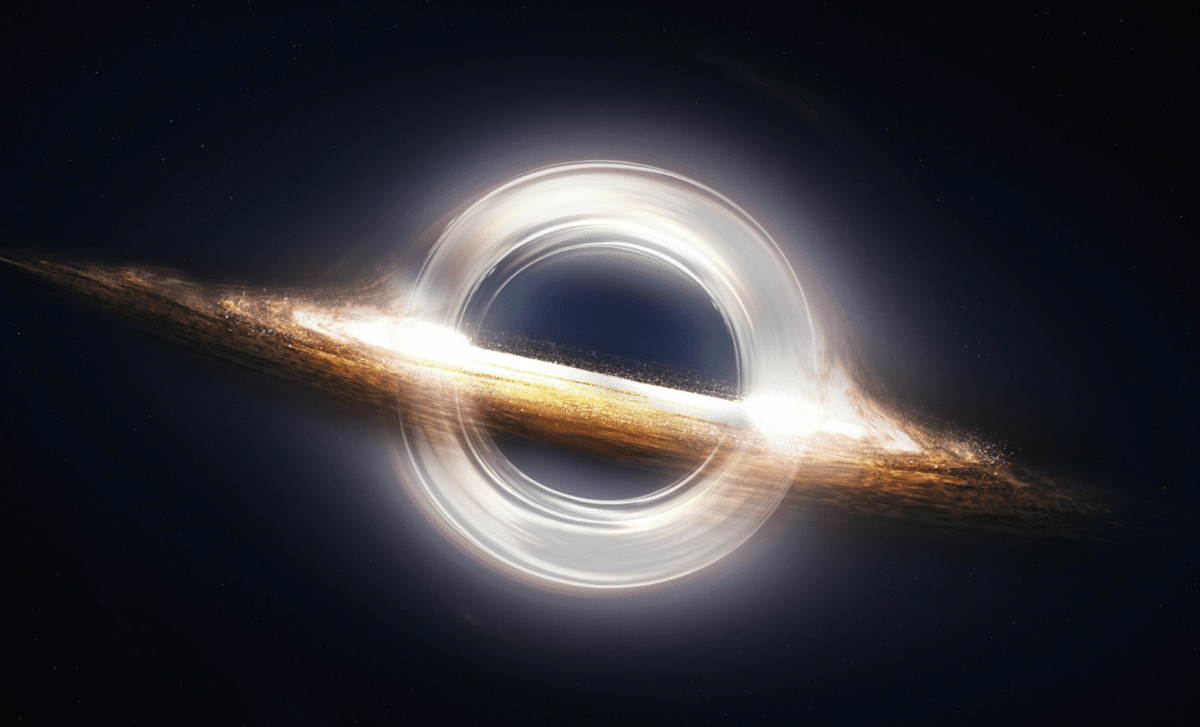
For decades, black holes have stood as the most enigmatic objects in the universe, defying our understanding of space, time, and matter. Yet, some physicists propose an even more mind-bending idea: what if our entire universe exists inside a black hole belonging to a much larger cosmos? A concept once considered fringe now returns to the forefront of cosmology, fueled by modern insights into thermodynamics, quantum mechanics, and holographic principles.
The Black Hole’s Information Mystery
Physicists have long grappled with the paradoxes at the heart of black hole physics. The classical picture, as described by French astrophysicist Jean-Pierre Luminet, offers a haunting vision of these cosmic prisons.
“In classical general relativity, a black hole prevents any particle or form of radiation from escaping from its cosmic prison,” Luminet explains in a 2016 review. “For an external observer, when a material body crosses an event horizon all knowledge of its material properties is lost. Only the new values of M [mass], J [angular momentum], and Q [electric charge] remain. As a result, a black hole swallows an enormous amount of information.”
This “information loss” stands at the core of what’s called the black hole information paradox. If information truly disappears when matter falls into a black hole, it would violate quantum mechanics, which forbids the destruction of information. This puzzle has driven theorists to propose extraordinary frameworks to reconcile the two.
Hawking’s Paradox and the Birth of the Holographic Idea
In the 1970s, Stephen Hawking introduced a key twist: black holes should emit faint radiation, now called Hawking radiation, due to quantum effects at their boundaries. This insight deepened the paradox rather than resolving it.
“Hawking then pointed to a paradox. If a black hole can evaporate, a portion of the information it contains is lost forever,” Luminet continued. “The information contained in thermal radiation emitted by a black hole is degraded; it does not recapitulate information about matter previously swallowed by the black hole. The irretrievable loss of information conflicts with one of the basic postulates of quantum mechanics. According to the Schrödinger equation, physical systems that change over time cannot create or destroy information, a property known as unitarity.”
This contradiction inspired the search for a deeper description, one that could bridge relativity and quantum theory. The proposed solution, known as the holographic principle, suggests that all the information within a volume of space can be represented on its boundary, much like a 3D image projected from a 2D surface.
The Universe As a Hologram
Physicists Gerard ’t Hooft and Leonard Susskind expanded this concept, arguing that black holes encode information about what falls into them on their event horizons.
“From the point of view of information, each bit in the form of a 0 or a 1 corresponds to four Planck areas, which allows one to find the Bekenstein–Hawking formula for entropy,” Luminet continues. “For an external observer, information about the entropy of the black hole, once borne by the three-dimensional structure of the objects that have crossed the event horizon, seems lost. But on this view, the information is encoded on the two-dimensional surface of a black hole, like a hologram. Therefore, ’t Hooft concluded, the information swallowed by a black hole could be completely restored during the process of quantum evaporation.”
This idea reshapes our understanding of space-time itself. According to the holographic universe hypothesis, our reality could be a projection encoded at the boundary of a vast cosmic black hole. This would mean that everything we perceive stars, galaxies, even ourselves, may exist as information patterns on a two-dimensional surface.
The Strange Coincidence Of The Cosmic Radii
One of the most intriguing coincidences supporting this hypothesis lies in the geometry of our universe. The Hubble radius, roughly the distance to the edge of the observable universe, is numerically close to the Schwarzschild radius that would result if all matter in the universe were compressed into a black hole.
To some researchers, this alignment hints that our cosmos could indeed be the interior of such a black hole. The concept also aligns with mathematical models that blend general relativity and quantum field theory, offering an elegant, if speculative, symmetry.
While this idea remains far from proven, it continues to attract interest from cosmologists and quantum theorists alike, offering tantalizing bridges between information theory, gravity, and the fabric of spacetime itself.
Beyond The Horizon: A Universe Within A Universe?
If the holographic universe concept holds true, it might mean that our universe’s birth, the Big Bang, was not a singular event in empty space, but the moment when a massive star collapsed into a black hole in a higher-dimensional cosmos.
Inside this “parent” black hole, time and space as we know them could have emerged, expanding into the vast universe we now observe. Such an origin story implies that what we call cosmic inflation could be an artifact of the black hole’s internal expansion, a universe within a universe.
Though no direct evidence confirms this yet, ongoing research in quantum gravity, such as that referenced in arXiv, continues to explore the deep connections between information, geometry, and the fundamental limits of reality itself.