
The odds of discovering another Earth are looking slimmer than once believed. A growing body of evidence suggests that truly Earth-like conditions are rare, and complex life even rarer, perhaps to the point of near isolation. According to new models presented in a SETI Live discussion, the requirements for a planet to sustain intelligent life are much more restrictive than previously assumed.
In a conversation hosted by Dr. Simon Steel, Deputy Director of the Carl Sagan Center, planetary scientists Dr. Manuel Scherf and Dr. Helmut Lammer from the Austrian Academy of Sciences explored the idea that many so-called “Earth-like” exoplanets fall far short of the chemical and atmospheric balance needed to support intelligent species.
Earth’s Atmosphere Is Not The Norm
The Earth’s ability to support complex life may come down to a rare set of atmospheric conditions. As explained by Dr. Scherf during the SETI Live session, the stable mix of oxygen, nitrogen, and low carbon dioxide is not just unusual, but extremely difficult to replicate naturally. Oxygen, which is vital for high-energy metabolism, must exist at pressures above roughly 100 millibars to sustain organisms with the energy needs and size associated with tool use and intelligence.
According to a SETI release, this balance is the result of billions of years of co-evolution between life and atmosphere. Dr. Lammer noted that processes such as the carbon-silicate cycle, the rise of oxygen, and the recycling of nitrogen all contributed to the planet’s long-term stability. But the tolerances are narrow. Too much CO₂ becomes toxic, while too little makes the upper atmosphere unstable. Oxygen levels above 300 millibars, meanwhile, introduce a serious fire hazard.
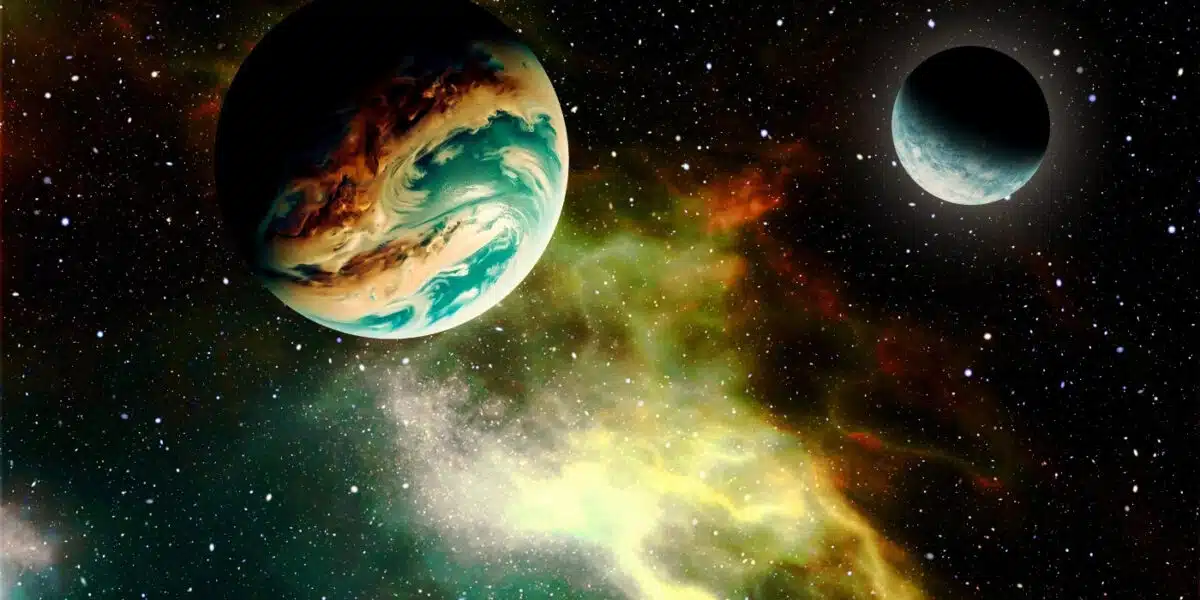 Two distant exoplanets drift through the cosmic void. Credit: SETI
Red Dwarfs May Host Planets, But Not The Right Kind
Although M-dwarfs, commonly known as red dwarfs, make up the majority of stars in the galaxy, planets orbiting them face a range of severe challenges. According to Dr. Lammer, these stars emit strong ultraviolet and X-ray radiation, which heats planetary atmospheres and causes gases to escape into space over time. Even atmospheres dominated by CO₂, which typically help cool the upper layers, struggle to survive under such intense bombardment.
This concern has been reinforced by recent observations from the James Webb Space Telescope, which failed to detect any atmosphere on several planets in the TRAPPIST-1 system. Even if some planets retain a thin atmosphere, other problems persist: many become tidally locked, creating permanent day and night sides; some suffer atmospheric freeze-out on the night side; others lack large, stabilizing moons.
Earth-like Planets May Be Fewer Than We Thought
Trying to figure out just how rare Earth-like planets really are, the researchers put together a stripped-down version of the Drake Equation. Instead of using broad guesses, they focused only on things we can actually measure, like how often rocky planets show up in the habitable zone, how likely they are to keep an atmosphere, and where they sit in the galaxy.
Even with optimistic numbers, their model suggests the Milky Way might have no more than 250,000 planets with atmospheres similar to Earth’s. And that’s before you even get to the really tough parts, like life actually starting, becoming complex, or developing technology. Once you add all that in, the number of intelligent civilizations out there might shrink to just a few… or maybe even none that are close.