In a recent study, astronomers reported the discovery of a rare double nucleus in the nearby galaxy NGC 4486B, located close to the Virgo Cluster’s central region. The findings, now available on the arXiv preprint server, offer new insight into the final stages of supermassive black hole (SMBH) mergers, events that shape galaxies across cosmic time.
Revealing A Hidden Core In A Familiar Galaxy
Using advanced photometric and kinematic observations, the research team analyzed the inner structure of NGC 4486B and found two distinct bright regions at its center. These features strongly suggest that the galaxy hosts two compact stellar components, each potentially associated with an SMBH remnant.
“In this work, we investigate the photometric and kinematic signatures of the double nucleus in NGC 4486B,” the researchers wrote in the paper.
Their detailed measurements revealed subtle differences in the motion and brightness of stars near the galactic core, consistent with the gravitational influence of a recently merged black hole pair.
Such dual nuclei are rarely observed in nearby galaxies. NGC 4486B, once considered a calm and ancient elliptical system, now appears to bear the energetic scars of a much more recent cosmic event, one that could redefine our understanding of black hole coalescence in mature galactic environments.
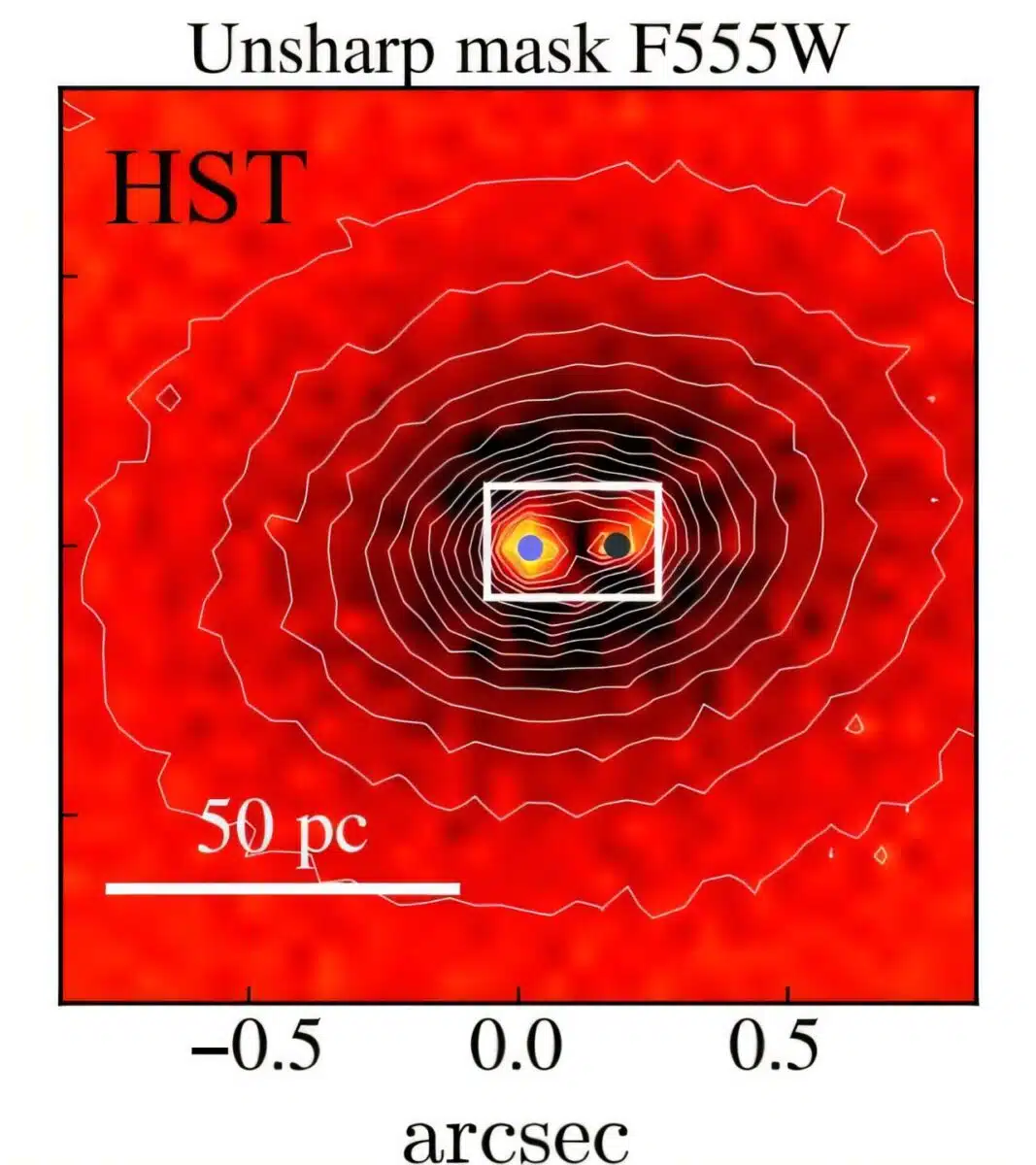 Unsharp-masked WFPC2/F555W image of the double nucleus in NGC 4486B, showing two peaks separated by ∼12 pc. Credit: arXiv (2025). DOI: 10.48550/arxiv.2512.14695
Signs Of A Recent Supermassive Black Hole Merger
The team’s results indicate that the supermassive black holes at the core of NGC 4486B likely merged not long ago on cosmic timescales. Despite the galaxy’s age and its proximity to the massive M87 in the Virgo cluster, the data imply that dynamical relaxation is incomplete, leaving a visible record of this violent past.
“Thus, although NGC 4486B is an old, relaxed galaxy near the Virgo cluster center, its SMBH appears to have merged only recently, making its nucleus a rare nearby laboratory for studying post-merger SMBH dynamics,” the authors of the paper concluded.
This conclusion places NGC 4486B among a handful of galaxies where astronomers can directly probe the aftermath of black hole mergers, a stage that is usually hidden by dust, distance, or time. The galaxy’s relative proximity offers an unprecedented opportunity to refine models of gravitational wave emission and nuclear stellar dynamics in post-merger systems.
What NGC 4486B Teaches Us About Galaxy Evolution
The discovery underscores how black hole activity can persist even in seemingly quiet galaxies. Each supermassive black hole merger releases enormous amounts of energy, capable of reshaping the surrounding stellar orbits and altering the galaxy’s central morphology.
By tracing the distinct signatures of this merger, scientists can test long-standing theoretical models that link galactic mergers to black hole growth. The arXiv preprint server paper suggests that NGC 4486B could serve as a nearby benchmark for studying these transformations in detail, bridging the gap between simulations and observation.
A Rare Glimpse Into The Heart Of Galactic Mergers
The implications of this research extend far beyond a single galaxy. Observing a double nucleus in NGC 4486B provides crucial evidence of how galaxies like our own Milky Way might evolve after their central black holes merge. It also supports the growing expectation that LISA and other next-generation observatories may soon detect low-frequency gravitational waves from similar systems in the nearby universe.
As astronomers continue to refine their observations and simulations, NGC 4486B stands as a powerful reminder that even the most seemingly tranquil galaxies can hide the echoes of cosmic violence at their cores, a testament to the universe’s ever-changing nature.