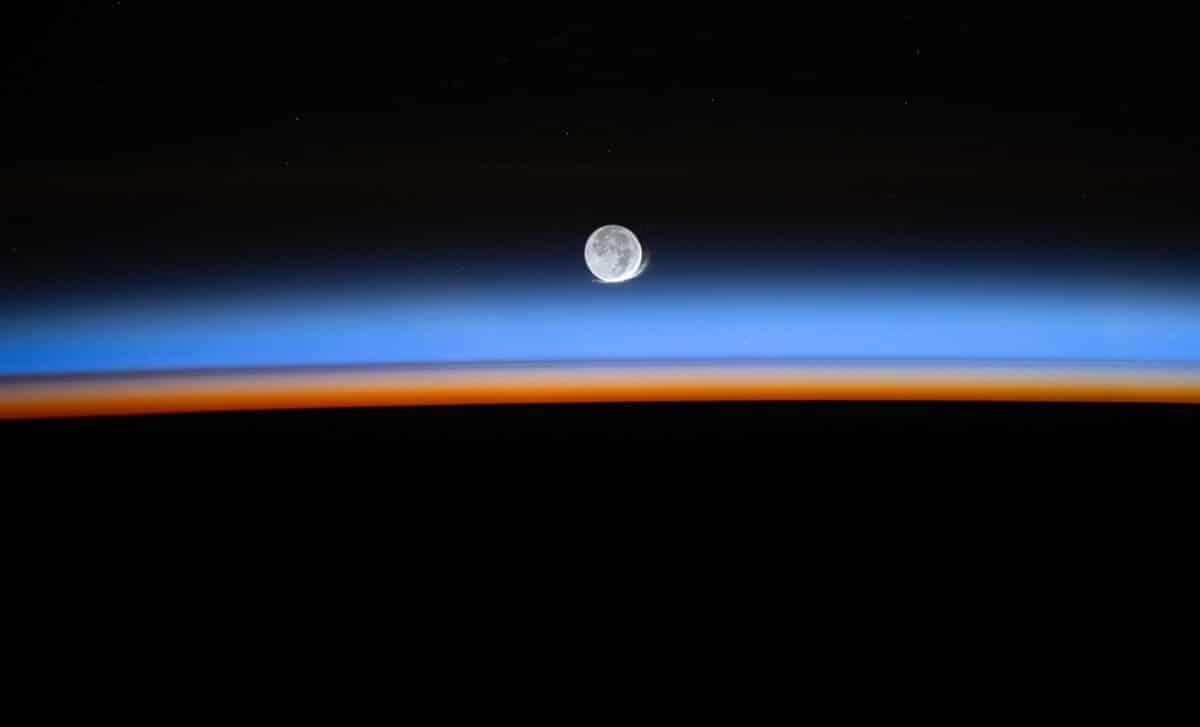
An astronaut aboard the International Space Station (ISS) recently snapped a breathtaking photo of a lunar halo, a rare optical phenomenon visible from space. The image, showcasing a delicate arc of light circling the Moon, was captured above the Indian Ocean and reveals how light interacts with tiny ice crystals in Earth’s atmosphere. The phenomenon, known as a lunar halo, occurs when moonlight refracts through ice crystals high in the atmosphere, forming bright rings or arcs around the Moon.
How Lunar Halos Form?
According to the NASA, lunar halos are produced when moonlight passes through ice crystals in the atmosphere. These crystals refract the light, separating it into a spectrum of colors, and bend it at precise angles, creating arcs or rings around the Moon. The most common halo, a 22-degree ring, typically forms when the light refracts through hexagonal ice crystals. The ISS’s orbit, just above the Earth’s atmosphere, allows astronauts to witness this rare optical effect when the Moon sits just behind the thin layer of ice in the mesosphere, Earth’s uppermost atmospheric layer.
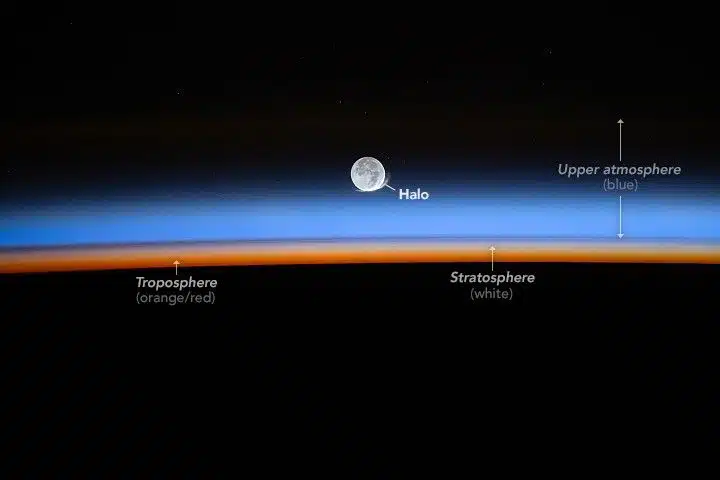 View of Earth’s atmosphere from space, showing the troposphere, stratosphere, and upper atmosphere, with a halo around the moon. Credit: NASA
The geometry of ice crystals is crucial to the halo’s appearance. As seen in the astronaut’s photo, the halo appears as an arc rather than a full ring. This partial formation occurs when the ice crystals don’t fully encircle the Moon from the astronaut’s perspective, but instead, form a delicate curve. Even small shifts in the crystals’ orientation can influence the shape and sharpness of the halo.
The ISS: A Unique Vantage Point for Atmospheric Observations
The ISS orbits Earth at an altitude of about 200 nautical miles, well above most weather systems. This high position allows astronauts to capture images of rare atmospheric phenomena, like lunar halos, that would be invisible from the ground. With the Moon positioned just right behind the atmosphere, we get a crystal-clear view of how light interacts with Earth’s upper atmosphere, free from any cloud or weather distortion.
Atmospheric optics at their finest. ❄️
This display features a 22° halo, bright parhelia (sun dogs), upper tangent arcs, and a brilliant circumzenithal arc at the top. All caused by sunlight refracting through hexagonal ice crystals.pic.twitter.com/mBVdWfHVVa
— Curiosity (@MAstronomers) December 25, 2025
This type of photography, led by NASA’s Crew Earth Observations facility, serves as an invaluable tool for studying Earth’s atmosphere. As the ISS moves above various regions, it can capture fleeting moments of natural beauty and scientific interest that might otherwise go unnoticed. Each photograph from the ISS helps scientists better understand how light, weather, and chemistry interact on a planetary scale. The recent image of the lunar halo, for example, has provided researchers with more details about the behavior of ice crystals and the rare conditions that allow them to form in such high altitudes.
Ice in the Upper Atmosphere: A Rare and Delicate Phenomenon
The ice responsible for the lunar halo is not the same as the clouds found at lower altitudes. As stated in a recent research, published in Atmospheric Chemistry and Physics, these high-altitude ice crystals form at about 30 to 54 miles above Earth’s surface, in the mesosphere. This area is cold and thin, and the ice that forms here is extremely sensitive to temperature changes. These crystals are not typically the result of conventional cloud formations, but are part of a complex process that occurs under very specific conditions.
Ice in the mesosphere is also influenced by gravity waves, ripples in the air caused by storms and terrain, which can help shape the delicate ice structures needed for a lunar halo to appear. The unusual behavior of these ice layers has recently attracted the attention of scientists, who are working to better understand how they affect atmospheric phenomena like lunar halos.