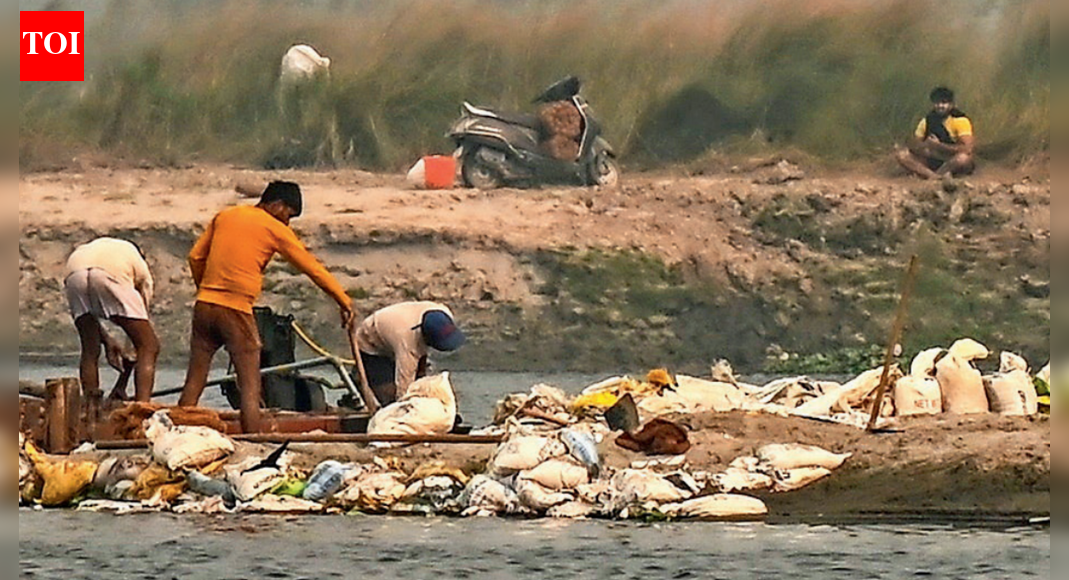
 GHAZIABAD: A National Green Tribunal-ordered inspection of the Yamuna floodplains lying between Delhi and Ghaziabad has found largescale violations by miners, corroborating a TOI report on Nov 30 last year about an embankment being built across the river to illegally dredge sand.The joint committee report, submitted to NGT after surprise inspections on both Delhi and UP sides of Yamuna earlier this month, pointed out that though the mining lease was legal, the mining area breached legal boundaries with construction of illegal ramps. Miners, it added, operated heavy machinery within the river’s flow and ignored Delhi-NCR’s GRAP rules, continuing operations even during periods when all mining activities were prohibited to curb pollution.After taking note of the TOI report, NGT’s principal bench, headed by chairperson Prakash Shrivastava and expert member A Senthil Vel, had consolidated all pending cases on sand mining around Yamuna. It directed the formation of the joint committee — comprising representatives from Central Pollution Control Board, ministry of environment, forest and climate change and Commission for Air Quality Management — on Nov 20 this year.
 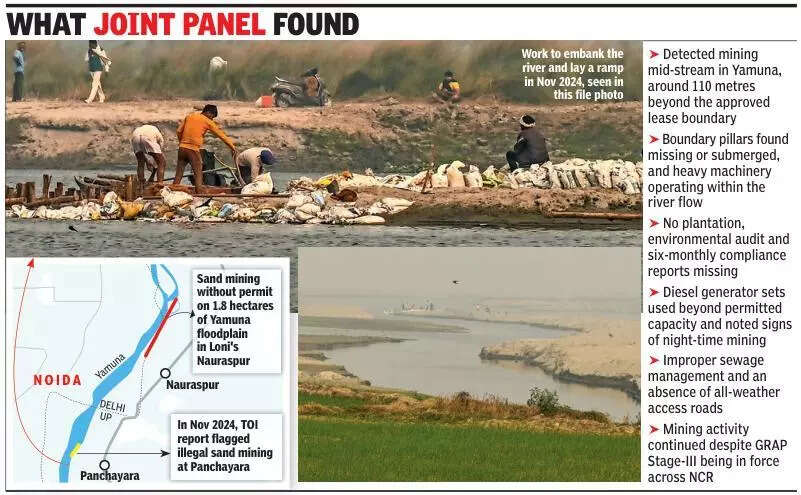 In its report dated Dec 19, the panel painted a bleak picture of the Yamuna floodplains, particularly in Ghaziabad’s Navraspur area of Loni. Here, mining was found to have taken place in the very centre of the river, up to 110 metres beyond the legal lease boundary. The violations included excavation of up to 15-20 feet in the riverbed using machinery deployed using the illegal access ramps – the TOI report had pointed out that the ramps were built by laying sandbags across the river’s flow – and absence or submergence of boundary pillars meant to demarcate legal mining zones. The committee also found a weighing bridge and an office around 200m from the legal lease area.The panel was also critical in its assessment of administrative lapses. It highlighted that there was no curb on mining activity when GRAP III was in force. The committee also found evidence of night-time operations. Other environmental conditions that were ignored included the absence of required plantation drives, no submission of environmental audits or compliance reports every six months, and the lack of solar lighting. Diesel generator sets were also operated beyond their permitted capacity, sewage management was found wanting, the report pointed out. The lapses, the report said, increased the risk of long-term ecological damage to the river and its floodplains.An official from the mining office in Ghaziabad acknowledged the violations. “In 1.8 hectares of the Yamuna floodplains in Navraspur, a short-term mining permit was given for six months in May, but it excluded the three-month monsoon period when mining is banned. However, there were instances of violations of environmental norms for which we have issued a show-cause notice to the lessee. After their reply on the charges levelled against them, action, which includes the imposition of a penalty, could be imposed,” the official said.Apart from laying down violations, the panel recommended that both Delhi and UP authorities take urgent steps to rein in illegal mining. It called on the mining office in Ghaziabad to act against mining conducted outside lease areas. It also advised against granting short-term mining leases that are less than two years. “UPPCB, Ghaziabad, and the Ghaziabad mining department may take necessary action against the mining done during the GRAP-III period. The Ghaziabad mining department may be requested to discourage granting sand mining leases with a duration of less than two years. The DM, through the mining department, shall ensure that no mining is carried out in the mainstream of the river Yamuna,” the tribunal ordered on Dec 23.