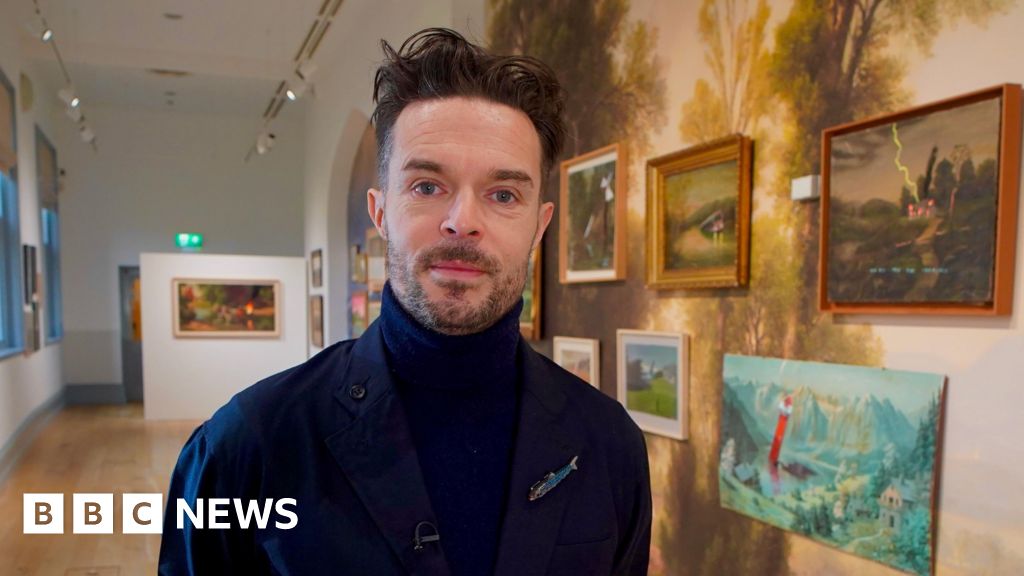
Chris Page Ireland correspondent, BBC News
 BBC
BBC

Oliver Jeffers Disasters and Interventions is being exhibited at the Naughton Gallery at Queen’s University
The artist and author Oliver Jeffers is holding his first exhibition in his home city of Belfast for more than 20 years.
In that time, he has become one of the biggest figures in children’s literature – with his books selling eighteen million copies.
Stories such as Lost and Found, How to Catch a Star, and Here We Are have delighted, intrigued and fascinated families around the world.
The collection of works called Disasters and Interventions transforms calmness into calamity.
Jeffers has added his own images into old pictures – with the result that tranquil landscapes become catastrophic.
An oil tanker is upended in a lake, leaving a slick in the previously pristine water.
An airship crashes into the ocean with three golfers apparently oblivious as they hole out on a seaside course.
An isolated house on a hill is struck by lightning.
When I ask the artist where the idea “came out of”, he replies: “Literally – the bin.”
 Getty Images
Oliver Jeffers’ project started with a “discarded print” in Chinatown, New York
The project began when he saw a “discarded old print” in Chinatown in New York.
“I thought it looked amazing, even though it was decayed and dilapidated.
“I thought – I’ll bring it back to the studio and paint something into it.
“That became a kind of game that I played with myself.
“After a while, I realise that I seemed to be painting disaster scenes into all of these.”
He said the outcome “had to be funny, but not in a laugh-out-loud kind of way – more of a smile in the mind”.
Reflecting on how the works came together over 14 years, he said it was “very reactionary” and speaks of “instability in the world”.
“The idea is that it provokes thought – even though there’s a lot of tragedy and disaster, it doesn’t mean it isn’t a good time to be alive.”
The artist has recently returned to live in Northern Ireland, after living in the US for some years, and said he “absolutely loves being back”.
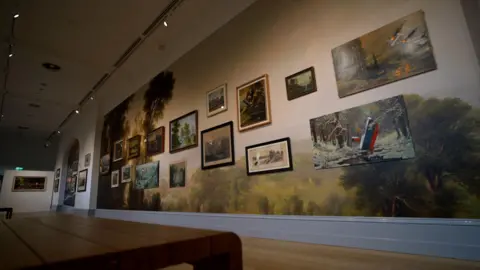
The collection of works is called “Disasters and Interventions”
When he was growing up in Belfast, he said he knew he wanted to be an artist “pretty early on”.
“I think I was 15 when a careers’ adviser who came into my school said art college might be an option to me.
“It was the first time I realised – wow, you can have a job drawing pictures.”
The books came “way later on”.
“I realised that so much of the art I was making was about storytelling – and telling stories comes so naturally in this part of the world.
“So much of it is empathy, and understanding your audience.”
He explained: “I still remember my world view as a child.
“All kids intuitively pick up crayons, make marks, play make believe.
“We are innately born with that ability – it’s just a matter of retaining it as you grow older.
“It’s not that I discovered something – I re-remembered something.”
‘Being naturally yourself’
Asked how he reflected on the 21 years since his first book, How to Catch a Star, was published – Jeffers said: “It can be a bit overwhelming to realise the role these books have played in people’s lives.
“I try not to look backwards, and keep myself interested in moving forwards – but it does feel a bit surreal.
“I think art is one of the few industries where the more selfish you are, the more generous you are.
“If you’re trying to assume what people want and then deliver that, you end up with a repeat of the last big thing, which is never what the next big thing will be.
“Being naturally yourself is what works.”
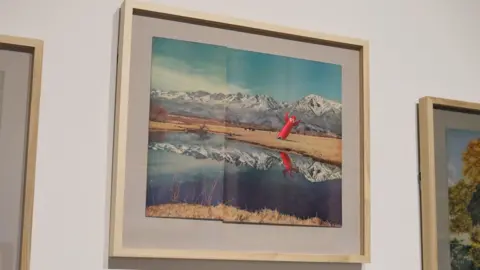
The red rocket which appeared in How to Catch a Star can be seen in the work called Down on the Range
Visitors to the exhibition at the Naughton Gallery at Queen’s University will spot a familiar red rocket – which first appeared in How to Catch a Star.
It’s been painted into a picture from a magazine, in a work called Down on the Range.
The rocket has crashed beside a lake, with snow-dusted mountains and a few buffalo in the background.
The reflection of the spaceship in the still water is particularly striking.
Jeffers explained that some of the approach is about putting “bright colours on top of old, dull, worn-away colours”.
“Because of how blue and white and yellow it is – something bright, fluorescent and red would work.
“So then my mind automatically goes to the rocket.
“The joy and the fun was in painting the rocket and making the light source was true and correct so it looked like it was really in the scene – and then playing about with the reflection as well.”
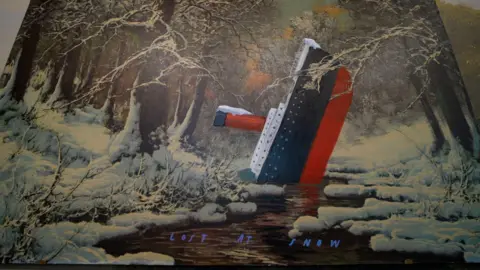
Lost At Snow depicts the Titanic which was built in Belfast
Several works feature the most famous, and disastrous, ship to be built in Belfast.
But instead of disappearing beneath the Atlantic waves – the Titanic is depicted sinking in a desert, a glen, and other non-maritime landscapes.
Images associated with what Jeffers described as “a city of storytellers” are prominent in the exhibition.
Since moving back to Northern Ireland, Jeffers has particularly valued the “slowness and sense of community”.
“We don’t realise the importance of it,” he says.
“It’s only with coming back, having experienced the rat race at full tilt elsewhere, that I realise this is what I want, for my family and myself.
“There are a lot of really talented artists and storytellers coming through the ranks in Northern Ireland – it’s good to be here and encourage people.”
Jeffers said he planned to continue to “enjoy the work I make, and let it come naturally”.
“That will involve more books, more art, and staying still and observing the world and those around me,” he added.