Just as the clay tablet was the signature medium of ancient Mesopotamia, and just as early modern Europe was defined by the development and proliferation of the printed book, there is a case to be made that our particular civilisational interlude, with its total media saturation and its incipient return to a state of post-literate orality, might be characterised by its own signature form of communication: videos of guys talking on podcasts. Some of the dumbest and most objectionable stuff I’ve ever encountered – the precise material, in other words, by which the current media environment is defined – I have encountered in precisely this form.
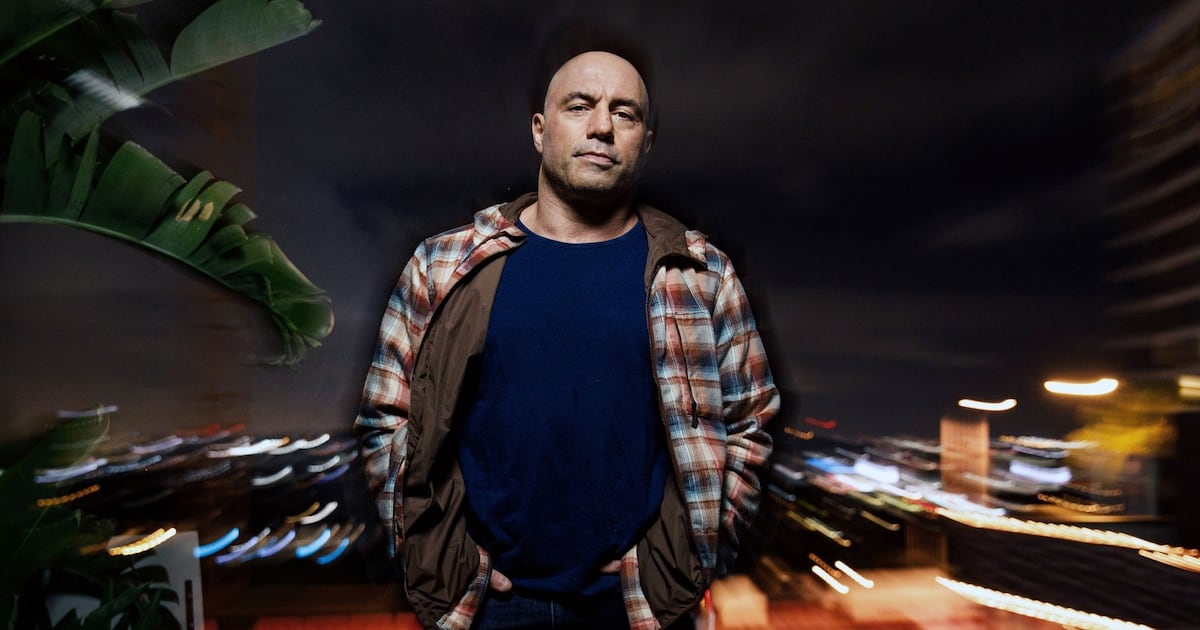
For instance, I have just this moment rewatched, to reassure myself I did not imagine it the first time, a snippet of a video on YouTube in which Joe Rogan, the host of The Joe Rogan Experience (the world’s most popular podcast), expounds on the prospect that Jesus Christ might return to the world in the form of an artificial intelligence. Talking about the convergence of quantum computing and AI, Rogan lays out a vision of the future that combines Christian eschatology and AI boosterism.
“Jesus was born out of a virgin mother,” he begins. “And what is more virgin than a computer? So if you’re going to get the most brilliant, loving, powerful person that gives us advice, and can show us how to live, how to be in sync with God – who better than artificial intelligence to do that? Even if Jesus was a physical person, you don’t think He could return as artificial intelligence? Artificial intelligence could absolutely return as Jesus. And not just return as Jesus, but return as Jesus with all the powers of Jesus. It reads your mind, and it loves you, and it doesn’t care if you kill it, because it’s just going to go be with God again.”
As so often with this sort of thing, I find myself suspended between, on one hand, the sense that this is too stupid to spend any time at all thinking about and, on the other, the sense that, precisely because of its stupidity, something of political and cultural significance lurks within it. And given my contractual obligation to produce a column here, I’m inclined to come down more or less firmly on the side of the latter. There is, as they say, a lot to unpack here.
Because as ludicrous as this monologue seems, and in fact is, there are multiple contexts in play. Rogan – previously known as a vocal atheist, but in recent years increasingly Christ-curious – is channelling a notion, or cluster of notions, that has been current among technologists for many years now.
Geoffrey Hinton, the Nobel-laureate computer scientist whose pioneering work on neural networks gave rise to a reputation as “the Godfather of AI”, has spoken of the “godlike” capacities of the technology. Ray Kurzweil, the influential futurist and director of engineering at Google, has written bestselling books about a quasi-religious idea known as the technological singularity, a coming convergence of human and machine intelligence which he believes will mean the end of human life as we know it. And Elon Musk has likened the unchecked acceleration of AI to the creation of a “digital God.”
Peter Thiel, who founded PayPal with Musk – and who went on to co-found the surveillance tech firm Palantir – has recently been making all kinds of apocalyptic public pronouncements, revealing a long-term obsession with the coming of the Antichrist. He recently delivered four sold-out talks on the topic in San Francisco, entitled “The Antichrist: A Four-Part Lecture Series.” (He seems to believe that the Antichrist might in fact be Greta Thunberg.)
This comes amid a recent turn towards Christianity among a growing cohort of right-leaning prominent Silicon Valley figures. Thiel’s lecture series was organised by a non-profit group called the Acts 17 collective, founded by married couple Trae and Michelle Stephens. (Trae Stephens is a co-founder of Anduril, a manufacturer of autonomous weapons systems. The Acts in Acts 17 stands for “Acknowledging Christ in Technology and Society.” It feels basically futile to point out that acknowledging Christ would mean acknowledging that the basic spirit of his whole moral enterprise ran strongly counter to getting rich off autonomous weapons systems, so I won’t bother.)
Rogan’s extremely bizarre – and, admittedly, extremely goofy – remarks should be taken in the context of this recent turn towards Christianity, and of a long-established tendency among AI’s most enthusiastic proponents to think of it in quasi-religious terms. But they also seem to me to to be an expression, if presumably an unconscious one, of a particular kind of capitalist idolatry. Within the logic of this messianic prophesy, Christ will return in the form of an AI owned by some or other large corporation. If the first coming was the word made flesh, this second coming will be a kind of a capitalist apotheosis: the market made god.
It’s worth pointing out here that artificial general intelligence or superintelligence – meaning a fully sentient AI that surpasses human cognition in every respect, and whose advent will constitute an evolutionary leap – is a prospect hardly more plausible than the second coming itself. It’s a chimera, a seductive but basically empty concept, whose value lies in its usefulness to the AI hypemen who require ever vaster amounts of capital investment to stay in the race. It’s an idea that has gripped not just an entire industry, but an entire economy: the global stock market is now massively over-leveraged on a handful of AI companies with no apparent path to profitability, all of which are predicated on building some version of this chimera.
[ Could we be on the verge of a techlash?Opens in new window ]
Like the Christian rapture, it’s a conviction that arouses and justifies all kinds of madness in this mortal world. Rogan’s projection, in other words, is just a more lurid version of something the prophets of AI have been telling us constantly for years now: that the second coming is near at hand. But if there is an apocalyptic endpoint on the horizon, it will come not in the form of a technological singularity, or of a holy ghost in the machine, but in the collapse of an economy increasingly held together by belief in a powerful and pervasive fantasy.