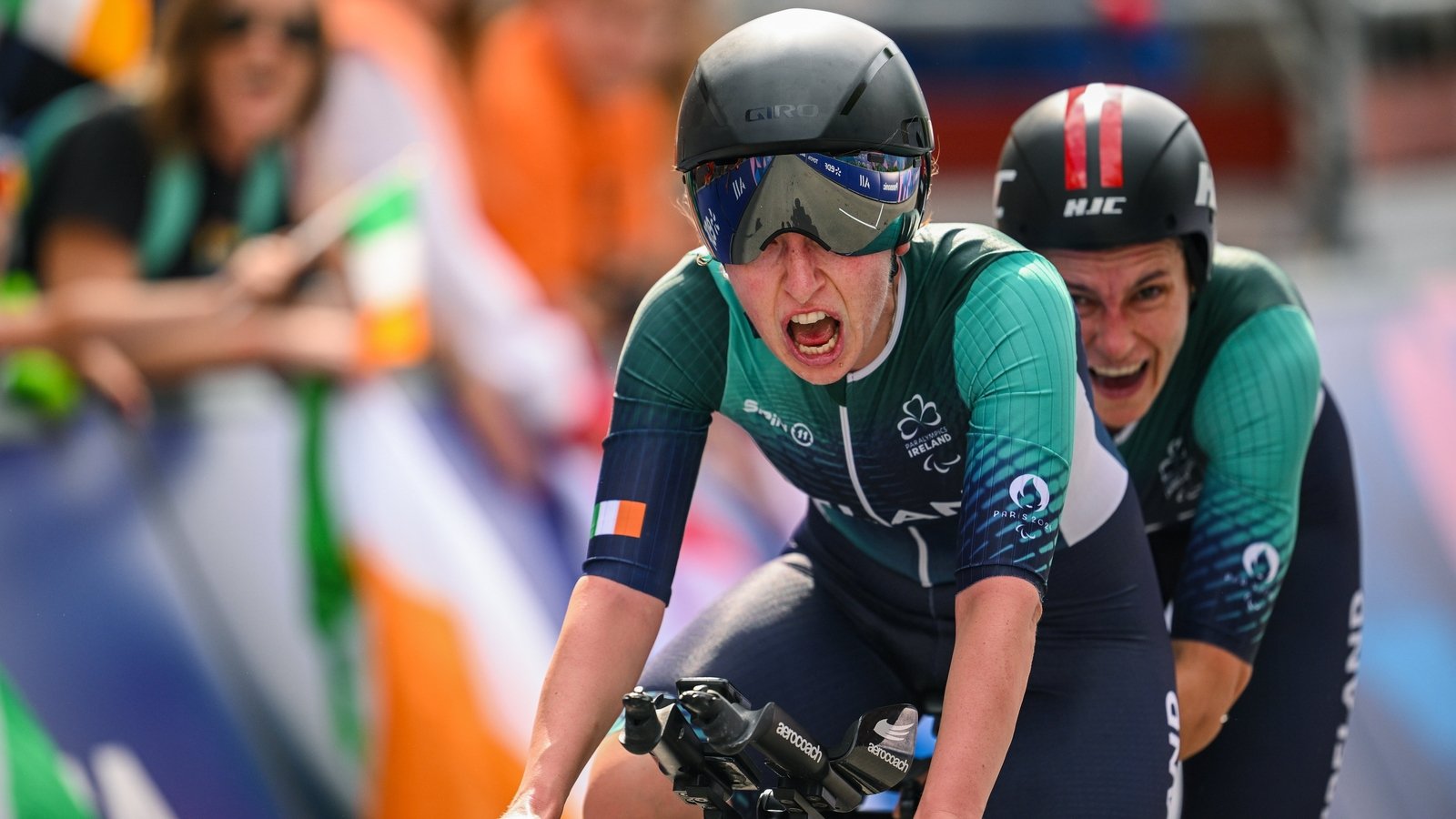
Less than a week after returning from the Paris Paralympics, her debut Games, wheelchair racer Shauna Bocquet was one of just two Irish athletes in Brussels for Diamond League action.
The other was global superstar Rhasidat Adeleke, who capped off a memorable season with a third-place finish in the women’s 400m.
On a chilly night in the Belgian capital, Bocquet, the youngest competitor in the field in the T54 800m, finished second behind hometown favourite Lea Bayekula.
With the exploits of Katie-George Dunlevy (cycling), Róisín Ní Ríain (swimming) and Orla Comerford (athletics) propelling Ireland to six medals in Paris and Team Ireland in general enjoying more time in the spotlight than ever before, the failure by sections of the media to carry Bocquet’s performance rankled somewhat with Paralympics Ireland CEO Stephen McNamara.
In an Irish Times ‘Letter to the Editor’ he contrasted the extensive coverage of Adeleke as a further reminder of the struggle for recognition, concluding with the line: ‘Two legs good, three wheels bad?’
“We became a little bit braver,” he says now of his public action, acknowledging the fact that stretched newsroom resources make it a more challenging task. “It was written in such a way that it wasn’t terribly serious, but it tried to make a serious point. The reality is we’ve actually seen quite a bit of pick up after that.”
Since Paris, Irish athletes have added 17 major medals at both World and European level, with the aforementioned Dunlevy, Ní Ríain and Comerford accounting for all but six of those.
There was a time when the general public’s knowledge of Paralympic sport was based largely on sprint sensation Jason Smyth and his incredible success, but the winds of change have been blowing with greater gusto since Paris.
After a decade with the IRFU, McNamara has plenty of experience with extracting media coverage where it may be lacking.
The professional game certainly doesn’t struggle for column inches, but the AIL, and in particular the women’s game, were areas of focus. The Women’s Grand Slam of 2014 was a tipping point and reinforced his view that PR offensives can only truly work hand-in-hand with sporting success.
“We (IRFU) knew we wanted to try and get the women more coverage, but we realised that they had to achieve that sporting success to merit it as well,” he explains.
“So the reality of what the Para athletes have done this year is that they’ve continued to actually be newsworthy. When Katie-George picks up the paper or goes online and she sees herself there, the chances are it’s not because we push that in, it’s because what she’s done has merited that.”
Using Dunlevy (below) is the obvious example.
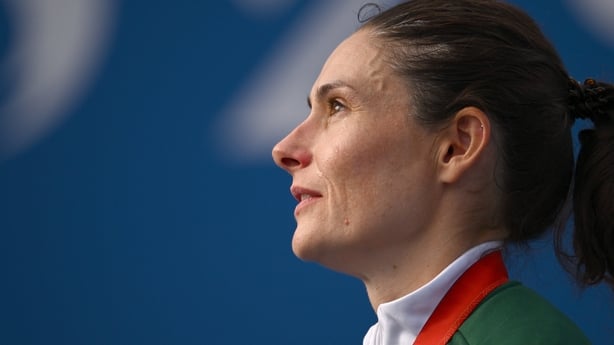
The 44-year-old is Ireland’s most successful Paralympian with a haul of four gold, six silver and three bronze medals to her name.
You can also throw 17 World Championship medals into the mix. Back in August she and Linda Kelly successfully defended both their time trial and road race titles at the World Championships in Belgium and the prospect of a fifth Games is a strong motivating factor to keep going.
“I think in the back of your mind, you’re thinking about it,” she says when asked about the 2028 Games. “We’re kind of like looking short term, but of course, the ultimate goal for both of us is to go to Los Angeles and hopefully get some medals.”
Having first competed for Ireland in 2011 – she was a Paralympic rower with GB before switching allegiance – she has seen the positive evolution of the sport.
The growing media coverage has been welcomed, but she believes there is still some way for it to go, with a significant lull between Paralympic cycles.
Dunlevy, who was diagnosed with retinitis pigmentosa aged 11, a genetic condition that has caused her eyesight to continually get worse, insists the importance of giving impaired children role models to aspire to is crucial.
“We are elite athletes and we go through the same as the Olympic athletes, the trials and tribulations when it comes to injuries and illnesses, but we have more obstacles to overcome while competing at an elite level,” she says.
“People need to see it because it is like amazing. Sports should be for everyone.
“When I was a child, I felt like I was worthless. If I had someone I could see on TV or, if I saw visually impaired people like me achieving things in sport, it would have made such a difference to me. It would just really have inspired me.”
The situation is improving, but there is still the sense that a Para athlete has to achieve more to receive equal recognition.
“An Olympic and a Paralympic medal, for some reason, are not looked at the same,” she says, adding that awards ceremonies over the years have borne this out. The fact that she and Kelly claimed the 2024 RTÉ Team of the Year, the first impaired athletes to do so, is a further nod to progress.
Two-time Paralympic archer Kerrie Leonard – pictured below – also sees green shoots.
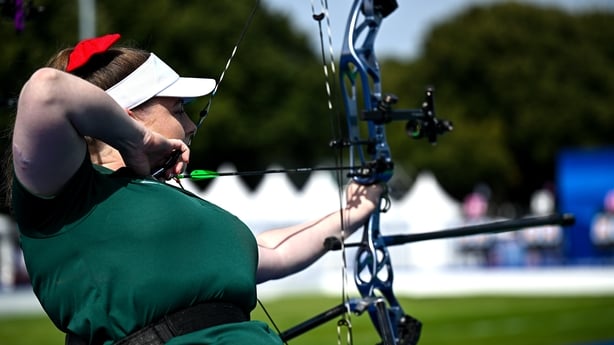
Having retired following the Paris Games, she has thrown herself into the International Paralympic Committee (IPC’s) new four-year professional training course.
The Meath woman feels small measures would make a big difference. Ellen Keane was put in front of a wider audience in 2022 in RTÉ’s Dancing With the Stars, and allowing the general public more exposure to impairments shines a greater light on Para sort.
“We don’t incorporate personalities and disabilities into mainstream cultural moments to reduce the stigma,” she says.
“There’s no one in the lineup (for 2026) and don’t incorporate personalities and disabilities into mainstream cultural moments.
“That would be a very simple and authentic way of us as a society showcasing how we want to incorporate every member of society and break down the stigma around disability.”
Retirement simply isn’t on Dunlevy’s radar, with no let-up in the training schedule for Christmas and New Year.
The six-day-a-week training schedule won’t be impacted with the World Championships in mind next year, Alabama for the road race and Netherlands for the track event.
Dunlevy and Kelly will fund their own foreign training camp in March, an escape from the early year slog and a chance to refamiliarise themselves as a team on the bike.
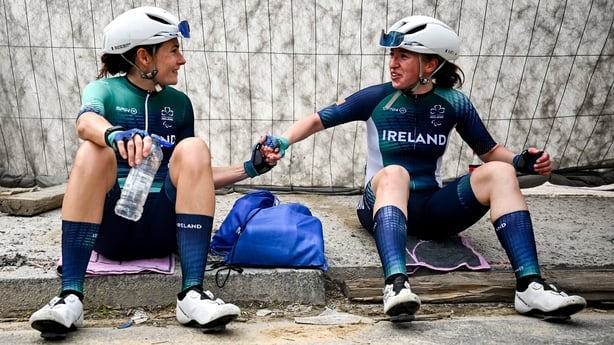
Dunlevy and Kelly enjoy a close working relationship
“The more tandem time we can get together as well, the better. When we won the World Championships last year, we put a lot of time in together beforehand and it can make the difference.”
Building their winning bond means living in each other’s pockets at times, the behind-the-scenes work that has lead to incredible success on the biggest of days.
“We’re good friends, but we’re exhausted at times. I do find that we can sometimes snap at each other. It’s the nature of what we’re doing. We’re just so driven as well as individuals. We want to make sure that every session is done properly.”