Scientists have detected a narrow structure of hot plasma extending from the Local Hot Bubble surrounding the Sun toward distant regions of the galaxy. The newly observed feature, described as a possible interstellar tunnel, may represent a rare corridor in the interstellar medium, potentially shaped by ancient supernova explosions.
The findings come from a large-scale analysis of the soft X-ray background using data from the eROSITA telescope, part of the Spectrum-Roentgen-Gamma (SRG) mission. This space-based observatory scanned the sky in high detail, revealing features in the hot, low-density gas that surrounds the Solar System and neighbouring regions of the Milky Way.
A recent peer-reviewed study published in Astronomy & Astrophysics outlines the discovery of multiple tunnel-like plasma structures within the Local Hot Bubble (LHB). These narrow regions, aligned toward constellations such as Centaurus and Canis Major, appear to act as low-density pathways connecting the Sun’s environment with more distant parts of the galaxy.
Researchers involved in the analysis used over 2,000 spatial bins to build a high-resolution map of the western Galactic hemisphere. The resulting plasma distribution supports older theories that supernova events not only cleared large bubbles of space but may have created extended routes through the hot interstellar medium.
X-ray observations reveal plasma structures near the Sun
The study was led by a team at the Max Planck Institute for Extraterrestrial Physics, who used data from eROSITA’s first all-sky survey (eRASS1), conducted during a period of low solar activity. This phase helped reduce interference from solar wind charge exchange, a known contaminant in X-ray background studies.
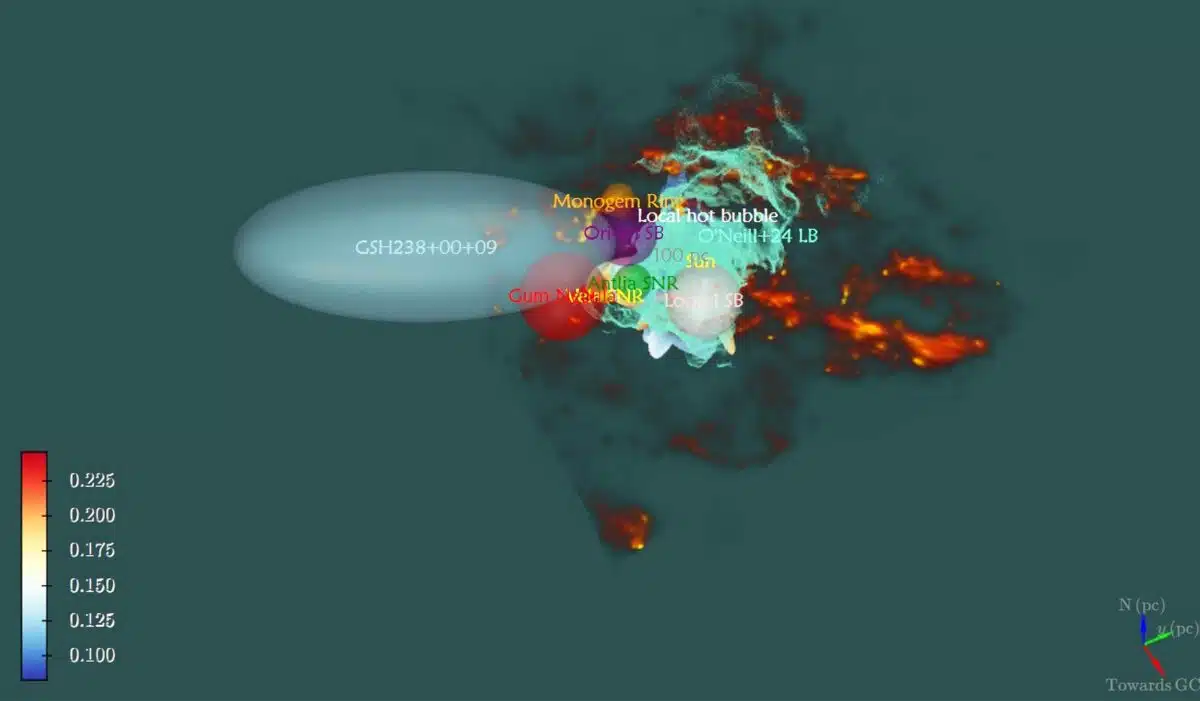 3D map of the Milky Way’s Local Hot Bubble (LHB) created from eROSITA data reveals a low-density region around the solar system, heated by ancient supernovas. The bubble shows temperature gradients and an interstellar “tunnel” toward Centaurus, likely formed by young stars’ winds. This bubble may connect to other superbubbles, shaping the Milky Way’s structure. Credit: Max Planck Institute
The eROSITA instrument, operating in the soft X-ray band, is designed to detect diffuse emissions from hot gas and interstellar plasma. By combining this with historical data from the ROSAT satellite and integrating neutral hydrogen and dust maps from HI4PI and Planck, the researchers were able to create a detailed three-dimensional model of the LHB and its extensions.
One of the most significant results of the study is the detection of elongated low-density structures that appear to be filled with hot plasma. These regions are characterised by low dust content and enhanced X-ray brightness. In several directions, including toward Centaurus and Canis Major, the data indicate the presence of extended cavities, which the authors interpret as tunnels carved into the surrounding interstellar gas.
The news report on Earth.com highlighted that such a discovery may confirm older theories about hidden structures in space. These observations support models that suggest interstellar plasma pathways are shaped by large-scale feedback from stellar evolution.
The team explains in the journal article that the emission measure maps of the LHB show a strong anti-correlation with local dust, reinforcing the interpretation of large-scale structures with coherent geometry. They also note that the average thermal pressure within the bubble is lower than typical values for isolated supernova remnants, which may suggest the bubble is open in certain directions, especially at higher Galactic latitudes.
Galactic environment shaped by ancient supernovae
The Local Hot Bubble is a well-documented feature of the Sun’s neighbourhood. It spans roughly 300 light-years and is thought to have been formed by multiple supernova events that occurred between 10 and 20 million years ago. These explosions swept away cold interstellar gas, leaving behind a cavity of hot plasma that can be traced through soft X-ray observations.
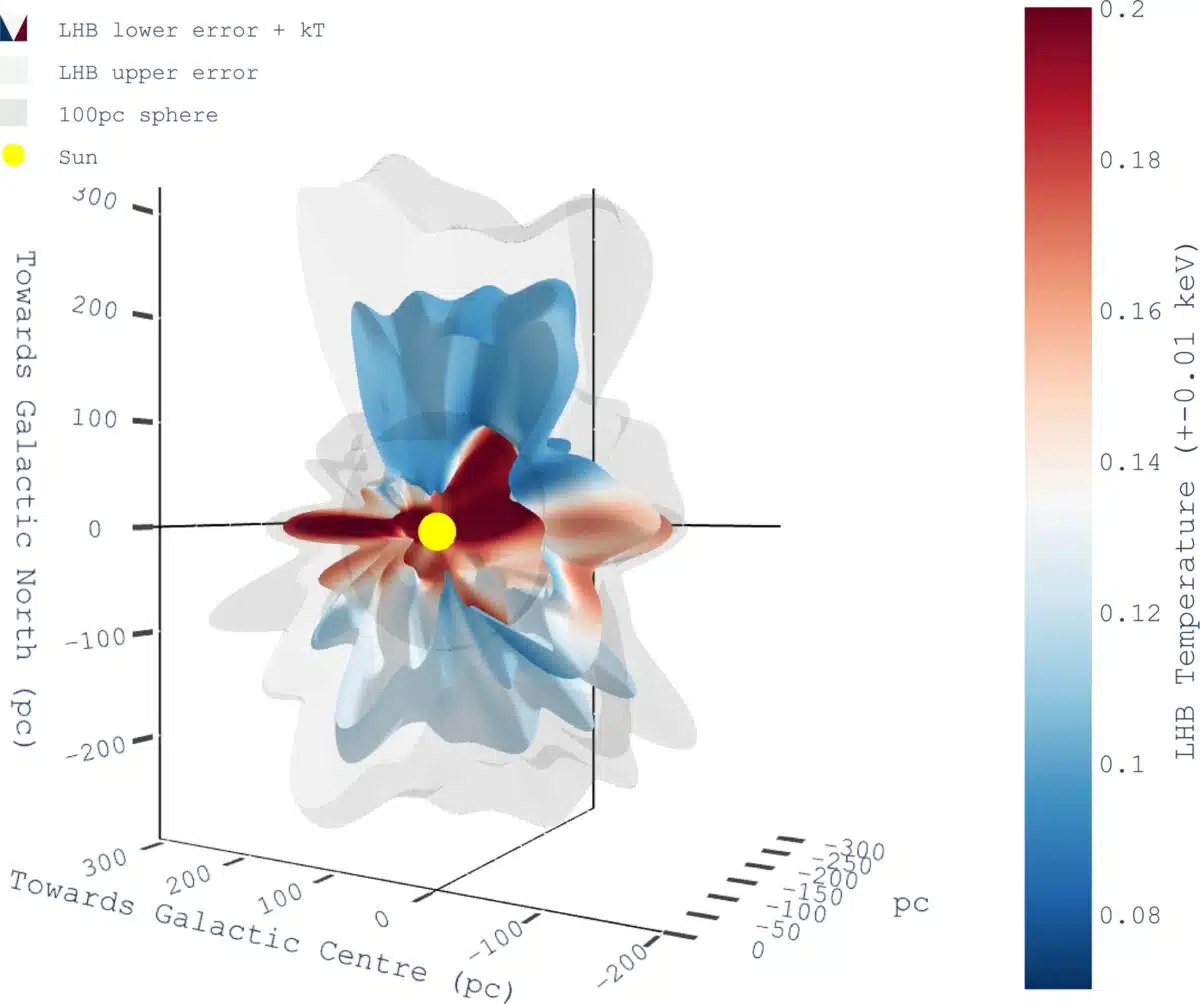 Three-dimensional structure of the LHB in the western Galactic hemisphere assuming a constant density of 4 × 10⁻³ cm−3. The inner (opaque, coloured) and the outer (grey, translucent) surfaces show the ±1 σ uncertainty bounds of the distance under the constant ne assumption. We note that the two surfaces only reflect the uncertainty in the spectral fitting but not in ne. We note that kTLHB is also color-coded on the inner surface. A sphere of 100 pc radius is shown around the Sun (yellow) as a ruler. Credit: Astronomy & Astrophysics
In earlier decades, scientists proposed that supernova-driven cavities could be interconnected, forming a network of superbubbles. However, definitive evidence remained limited until high-resolution X-ray mapping tools like eROSITA became available. The new analysis provides significant support for this model.
A key result of the study is the detection of a north-south temperature gradient within the Local Hot Bubble. The researchers found that the southern Galactic hemisphere has a higher mean plasma temperature (122 eV) compared to the northern hemisphere (101 eV). This dichotomy, identified through spectral analysis, suggests that the LHB is not uniform, and may have been shaped by asymmetrical heating events or directional outflows.
By comparing these temperature variations with dust and gas measurements, the study improves upon earlier models that used only broadband count ratios. As shown in work by Cambridge University Press, mapping such interstellar structures requires resolving multiple overlapping emissions—an approach now made more feasible by eROSITA’s spectral resolution and sky coverage.
Interstellar tunnels and broader galactic mapping
The tunnel-like cavities resemble long-theorised interstellar plasma channels—corridors of hot gas linking different regions of the galaxy. The study’s results indicate that these paths are not isolated features but part of a larger structure embedded within the hot interstellar medium. The geometry and spectral properties of these structures support the idea that they were created by ancient stellar winds or supernova-driven shock fronts.
With the Solar System currently situated near the centre of the Local Hot Bubble, scientists are using this unique vantage point to investigate how interstellar tunnels may transport cosmic rays, influence gas flows, and shape dust dynamics on a galactic scale.
The researchers also report that regions with unusually low thermal pressure might represent openings in the LHB, allowing material to flow between cavities. This supports the interpretation of a connected plasma network, rather than isolated bubbles.