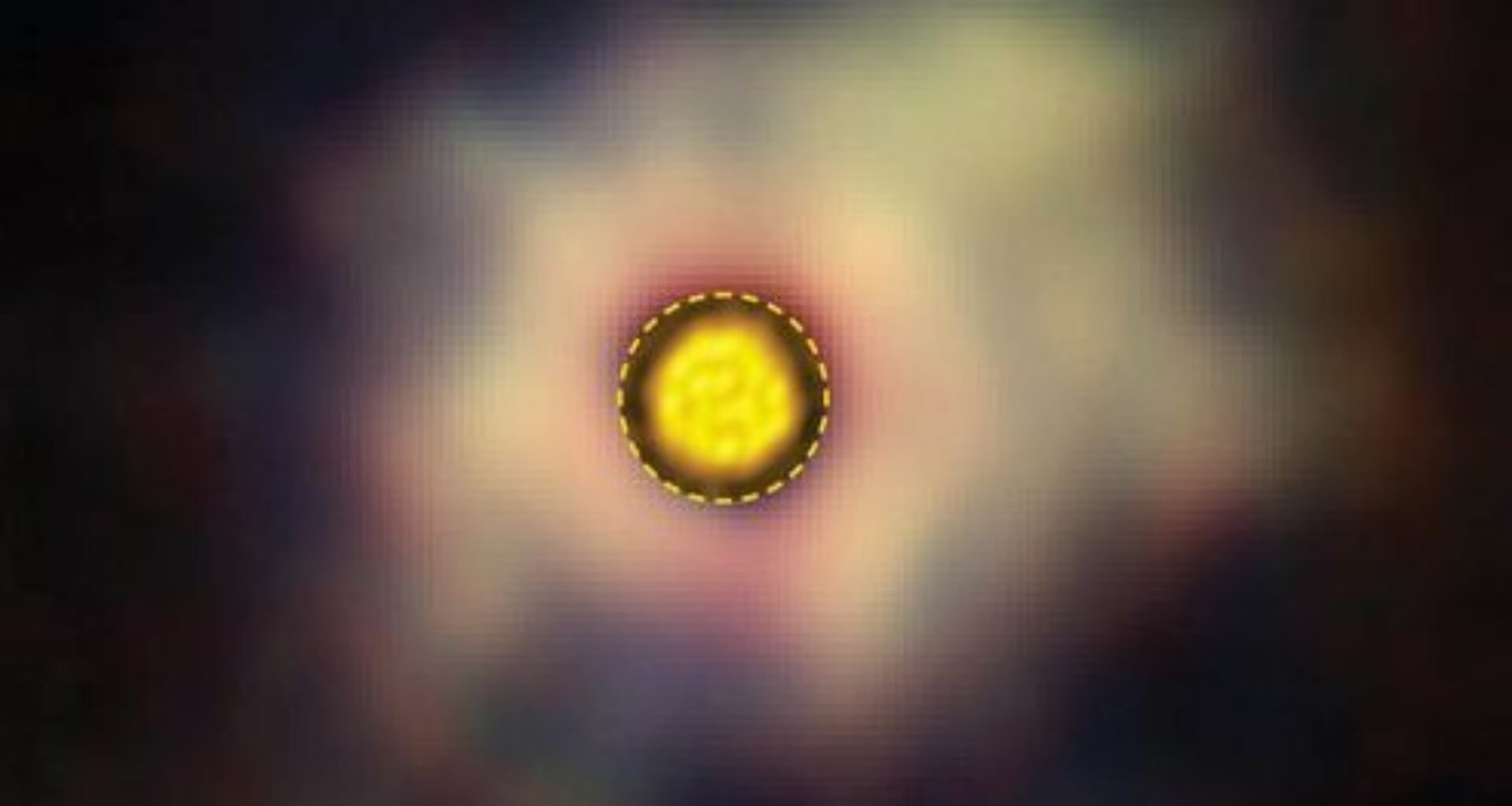
For decades, scientists thought dust helped aging stars push gas into space – but a nearby star shows that may not be true.
Astronomers closely examined the material flowing from R Doradus, a Sun-like star in its late-life asymptotic giant branch phase.

Few stars at this stage of life are close enough to be examined carefully, which is why researchers focused on this one. R. Doradus is located 180 light-years – or about 1.1 quadrillion miles – away.
The work was led by Theo Khouri, an astronomer at Chalmers University of Technology (Chalmers) in Gothenburg.
His research follows how old stars shed gas – material that later becomes the raw feedstock for new planets.
Why stellar winds matter
Giant stars lose mass in stellar wind, a steady flow of gas leaving a star, long before they fade away.
That outflow carries carbon, oxygen, and nitrogen outward, and later stars and planets can reuse those atoms.
If astronomers misread what launches the wind, they also misread how fast galaxies get chemically enriched.
For decades, many models assumed radiation pressure, force from light pushing on matter, could shove newborn dust outward.
As grains accelerate, they collide with nearby gas and drag it along, which builds a wider wind.
That picture works well for some carbon-rich stars, but oxygen-rich giants like R Doradus have been harder to explain.
Observing stardust in color
The team used polarized light, light waves lined up in one direction, to isolate faint dust close to the star.
In November of 2017, the experts observed the dust in visible colors with the SPHERE instrument on the Very Large Telescope at Paranal, Chile.
The years that followed were spent carefully analyzing the data and testing whether it truly supported long-standing theories.
Because the technique separates scattered starlight from glare, researchers can measure dust where the wind starts accelerating.
Color patterns and grain sizes
Subtle changes across wavelengths revealed how dust reflected light, and the color pattern pointed to grain sizes.
The scattered signal matched mostly silicates, minerals built from silicon and oxygen, and also alumina dust near the star.
Those compositions fit what oxygen-rich giants can condense, but composition alone cannot reveal whether the grains can escape.
Testing stardust with simulations
The team used radiative transfer models – mathematical simulations of how light moves through dust and gas – to link the telescope images to the underlying physics.
The experts tracked photon scattering and absorption around the star, and then predicted polarization patterns for different grain sizes.
Matching those patterns to the telescope data provided a strict limit on how much push starlight can deliver.
Small grains can’t drive stellar wind
Dust grains smaller than the star’s light wavelength don’t catch enough light to push gas outward.
When the team calculated the forces, they found gravity still held the gas in place – meaning these tiny grains can’t drive the stellar wind.
“We thought we had a good idea of how the process worked. It turns out we were wrong. For us as scientists, that’s the most exciting result,” said Khouri.
The team compared dust demands to a gas-to-dust ratio in the envelope, meaning how much gas exists for each dust mass.
Even if every available silicon or aluminum atom locked into solids, the models still fell short of driving the wind.
When iron-rich dust heats
Iron-rich grains absorb more starlight, which raises the force, but absorption also raises their temperature.
At high temperatures, sublimation – solid material turning directly into gas – removes those grains before they can accelerate gas.
That tradeoff leaves iron-bearing dust as a poor driver near R Doradus, even if it could help farther out.
Bubbles and pulses push gas
Churning convection, hot material rising and cooler material sinking, can lift gas into cooler layers above the star’s surface.
Rhythmic swelling of the star can also send shocks outward, and shock-compressed gas can start flowing away.
Those processes may hand dust an easier job by lifting gas where new grains can form and catch light.
Stars with repeated cycles
R Doradus brightens and dims on repeating cycles, so the wind launch zone may look different month to month.
The star pulsates – regularly swelling and shrinking – with cycles of roughly 175 and 332 days.
If dust formation spikes during certain phases, a snapshot from one observing season may miss short-lived bursts.
Stardust still plays a role
Dust does not need to drive the whole wind to matter, because grains can cool gas and block heat.
In condensation, gas molecules sticking together into solids, alumina can seed silicates that grow as they drift outward.
If another mechanism first lifts gas, even modest dust pressure could help set the final mass-loss rate.
Turning starlight into wind
Stars like the Sun eventually shed outer layers and leave a white dwarf, the dense core left after a star sheds layers.
Before that quiet end, many such stars pass through the asymptotic giant branch phase and lose huge amounts of gas.
That uncertainty forces models to treat the Sun’s distant future cautiously, because its own wind will shape the final planetary system.
Taken together, the observations and models show that tiny dust around R Doradus cannot turn starlight into a strong wind.
Future campaigns across many pulsation phases should test when other forces dominate, and whether dust helps more in faster-losing giants.
The study is published in the journal Astronomy & Astrophysics.
Image Credit: ESO/T. Schirmer/T. Khouri; ALMA (ESO/NAOJ/NRAO)
—–
Like what you read? Subscribe to our newsletter for engaging articles, exclusive content, and the latest updates.
Check us out on EarthSnap, a free app brought to you by Eric Ralls and Earth.com.
—–