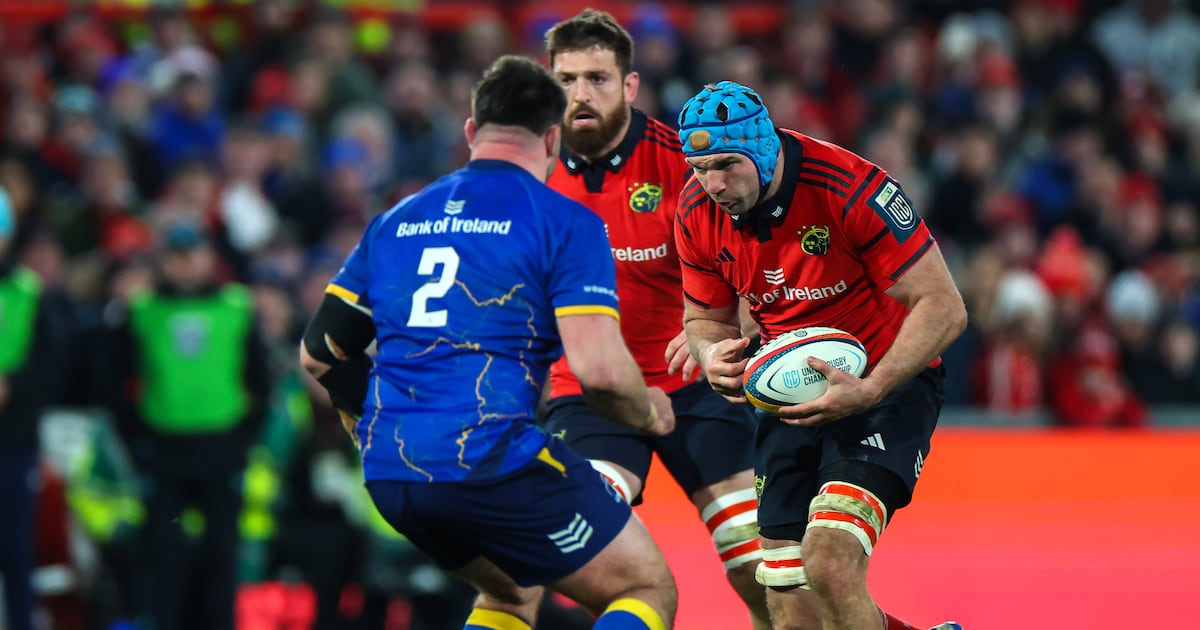
“Let’s be honest about it, the style of the game has gone backwards.”
Tadhg Beirne was in no mood to hold back following Munster’s Saturday night defeat to Leinster. Frustration abounded at the result alone, sure. There was also a sense that Munster’s skipper was annoyed at losing to a team that play as Leinster do. A more competitive edge has reignited this rivalry in recent times. Now, a rugby culture war appears to be taking hold.
It’s been well documented how, under Jacques Nienaber, the URC champions’ focus on being a disruptive force as much as a creative entity. It can be effective. In Thomond Park on Saturday, Joe McCarthy ruined a few mauls, Caelan Doris a handful of breakdowns. The word “shitfight” has become part of the Leinster’s lexicon.
By contrast, Beirne and Munster see themselves as fighting the good fight. Attack coach Mike Prendergast has previously lamented the law tweaks that have led to kick-heavy game plans across the sport. His captain clearly agrees. “If we’re being serious, teams are just kicking the ball,” said Beirne.
“Why? Because it’s a 50-50 chance of getting the ball back. Teams are going to set-pieces more because if you go up for a 50-50 in the air and you get a knock on, you get a scrum. And if you have a good scrum, you can get a penalty into the corner.
“It’s just becoming a set-piece and kicking game with the way they’ve changed the rules. You see teams kicking more and more and I think it’s just going to continue going that way unless they decide to do something about it.
“You want a bit more flow to the game, personally.”
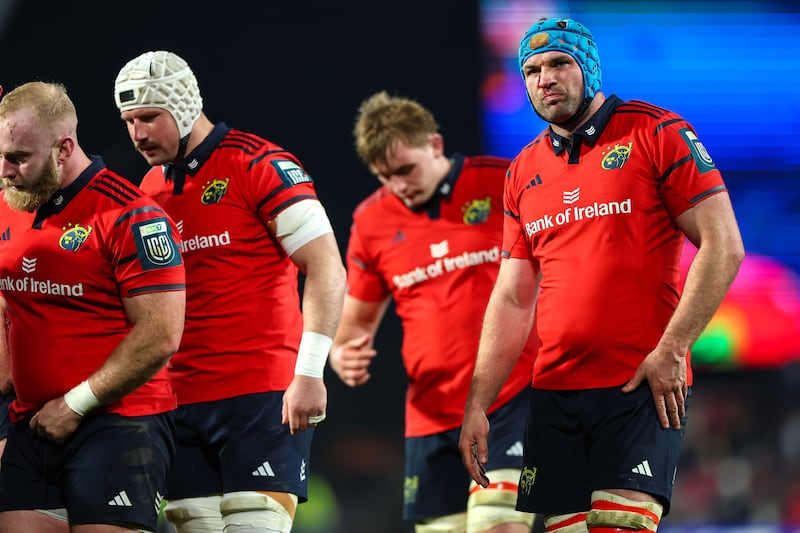 Munster’s Tadhg Beirne. Photograph: Andrew Conan/Inpho
Leinster kicked 24 times on Saturday, Munster 20. The visitors certainly played with less of the ball, carrying 86 times compared to 138 Munster carries. After the fact, Leo Cullen was more than happy to point to the Croke Park iteration of this fixture, Munster kicking 28 times and making 82 carries to Leinster’s figures of 13 and 178. To paraphrase: “That lot are at it as well”.
Come Saturday’s rematch, in what was Irish rugby’s most high-profile game between the November internationals and the Six Nations, the two sides crossed for one try apiece. Leinster’s came off a maul while Munster’s opening was in part thanks to a fortuitous bounce off Rieko Ioane when he hit Beirne in a man-and-ball tackle.
This isn’t necessarily a case of pearl clutching. Plenty of analysts pine for a day when the collision didn’t dominate rugby to the extent it does now. This correspondent isn’t old enough to remember those days. The bite which accompanied much of Saturday’s interpro is to be celebrated but there has to be balance.
The last two World Cups have been won by a team which wants to be more of a destructive force than a constructive one. That ethos has seeped into Irish rugby. Still, it’s difficult to avoid the conclusion that our flagship domestic contest needs more than two tries to sustain what ultimately is an entertainment product.
Everyone involved seemed to agree, even if only implicitly. In the blue corner, after a stream of games when their attack has failed to click, Cullen doesn’t deny that he wants more creativity from his players. Pointing to how referees officiate the breakdown, he claims his hands are tied.
“When you come away here, this time of year, it’s not going to be free-flowing rugby, is it?” said Cullen post-match on Saturday. “Not with the way the game is at the moment. Players are getting done for in the side, neck rolls, it’s just a hard way to attack right now.
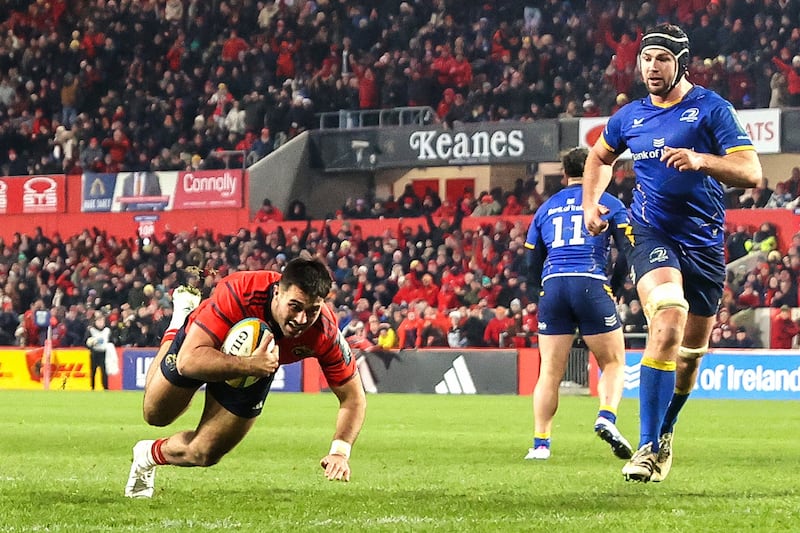 Munster’s Dan Kelly scores his sides only try of the match. Photograph: Bryan Keane/Inpho
“That’s for the lawmakers, we’re coaches trying to play the game with the rules the way they are.
“Sometimes having lots of possession doesn’t get you the positive outcome. That’s the bit where everyone is a bit confused about the game at the moment. You’re not necessarily getting the reward. Until we clean up the breakdown, it remains very, very messy, it’s not going to be attractive to play the game, is it?
“Defending is going to be very important. Playing the right areas of the field, that’s big boys rugby. There’s no point giving out about it. If that’s the way it’s going to be, that’s the way it’s going to be.”
One team thinks they’re raging against the dying of the attacking light. The other sees that as a bit naive. To be successful, both probably should come towards the middle. Munster need more tight-five grunt to earn the right to attack against teams of Leinster’s size. Cullen and co have to improve their skills and decision-making on the ball against European teams that can’t be bullied.
Whatever your blue or red persuasion, we all want to watch winning rugby while being entertained. There are many ways of putting on a show. There is beauty in the niggle. But what goes on behind the collision is also important. It appears to have been neglected in some quarters.
“The game is difficult at the moment, isn’t it?” was Cullen’s verdict. Difficult to attack, sure. At times, difficult to watch as well.