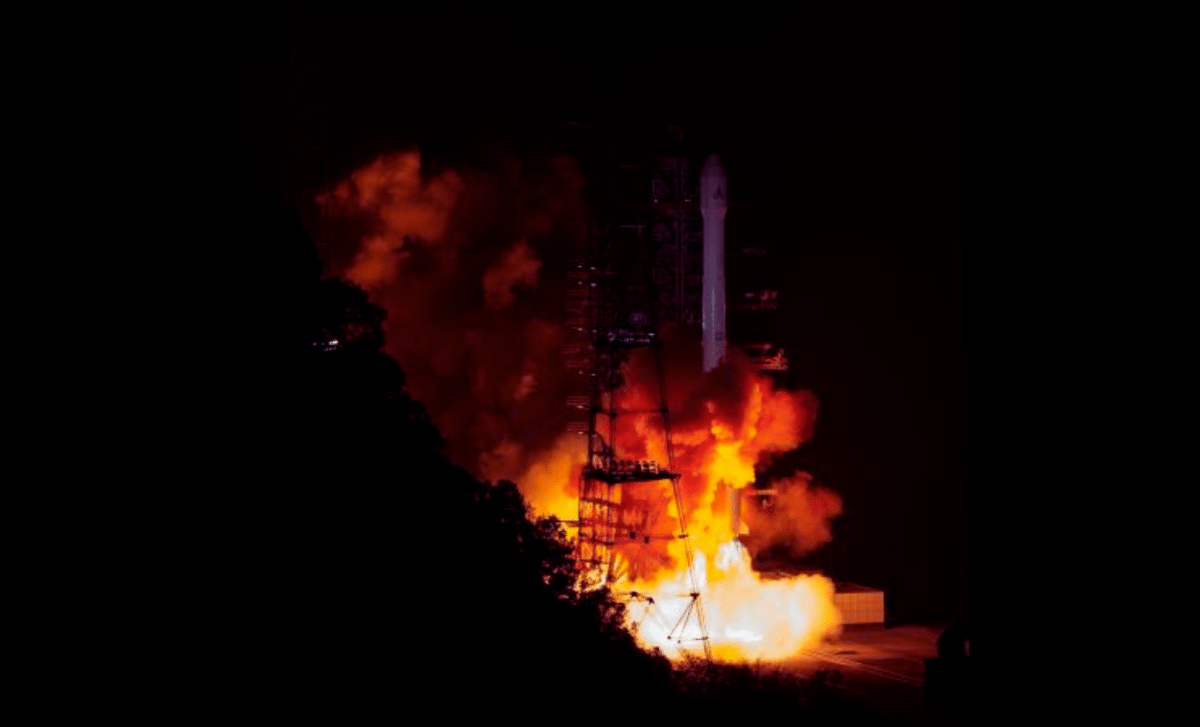
China has launched a next-generation Fengyun-4C meteorological satellite to enhance its ability to monitor extreme weather and climate systems. The launch, conducted from the Xichang Satellite Launch Center in Sichuan province, marks a significant advance in China’s growing network of space-based environmental observation systems.
Expanding China’s Space-Based Weather Network
On December 27, 2025, at 12:07 a.m. local time, a Long March-3B rocket thundered into the sky, carrying the Fengyun-4C satellite into geostationary orbit. The launch, as reported by China Daily, is part of a long-term strategy to strengthen national and regional meteorological capabilities. The new satellite will replace the aging Fengyun-4A and join the Fengyun-4B in orbit, forming a triad of high-performance observation platforms.
Cao Xiaozhong, deputy head of the China Meteorological Administration (CMA), emphasized the significance of this launch:
“The Fengyun 4C represents a comprehensive leap in observational performance,” Cao said. It offers high stability observation, high-precision remote sensing products, and high-efficiency data processing, he added.
These features enable scientists to detect and track developing storm systems with unprecedented detail, contributing directly to early warning and disaster prevention efforts.
The satellite’s instruments are designed to capture small- and medium-scale atmospheric phenomena that often trigger sudden storms, heavy rainfall, or typhoons. The Fengyun-4C’s onboard geostationary radiation imager can scan the entirety of China and its neighboring regions every five minutes, while offering rapid one-minute imaging for critical zones during severe weather events.
Advanced Technology For Real-Time Atmospheric Observation
The Fengyun-4C is equipped with six advanced payloads that meet or exceed international standards for meteorological observation. Its interferometric vertical atmospheric sounder now delivers improved spatial resolution, upgraded from 12 kilometers to just 8, allowing meteorologists to observe dynamic atmospheric changes at far greater precision.
These instruments conduct routine hourly scans and enhanced observations every 15 minutes, creating an almost continuous stream of high-resolution meteorological data. This capability plays a crucial role in numerical weather prediction models, improving typhoon forecasting and storm tracking accuracy.
The China Meteorological Administration highlighted that the satellite’s lightning monitoring capability operates in a full-domain, uninterrupted mode, providing vital data for severe convection warnings. This continuous lightning data, integrated into the CMA’s AI-powered meteorological system, MAZU, supports a new level of predictive accuracy.
A Broader Role In Monitoring Space Weather
Beyond atmospheric observation, Fengyun-4C carries sophisticated instruments for space weather monitoring, capable of detecting solar proton events and geomagnetic disturbances that can affect satellite communications, navigation systems, and even power grids on Earth. Positioned at 133 degrees east longitude, the satellite’s geostationary view extends into the central Pacific Ocean, significantly expanding China’s surveillance range over critical typhoon formation regions.
Lu Feng, chief designer of the Fengyun-4 series’ optical ground system, noted that once operational, the satellite will “serve as the first line of defense for meteorological disaster prevention.” This expanded observational coverage enables China to better monitor typhoon genesis areas in the western Pacific and to provide early warnings to both domestic and international users.