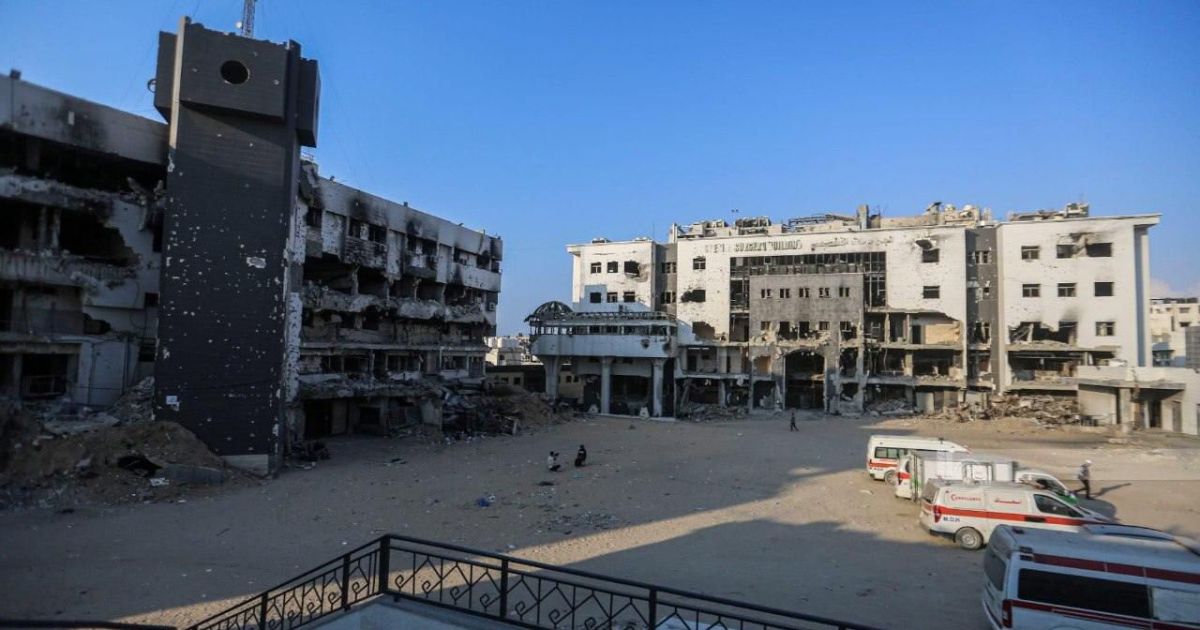
I start my shift at al-Shifa Hospital’s emergency ward at 7:30am, and I stay at the hospital for a full 24 hours. During that time, there is a constant stream of patients, from heart attacks to hypothermia to chronic diseases that have suddenly worsened due to the lack of treatment for traumatic injuries from Israeli attacks.
On a regular shift, there are four to six of us nurses, and up to three doctors – about a third of the staff that the emergency room had before the war. Like many of the other medical staff, I do not get paid for this work. The hospital cannot afford to compensate us; some colleagues occasionally receive symbolic remuneration from supporting organisations. No one has a fixed salary.
Out of 29 departments, just three are partially operational at al-Shifa. Most of the buildings in the once-sprawling medical complex are destroyed or burned. We work in three of them that have been partially restored.
Once I am done with my shift, I go back to my bombed-out home, which now has tarpaulins instead of walls. We have no heating, no electricity, and no running water, and we struggle to get adequate food because I bring no income back.
This is the reality that medical workers face across Gaza. It has been more than two months since the ceasefire came into effect, but Gaza’s hospitals still feel like battlefronts. The health sector is on the brink of collapse; it is barely functioning only because of the volunteer work of countless medical professionals and their sense of moral duty.
All across Gaza, doctors are working under immense pressure, nurses are performing tasks beyond their capacity, and patients stand in long queues waiting for unavailable medication or surgeries postponed due to equipment shortages.
Hospital occupancy rates have reached record levels, and in some departments, capacity has been exceeded many times over.
Medical teams are working in an environment lacking almost everything: essential medicines, ventilators, functioning operating rooms, and even beds. This is compounded by a severe shortage of spare parts for broken medical equipment, meaning that even a minor malfunction can halt the treatment of dozens of patients.
There are 350,000 people with chronic illnesses, the majority of whom are unable to receive their regular treatments. There are 42,000 people with life-changing injuries who require multiple surgeries and/or long-term rehabilitation, which is inaccessible in Gaza. There are more than 16,000 patients who require urgent medical evacuation; nearly 1,100 have died while waiting to be allowed to leave for treatment.
Meanwhile, Israel continues to bomb civilians and block the delivery of essential and life-saving medications, including cancer drugs, supplies for dialysis, heart medications, antibiotics, insulin, and emergency care IV solutions.
At least 411 people have been killed and 1,112 injured by Israeli attacks since the truce took effect on October 10. We can only guess the number who have died as a result of Israel’s decision to block medicines.
All of these pressures – the high number of patients, the destroyed medical infrastructure, and the lack of medicines – fall on the shoulders of medical workers who have already been through hell.
At least 1,722 of our colleagues were killed during the genocide, according to Medical Aid for Palestinians. Some fled Gaza when they got a chance. At least 80 of our colleagues are still held captive in Israeli jails, including Dr Hussam Abu Safia, the director of Kamal Adwan Hospital.
Those of us who are still on the ground, working, are exhausted. Images of the horrors of the genocide continue to haunt us: Babies and children who have lost multiple limbs; elderly people with severe internal injuries who cannot be operated on; young people with spinal or head injuries whose lives are now fully dependent on a caregiver and unavailable equipment or medications.
“I carry my grief with me in my pocket, among the instruments and bandages. Sometimes I treat a child who looks like my own son, and I have to hide my tears,” one colleague at al-Shifa Hospital who lost a child told me recently.
Another colleague said, “We don’t work in a hospital; we’re on a battlefield, fighting against time and death.”
We, medical workers in Gaza, are not merely caregivers or employees. We are witnesses to tragedy, heroes without armour, soldiers in a different kind of war. Some of us have lost loved ones, others have lost homes, and yet we return to work, putting our personal pain aside. Not because we are fearless, but because we cannot afford to let our patients down. Despite the exhaustion, the fear, and the sorrow, there is an unwavering will, there are hearts that beat with a sense of duty and humanity.
We will keep going, but we cannot do it alone. We need urgent help to restore Gaza’s healthcare sector, to re-equip operating rooms, and replenish medical supplies.
Gaza doesn’t need more statements; it needs medicine, equipment, personnel, and a guarantee of the basic right to treatment.
Let this article be a cry for help, a call to urgent action. Gaza healthcare must be saved so it can save lives again. Palestinian lives matter.
The views expressed in this article are the author’s own and do not necessarily reflect Al Jazeera’s editorial stance.