 BBC
BBC

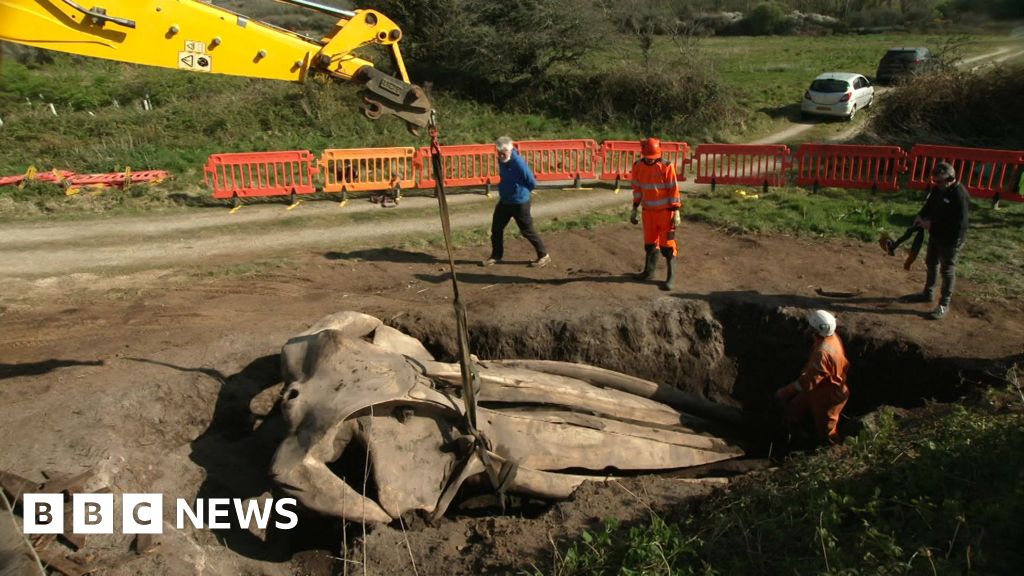
Excavating the whale’s head took some heavy equipment
Earlier this year, I found myself standing in a field, watching, as a digger lifted the remains of an enormous fin whale’s head from a resting place few people knew about.
It was the culmination of an investigation into something I initially thought may be a myth but turned out to be true – a whale’s head being buried somewhere in my hometown.
On Valentine’s Day 2020 the crew of a former Danish fishing boat, collecting rubbish in the sea, delighted in an unusual sight – a whale swimming alongside them near Falmouth in Cornwall.
Despite their joy there was concern she was close to the coast and in shallow water.
By midday she had beached on rocks at the remote Parbean Cove in the mouth of Helford River.
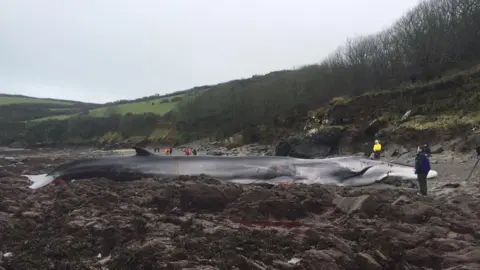
The young female fin whale stranded at Parbean Cove in 2020 and despite the best efforts of locals it later died
Milo Constantine was 16 at the time and was among the crew members of the Clean Ocean Sailing vessel – The Annette.
“It’s like in those films when they meet an alien or something and it’s just like so surreal because it’s not something you see,” he told me.
The team tried relentlessly to keep the whale hydrated, using dry bags, hoping it could be refloated when the tide came back in.
“The noises it was making, it wasn’t just noises, it was like deep bellowing sounds and we were pouring water on it to kind of ease it through its pain,” he said.
“Every time we put water on it, its mouth would open and it would kind of do a very deep, a whale sound, but it was very, very deep and quite an emotional moment of interaction with the whale.
“And it genuinely did feel like it was saying thank you.”
Dozens of other people also made their way to the beach as word spread.
By the time a team from British Divers Marine Life Rescue – a frontline response organisation – got to the scene, it was sadly too late for the whale and the autopsy unit was called in to try to find out what had caused her to die.
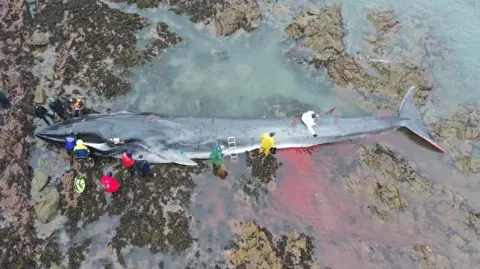 Rob Deaville
The whale beached on rocks and could not be refloated at high tide
Fin whales are the second largest animal to have ever existed on our planet. This one was a young female, not fully grown but still enormous at nearly 20m (66ft) – about the length of two buses.
Although fin whales are migratory there are near-resident populations that hang out in UK waters, especially in the Celtic and Irish seas.
Sightings from shore were once rare but more recently have become far more frequent, according to the Cornwall Wildlife Trust.
It would turn out the stories I had heard about the whale’s head being buried related to this particular, incredible animal, and it was more than just a community rumour.
Having a fiance, Stuart Bearhop, who worked as a professor of ecology at the University of Exeter proved useful, as he asked around and found out about a semi-secretive mission to save the whale’s head from incineration.
The man who carried out the mission was scientist Prof Robbie McDonald.
He went along to lend a hand at Parbean Cove and like everyone else was struck by the sheer size of the whale and its tragic death.
Recalling the day, he said: “There’s lots of different people having different experiences there… on one side of the animal there was a group of scientists thinking about how are we going to take samples and on the other side there were people mourning its passing, saying quiet little prayers.
“Somebody had placed a bunch of flowers on the whale’s fin and there were lots of different people taking different meanings from this animal that had died on the beach.”
If left on the shore the whale’s body would have posed a biohazard risk so the plan was for it to be disposed of, either by being rendered, sunk or incinerated, which is the responsibility of the land owner.
It was while these plans were developing that Prof McDonald made his bid for the head.
“Because it would’ve just been sunk out to sea or rendered… a sad ending,” he said.
“So the intention was that we make this something of a monument to that moment, to that animal, to that place, jutting out into the Atlantic, and for all the people who connected with it that day, and keep that for the future.”
The King owns the head
Acquiring the head was not straight forward.
The whale was lying on the foreshore where the Duchy of Cornwall has special royal rights and privileges.
The Duchy is the private estate of the eldest son of the British Monarch and at the time in 2020 that was Prince Charles.
The Duchy had released a statement saying the whale would be disposed of “sensitively over the coming days”.
Prof McDonald said: “There’s lots of biohazards associated with it so I had to do a lot of persuading and show I had the requisite papers.
“I think their worries were understandable.
“There are a lot of concerns that people have for animals like whales, and they wanted to get the job done efficiently but also sensitively which is perfectly sensible.
“And there I was trying to make life difficult by saying, ‘please don’t throw it away’. But, to their great credit, they let me have it.”
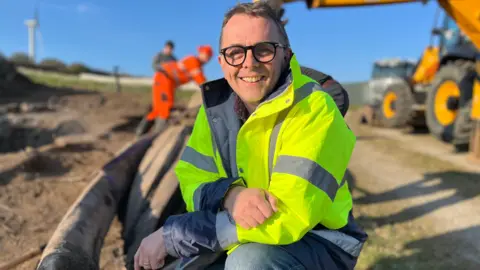
Prof Robbie McDonald buried the head of a fin whale in 2020 and was there five years later when the decomposed remains were dug up
When he finally got the head, it was just before the onset of the Covid pandemic and lockdown and with the need to also be respectful, the job of burying it was done quickly and quietly.
“I suppose that’s why it became an urban myth, but it was not my intention for it to be a secret,” he recalled.
“It was just at a time when there were much more important things for people to think about, so I didn’t really talk about it.”
The remainder of the whale was dealt with by the landowner but the head was kept in tact for Prof McDonald and taken by trailer up to the University of Exeter campus in Penryn, Cornwall.
He buried the head packed with rich fertiliser to facilitate decomposition. The organisms in the soil strip the bones of any remaining flesh and tissues, and so getting them to a condition where they could be displayed.
As part of my investigations for the podcast I spent some time in London – 300 miles from where the whale washed up.
I visited Sophie Nicolov of the Natural History Museum’s whale, dolphin and porpoise collection, which consists of thousands of bones at a secret location and not on display to the general public.
I also went to the autopsy rooms at Regent’s Park beside London Zoo where I met Rob Deaville, who did the post-mortem examination on the whale.
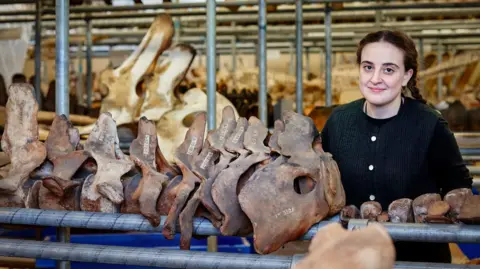 Trustees of Natural History Museum
Sophie Nicolov works with the whale, dolphin and porpoise collection at the Natural History Museum
There I learned how experts can spot the man-made threats that can cause some whales to strand and die, and how some of the chemicals we use in everyday life can be harmful to marine wildlife.
Unlike most creatures that wash up, its necropsy was not the end of the story for our whale.
Prof Macdonald had buried her head, both for science and as a monument to these beautiful creatures.
How do you dig up a whale’s head?
When plans were submitted for a wind farm in the field outside Falmouth where the head was buried, Prof McDonald started to look at how best to retrieve it.
However, he got a new job out of Cornwall before being able to do it, leaving the university with a two-tonne whale’s head under its premises, and nobody obvious to deal with it.
Stuart Bearhop does not know much about digging up whales, and he is not a whale biologist but the job of excavating it had to fall to someone, and the university decided it would be him – probably because he had been the one who started asking questions, on my behalf.
Left too long in the ground the bones would start to break down.
To help with the sizeable task was Paul White, a former Royal Marine who usually works excavating live electricity cables and utilities.
Also on hand were Johnny Nicolas, who lays slabbing for housing developments, and David Hatton who is a digger master.
They had with them a vacuum excavator usually used for working around live electricity cables and gas pipes.
A huge lorry would suck up all the soil from around the skull, making it easier to then be winched out on a digger arm.
Over the course of the next 10 hours I watched as the team, with great care and precision, painstakingly extracted the whale’s head from its resting place.
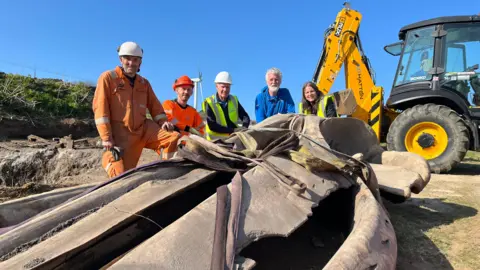
The skull, which was buried in Falmouth, was the length of a minibus
The bones were more fragile than anticipated with plant roots having worked their way into spaces left by veins and blood vessels.
Broken fragments were collected and put to one side with the team feeling the heavy responsibility of keeping the prized whale in as close to one piece as possible.
The critical point came when the soil had been removed, and a series of straps had been looped around the skull and the digger arm.
As it was slowly and expertly winched out there was a real concern the weight of the skull may crush itself.
If Prof Macdonald’s plan for the head to go on display was to become a reality, it would need to be kept together.
Eventually, after several attempts, the whale’s head emerged in nearly one piece from her shallow grave and into the sun.
She will understandably need to be patched up in places, and there are specialists to carry out this work.
For now, this whale’s head has been through enough and has been left to dry out in the open air until the next chapter in her storied after-life.