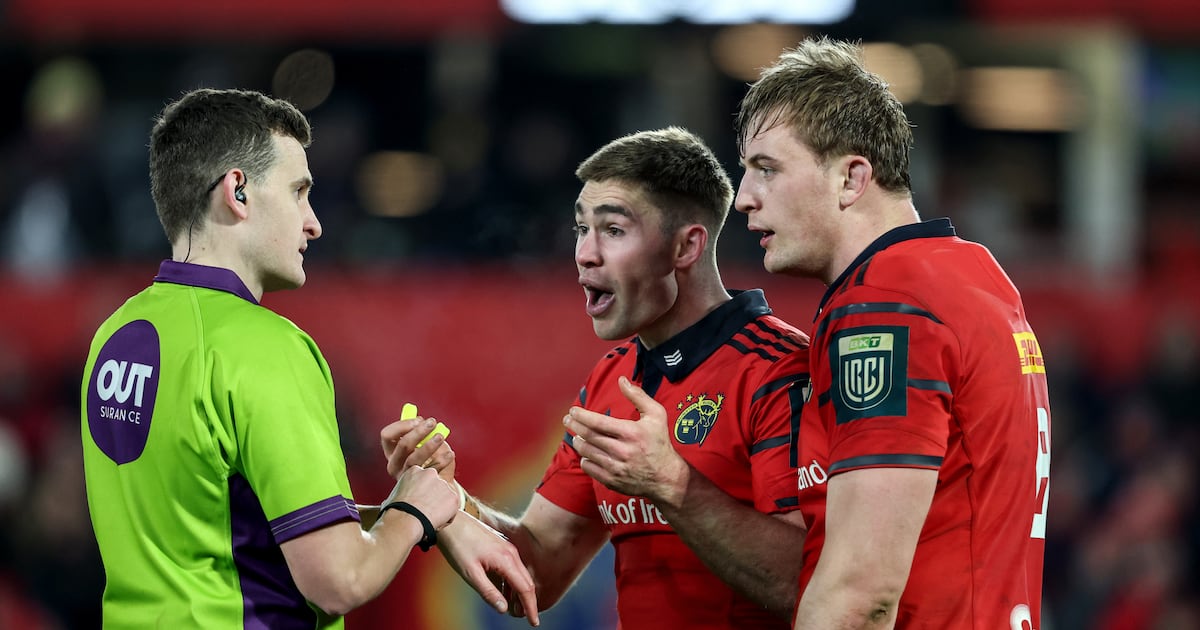
Thomond Park was packed to the rafters. The crowd were merciless, unforgiving, it is their wont. Not too many referees have avoided the ire of Munster’s supporters, a very passionate band of brothers. Ulster referee Peter Martin will now know exactly what it is like, it is certainly not pleasant. With experience, though, a successful referee will develop essential immunity to such indignant outrage.
But let’s start at the beginning. Martin is now contracted to the IRFU, and this appointment was his most important so far, by quite a distance, so I was very interested in watching his performance. As half-time approached he was going well, scrums apart, but that is par for the course. He looked composed, going about his business quite nicely, and then Alex Nankivell came along.
Leinster’s defence looked stretched for a rare moment, when Nankivell threw out an exquisite, space-creating, long pass. But the whistle interrupted things, a sharp blast from Martin informed us that the pass was judged to be forward. In that split-second, the last play of the first half, the referee lost the Munster players and the crowd.
I don’t know if it was the referee who shot himself in the foot, or if one of his assistants pulled the trigger for him, but the end result was a poor decision. One way or the other, Martin should not have whistled and instead allowed play to continue. In the event of a Munster try the pass could have been checked. In that scenario the try would have stood, the pass was not forward. So, both technically and tactically, the call was wrong.
As the teams and officials left the field there were clearly some players questioning the referee. Neither did the crowd hold back in venting their spleen, as they would also do at the finish. It can be quite destabilising, particularly when a referee is new to it.
All match officials should have a mechanism for dealing with a mistake. This writer used to put an error into the boot – ‘trunk’ for American readers – of his car, and slam the lid on it. It could also be scrunched up like an old newspaper and tossed on to an imaginary bonfire; or likened to restarting the car after a bad stall. But, however he does it, a referee cannot allow a mistake to prey on his mind, clouding both confidence and concentration.
Inevitably, the ferocity ratcheted up in the second half, and the degree of difficulty for Martin followed suit. The breakdown was fiercely contested, and in trying to keep things moving, his attempts to be preventive seemed to come after the offence, rather than before.
Munster weren’t saints, but Leinster hands were clearly visible delaying quick ball. The visitors also not only entered the breakdown at the side, they also came in at the back. It’s highly unusual to see rear entry, but it did make an unexpected appearance.
 Munster head coach Clayton McMillan. Photograph: Inpho/Bryan Keane
[ Tadhg Beirne: ‘The style of the game has gone backwards’Opens in new window ]
Munster coach Clayton McMillan has politely pointed out Leinster’s illegal infringements to the media, but he’s unlikely to be as kind in his discussions with URC referee manager, Tappe Henning. McMillan is also correct in stating that this area was supposed to be a refereeing priority, but it definitely slipped badly.
The match was compelling in that it was full-blooded, and physical, but not by a long shot was it a good game. Leinster’s cutting edge has gone AWOL, one try represents a poor day at the office. Andy Farrell will be scratching his head, too many Six Nations first picks are not performing, the signs are troubling.
Both Irish derbies saw the usual nonsense at scrum time. It’s inexcusable that World Rugby allows the shambles to continue. Match after match we are forced to endure what is now an overbearing feature of the game, everything in the garden of the scrum could not be less rosy. It’s time to find a solution, maybe actually enforce the laws, even though it might well upset the mighty scrummaging teams. It’s all been far too illegal for far too long.
The lineout continues to have its relatively new problematic issues. Over the weekend we saw fast throws, directly to the frontman, or to the second man, which were played on; even though the non-throwing team had no time to react, no time to put up a jumper.
It is of course completely unfair, but who cares, just as long as there isn’t a stoppage. Furthermore, throwers are supposed to stand in front of the assistant, on the mark, and not move their position to throw straight, but along their own line of players. It then beggars all belief when the assistant moves to accommodate the thrower, instead of hauling him back to the proper place.
We hear so much about the importance of ball in play time, and that it might actually be increasing. Really?
How much time is wasted at scrums, and players leisurely walking to lineout formation. How much is wasted when, having just won possession, the preference is to thump the ball away again, high into the sky, yet another goddam kick. And how much of the clock is used up with the senseless, unappealing, continuous goal line pick and drives. Where the hell has running rugby gone to?
Pick and drives, and the maul, are now the preferred attacking options of so many teams, hell-bent on crossing the whitewash, or pulling so many opponents into the morass that space will eventually appear out wide. Over the last few years, the game has been allowed to evolve into what we have today. It has not been for the better. Instead, undeniably, it has been for the worse.