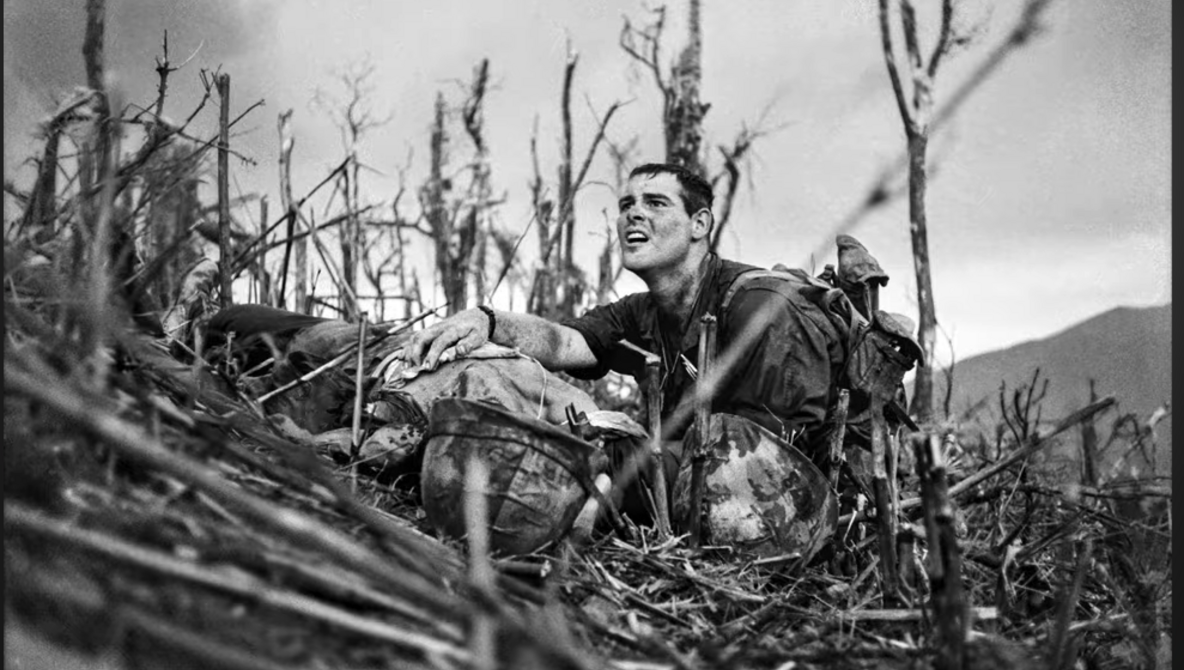
Catherine Leroy was a highly influential photojournalist in the twentieth century whose work fundamentally helped shape visual understandings of the Vietnam War. During the war, events were reported and viewed as strategic or abstract; however, her work presented the war as an immediate human experience characterized by the subject’s vulnerability, exhaustion, and the moral complexity of the conflict.
Born on August 27, 1944, in Paris, France, Leroy developed an interest in journalism and travel. She pursued photography independently and without formal training. Her work in Vietnam was published in major international magazines, including Life, Look, and Paris Match. Following the Vietnam War, she continued to document armed conflicts in regions such as Lebanon, Northern Ireland, and parts of Africa.
In 1966, at 21 years of age, Leroy arrived in Saigon with limited financial resources, her Leica camera, and no formal assignment. Despite being largely self-taught, she embedded herself with United States Marine units and operated in active combat zones, frequently exposing herself to extreme danger. Notably, she became one of the first women to participate in a combat parachute jump, accompanying the 173rd Airborne Brigade during Operation Junction City.
A defining attribute of Leroy’s photography was its physical and emotional closeness to its subjects. She depicted soldiers not as symbolic figures, but as individuals experiencing the intense psychological and physical stress of warfare. Often, her work immediately followed combat engagements and medical evacuations from the battlefield. Her most widely recognized photograph, taken during the Battle of Hill 881 in 1967, portrays a Navy corpsman attempting to aid a mortally wounded Marine. This image earned Leroy the Robert Capa Gold Medal, making her the first woman to receive the award.
In 1968, Leroy was captured by North Vietnamese forces while photographing behind enemy lines. After a brief period of captivity, she was released and returned with something unique: a rare photographic documentation of North Vietnamese soldiers. At the time, these images represented a rare and mostly unseen perspective of those engaged with U.S. forces. This work further reflected her commitment to portraying multiple facets and the complexity of armed conflict.
Leroy’s legacy extends beyond bravery to include a distinctive operational and ethical approach to photojournalism. She rejected observational distance in favor of close engagement, highlighting empathy and human presence. In a profession historically dominated by men, her career demonstrated that trust and access, along with emotional awareness, could function as critical tools of journalistic methods. Her photographs remain among the most intimate visual records of modern warfare, resisting both romanticization and detachment.
For contemporary photographers, Catherine Leroy’s work continues to serve as an important reference point for discussions of ethics, representation, and the role of photography plays in documenting conflict at home and around the world. In the above video, Zach Dobson explores Leroy’s career while showcasing her work.