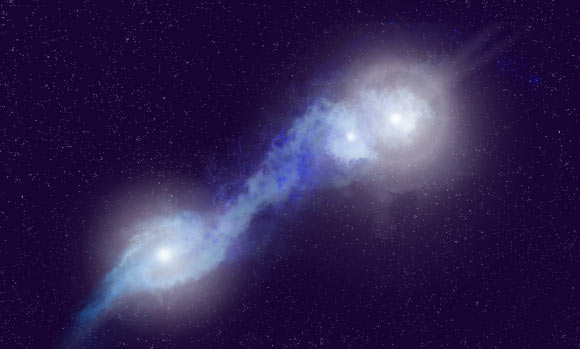
A rare trio of merging galaxies called J121/1219+1035 hosts three actively feeding, radio-bright supermassive black holes, according to a team of U.S. astronomers.

An artist’s impression of a rare trio of merging galaxies, J121/1219+1035, which host three actively feeding, radio-bright supermassive black holes and whose jets light up the surrounding gas. Image credit: NSF / AUI / NRAO / P. Vosteen.
The J1218/1219+1035 system is located approximately 1.2 billion light-years away from Earth.
It contains three interacting galaxies whose central supermassive black holes are all actively accreting material and shining brightly in the radio regime.
“Triple active galaxies like this are incredibly rare, and catching one in the middle of a merger gives us a front-row seat to how massive galaxies and their black holes grow together,” said Dr. Emma Schwartzman, researcher at the U.S. Naval Research Laboratory.
“By observing that all three black holes in this system are radio-bright and actively launching jets, we’ve moved triple radio active galactic nuclei (AGN) from theory into reality and opened a new window into the life cycle of supermassive black holes.”
Dr. Schwartzman and her colleagues used NSF’s Very Large Array (VLA) and Very Long Baseline Array (VLBA) to observe J1218/1219+1035.
The observations revealed compact, synchrotron-emitting radio cores in each galaxy, confirming that all three host AGNs powered by growing black holes.
This makes J1218/1219+1035 the first confirmed triple radio AGN and only the third known triple AGN system in the nearby Universe.
“The three galaxies in J1218/1219+1035 were caught in the act of merging, with nuclear separations of roughly 22,000 and 97,000 light-years, forming a dynamically bound group whose tidal features trace their mutual interactions,” the astronomers said.
“Such triple systems are a key but rarely observed prediction of hierarchical galaxy evolution, in which large galaxies like the Milky Way grow by repeatedly colliding and merging with smaller companions.”
“By capturing three actively feeding black holes in the same merging group, the new observations provide an excellent laboratory for testing how galaxy encounters drive gas into galactic centers and ignite black hole growth.”
J1218/1219+1035 was originally flagged as an unusual system using mid-infrared data from NASA’s Wide-field Infrared Survey Explorer (WISE), which suggested at least two obscured AGN lurking in an interacting pair of galaxies.
Follow-up optical spectroscopy confirmed an AGN in one nucleus and revealed a composite signature in another, but left the true nature of the third galaxy ambiguous because its emission could also arise from star formation or shocks.
“Only with new, ultra-sharp radio imaging from VLA — at frequencies of 3, 10, and 15 GHz – we uncovered compact radio cores precisely aligned with all three optical galaxies, demonstrating that each hosts an AGN that is bright in radio emission and likely driving small-scale jets or outflows,” the researchers said.
“The radio spectra of the three cores show signatures consistent with non-thermal synchrotron emission from AGN, including two sources with typical steep spectra and a third with an even steeper spectrum that may indicate unresolved jet activity.”