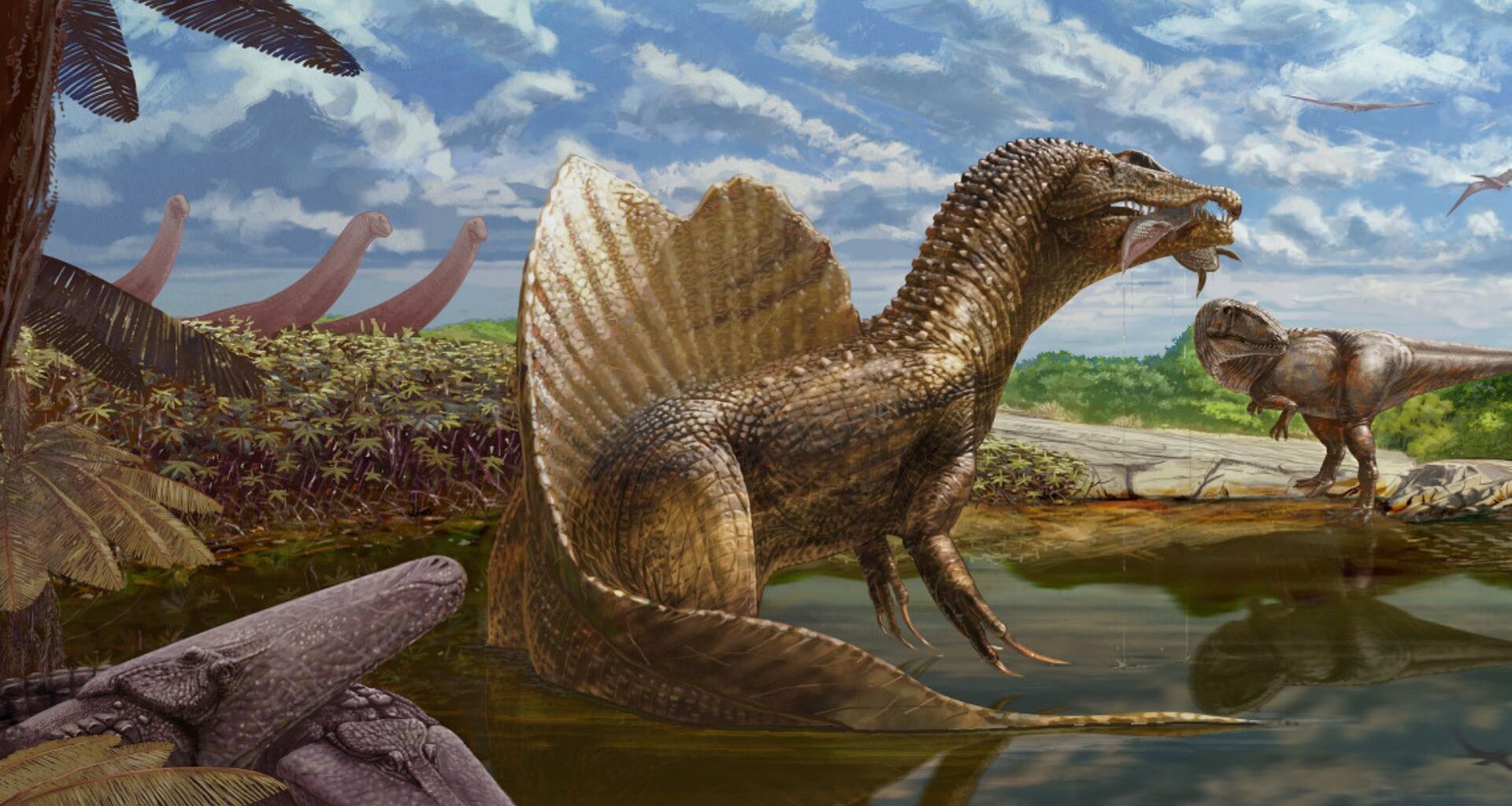
Fossilized remains of a giant dinosaur that lived 125 million years ago have been identified. It belongs to a 25-foot-long (seven to eight meters) dinosaur nicknamed “Sam Ran spinosaurid.”
Live Science reported that this fish-eating dinosaur stalked the Khorat Group’s waterways approximately 125 million years ago in Cretaceous Thailand.
The finding was presented by Adun Samathi, an assistant professor at the Walai Rukhavej Botanical Research Institute and Mahasarakham University in Thailand, at the Society of Vertebrate Paleontology 2025 annual meeting in Birmingham, England.
Interestingly, the discovery is being hailed as one of the most complete spinosaurid specimens ever recovered in Asia, consisting of spine, pelvis, and tail.
Specialized fish hunter
Found in 2004, this Thai specimen is linked to the Spinosaurinae subfamily.
These predatory theropod dinosaurs are best known for being the “crocodiles of the dinosaur world,” evolving unique features for a life spent hunting in and around water.
As a spinosaurine, the new find also featured the group’s signature long snout and cone-shaped teeth, which were ideal for catching fish.
The identification of the Sam Ran specimen as a spinosaurid is based on known skeletal traits, including its elongated neck vertebrae and prominent dorsal spines.
In addition, this truck-sized specimen is also unique in some ways from its closest relatives.
It boasts “paddle-like spines” on its back that are shorter than those of its North African relative, Spinosaurus, yet distinct from the Ichthyovenator found in neighboring Laos.
Preliminary analysis suggests this dinosaur may be more closely related to the famous Spinosaurus of North Africa than to other known Asian species, despite being geographically closer to the Laotian Ichthyovenator.
It hints at complex patterns of migration and evolution. These subtle variations in the vertebrae suggest a localized evolution within the river systems of Southeast Asia.
Bustling ecosystem
The ancient creature perished along the banks of a shallow river within a semi-arid landscape dominated by a slow-moving river system.
While this predator wasn’t necessarily a deep-water swimmer, it was a master of the edge, thriving in this landscape where floods periodically turned the plains into a hunter’s paradise.
And the Sam Ran locality was no lonely place. Excavations at the discovery site, Khok Kruat rock formation, have revealed a bustling Cretaceous ecosystem.
Reportedly, the site reveals a densely populated environment where this predator lived alongside freshwater sharks, bony fish, turtles, and crocodiles, as well as massive herbivores like sauropods and iguanodontians.
The evolution of Asian spinosaurids has remained enigmatic for a long time, pieced together mostly from isolated teeth. For paleontologists, this partial skeleton serves as a vital key, unlocking the mysteries of how these giants evolved.
New find provides the structural evidence needed to map how these unusual predators spread across the globe.
The findings are currently preliminary and await formal peer review.
Once published, the dinosaur will receive an official scientific name. It is currently nicknamed after the Sam Ran locality of the Khok Kruat rock formation in northeastern Thailand.
Ultimately, this Thai find proves that the dinosaur population in prehistoric Southeast Asia was far more varied than we once imagined.