
In May, a fleet of minibuses arrived in the quiet and close-knit village of Dunlavin, Co Wicklow. They gathered near the old Market House, the granite landmark that overlooks the village’s wide main street.
The buses were there to collect the 50 or so people who had been living at Tynte House, a black-and-white 19th-century farmhouse that sits on the village’s main street. All of the families who were now leaving – either to Mayo or Sligo or Dublin or somewhere else, depending on who you spoke to – had come to Ireland seeking international protection. Some of them were in tears.
Dunlavin locals gathered to watch as their friends departed. “I was there when they were leaving, it was very upsetting,” said Alicia Walshe, a local. “These people had become part of the fabric of the town. They were just put on buses, it was like something out of a movie.”
One woman, who had found accommodation locally that allowed her to stay in Dunlavin, struggled to explain this to the officials who were trying to encourage her on to the bus. “It was hard. She didn’t want to get in trouble with this government agency,” said Walshe.
For as long as most people could remember, Tynte House had been run as a guest house. A lot of its trade came from wedding guests attending a celebration at the nearby Rathsallagh House. But in May 2024, prospective customers were informed by the website that Tynte House would soon be closing “indefinitely”.
The owner had been contracted by the Government to provide accommodation for people seeking international protection. When the news broke, some local politicians complained that the Government had chosen an isolated area that wasn’t suitable. There were some concerns that Dunlavin would not have the resources to cope.
This is a village where everybody knows everybody, a situation that applied to the new arrivals, who soon got to know everyone too. Children were enrolled in the local primary and preschool, and soon befriended locals. Some of those seeking international protection had jobs in the village.
Despite a language barrier, and with the aid of a translation app, a couple of the men got involved with the Tidy Towns committee and started volunteering – painting railings, sweeping the streets and maintaining the village’s pretty aesthetic. “They made a show of the local council fellas,” one resident said. When residents noticed that the men were out doing odd jobs in the village in their runners in the middle of winter, they found out their shoe sizes and bought them new boots. None of the former residents responded to a request for an interview for this article.
One Sunday evening, the village hall was filled with the rich smell of Jordanian food. On stage, the new arrivals danced and sang for delighted locals. The Tynte House residents joined Walshe’s running club and started to make friends with local librarian Maura Greene.
Greene, who said she gets “very down in the dumps” about the way immigration is discussed now, organised a coat swap last winter to keep the residents warm. “We were heartbroken when they left, and they were heartbroken,” she said. She had heard that one of the families she was fond of had been sent to a small town in Mayo, “which doesn’t even have a library”.
“I was going up to work on the Monday, and there were a fleet of beautiful little minibuses all lined up, taking them away, everyone waving,” Greene said.
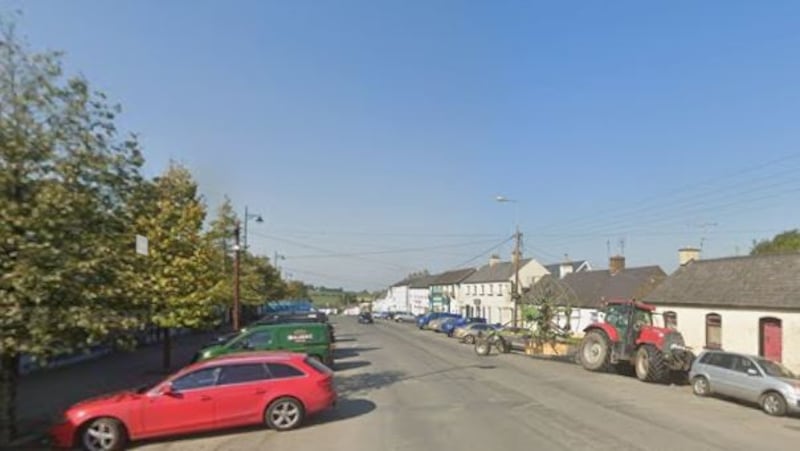 Dunlavin village, Co Wicklow. Image: Google streetview
In May, almost a year after it opened, the 51 residents of Tynte House received letters to announce the accommodation centre was closing. On the local Facebook page, the Tynte House residents said goodbye to Dunlavin. “How sad I was to be separated from you and how broken my heart was when I left them,” read one. “I extend my thanks, for every beautiful day I had with you,” another comment said.
The reason Tynte House closed as an accommodation centre was never explained. But its contract with the Government ended just one month after an independent inspection had raised concerns about the centre. The report, which is publicly available, said that a resident had taken the inspector to an annex at the back of the property “where they had been moved from their original room”.
“The room was occupied by four residents despite only being suitable for two, and does not have the required planning permission to be used as accommodation,” the report found. It said the provider “stated that they had done this at the request of Ipas. However, when I contacted Ipas following the inspection they had no record of this.”
The owner did not respond to requests for comment.
Other residents complained to the inspector of overcrowding. Based on its size, Tynte House should have only accommodated 34 people. Though there were children in the building, inspectors were able to walk on site “uncontested”.
“During the inspection, one of the rooms contained a child who was clearly very ill,” the report found. “The mother stated that she had raised this with the centre manager multiple times but that nothing had been done. An appointment with the doctor was made when the inspectors highlighted the issue.”
Tynte House is one of 22 contracts for international protection accommodation centres that ended this year. The Department of Justice will not reveal the reasons why the contracts were ended, saying only that they ceased for “a variety of reasons”. It would not confirm if the findings of the April 2025 inspection were the reason why the contract ended.
The 22 contracts that ended in 2025 was a sharp rise on the four contracts ended in 2024. Sinn Féin spokesman on migration Matt Carthy said he believed the “whole veil of secrecy” around Ipas centre contracts was not acceptable.
“There’s no clarification as to why those contracts are being ended, and that’s just not good enough when you’re talking about a budget of €1.2 billion this year as we expect to be spent on accommodation centres,” Carthy said.
“The very least that people deserve is that there’s maximum transparency and accountability and that everybody involved knows that the State is getting good value for money. That the services being provided to the residents are up to standard, but also that there’s full accountability in terms of how public monies are being expended.”
The Department of Justice said: “Contractual arrangements for Ipas centres are confidential and the department does not comment on individual contracts. Reasons for contract termination vary but can include noncompliance with contractual terms or with regulatory requirements such as building or fire regulations or planning matters. Providers may also terminate their contracts giving the requisite contractual notice.”