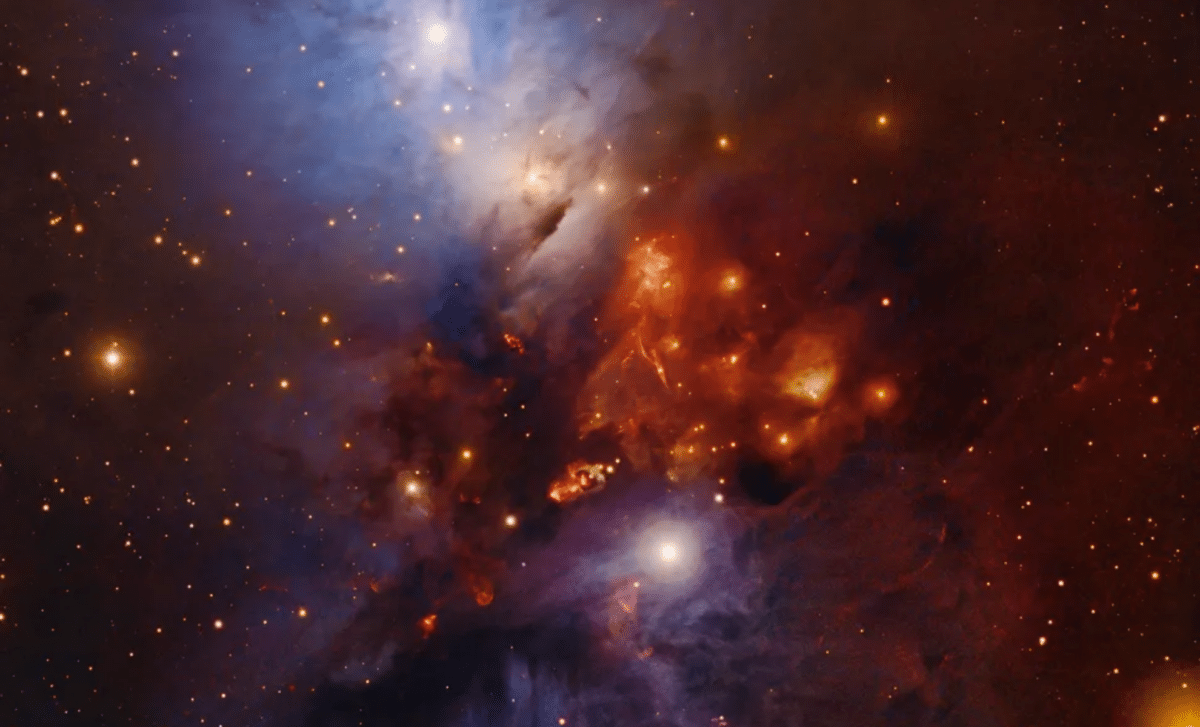
A groundbreaking discovery published in Nature Astronomy has revealed a cosmic phenomenon that may finally settle a 30-year-old mystery surrounding the early life cycles of stars. Astronomers observing the binary system SVS 13 within the NGC 1333 reflection nebula, located 1,000 light-years away in the constellation Perseus, have identified more than 400 bow-shaped rings created by violent ejections from a newborn star.
Time-Stamps From A Young Star’s Explosive History
The Atacama Large Millimeter/submillimeter Array (ALMA) provided the high-resolution data that allowed researchers to peer into the violent past of one of the two young stars in SVS 13. The team detected more than 400 concentric rings, each one marking a separate, explosive outburst as the star ejected material at high velocity into surrounding space.
Much like tree rings record a forest’s climatic past, these molecular shells map out episodic feeding and expulsion events throughout the star’s growth. What’s particularly compelling is that the most recent of these rings aligns with a bright outburst documented in the early 1990s, tying a visible historic event to a physical structure in space for the first time.
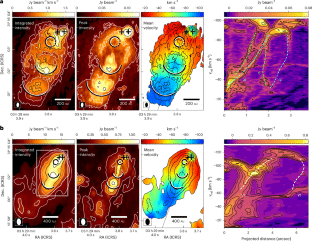 ALMA images and PV diagrams of the blueshifted Bullet 1. (Nature Astronomy)
“These images give us a completely new way of reading a young star’s history,” said study co-author Gary Fuller, a professor at the University of Manchester. “Each group of rings is effectively a time-stamp of a past eruption. It gives us an important new insight into how young stars grow and how their developing planetary systems are shaped.”
This ring structure not only corroborates prior models but offers an exacting visual narrative of the feeding-frenzy cycles that typify early stellar life.
Confirming A Long-Standing Theory With Direct Evidence
The implications of this discovery go beyond the visual spectacle. For decades, astrophysicists have hypothesized that young stars grow through sudden, intermittent infall of material from their surrounding disks, a process that sparks powerful jets ejecting matter into space. But until now, this model lacked direct observational confirmation. The study, detailed in the journal Nature Astronomy, closes that gap with compelling clarity. The ultra-thin rings were found to be bow-shaped, a morphology that supports the idea that they were formed by shocks traveling through interstellar gas.
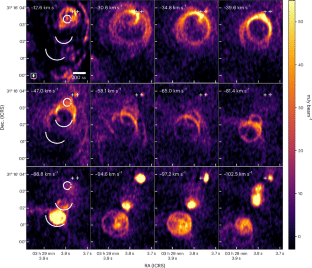 Observed CO (J = 3–2) spectral channel images at high angular resolution. (Nature Astronomy)
Their symmetry and spacing suggest that the ejections are not random, but periodic, likely triggered when a critical threshold of infalling mass is reached. The youngest ring, directly linked to a burst seen three decades ago, validates this episodic model with a real-time footprint of star-forming activity. The combination of precise imaging and historical data connects theory and observation in a way few cosmic phenomena allow.
What These Rings Reveal About Planetary Systems
While the star itself is in the early stages of development, the implications of this phenomenon extend to its potential to host planets. The explosive jets observed in the SVS 13 system help to regulate how much material the star ultimately absorbs and how much is left to form planetary disks. This regulatory mechanism, now visible through the ring structures, shapes the entire architecture of the forming planetary system.
As gas and dust are expelled, pressure waves propagate outward, altering the density and temperature gradients in the surrounding disk. These disturbances could influence everything from the formation of gas giants to the migration of protoplanets.
With hundreds of such ring signatures visible, researchers now have a timeline of events they can analyze to decode the early environment in which planets are born. This discovery doesn’t just give us a look into star formation, it offers the potential to reconstruct how our own solar system might have evolved under similar conditions.
NGC 1333: A Stellar Nursery Like No Other
NGC 1333 has long intrigued astronomers as a star-forming region. Hidden in visible light but glowing in infrared and radio wavelengths, it offers a rich tapestry of protostars, jets, and molecular clouds. The new images and data from ALMA now place NGC 1333 at the center of one of the most significant breakthroughs in observational astrophysics this decade.
The binary nature of SVS 13 makes it an especially interesting case, as the interactions between the two stars may also play a role in the timing and strength of these eruptive events. It’s possible that gravitational effects from the companion star could help trigger some of the more dramatic outbursts by perturbing the accretion disk. Future observations are already being planned to monitor the evolution of these rings and look for similar phenomena in other stellar nurseries. The hope is that this system will serve as a template for understanding star formation on a universal scale.
With more than 400 rings etched into the interstellar medium, this discovery gives astronomers both a snapshot and a timeline of a young star’s chaotic rise to maturity. Linking a decades-old optical flare to a physical structure observed today provides a rare bridge between theory and evidence. For the first time, scientists can now track the growth of a star by counting the scars it leaves behind.