
Holly PhillipsEast Yorkshire and Lincolnshire
 Stewart Baxter

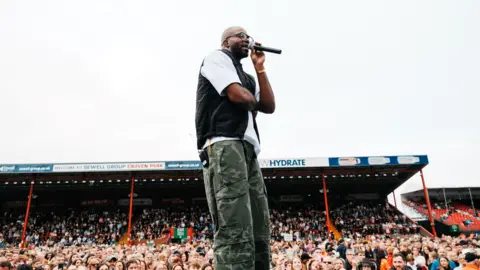
Chiedu Oraka supported Coldplay in Hull during their Music of the Spheres tour
Despite performing in front of 25,000 people while supporting one of the world’s biggest bands on tour, Hull rapper Chiedu Oraka still films music videos on the streets where he grew up.
Having performed at Glastonbury and supported Skepta – one of his inspirations – at the South by Southwest festival in Austin, Texas, last year, Oraka “didn’t think that could be topped”.
But, after a Facetime call from Coldplay’s frontman Chris Martin, who was sat in a studio in Los Angeles, everything changed.
Although more people now recognise him on the street and he is receiving more opportunities than ever – some of which he has had to turn down – Oraka remains true to the city that shaped him as an artist.
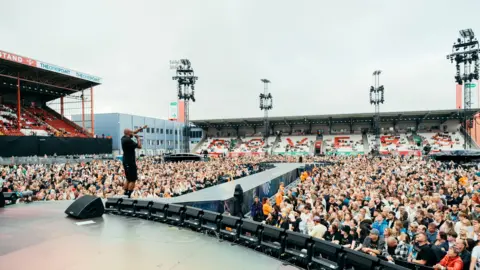
The 37-year-old teacher turned music artist had the biggest moment of his career in August when he joined Coldplay for the Hull leg of their Music of the Spheres world tour.
While that gave him the chance to perform to thousands of people at Craven Park Stadium, Oraka chose to film his most recent music video on the council estate where he grew up: North Hull Estate.
 Stewart Baxter
The two Coldplay concerts at Craven Park in Hull were sold out
The video for his new song Story of a Pauper, from his EP Undeniable, pays tribute to his childhood, with Oraka rapping: “I’ve come a long way from getting chases.”
When speaking to the BBC, Oraka said: “I’ve had my run-ins with the police over the years and I’ve said this in my lyrics.
“People know me or people know my past of being in trouble with the police when I was younger.”
The day before filming the music video, much to his surprise, Oraka got a knock on the door from the police. But this knock was different.
“They were actually really sound and really amazing,” he said.
Oraka said when the police heard from TikTok that he was shooting a music video, they wanted to check everyone would be safe as it was classed as a public event.
“It was safe. It was amazing,” he said.
“Why it was such a beautiful moment is the amount of young kids that turned up with their parents and it was such a community feeling. Everyone was behaving.
“It was such a moment of unity…. some of these kids’ faces, they were so excited, so happy, that they were going to be a part of something amazing, something positive, and that’s why I do music.”
Oraka said a council estate was a “very unique place” where there are “a lot of naturally talented people”.
“They don’t always use their talents to do things in the best way and I feel like that’s a lot to do with confidence issues,” he said.
Oraka, whose mantra is “council estate confidence”, said: “You need to be proud and not dim your own light because you’ve grown up on a council estate, you should actually be proud of that and wear that like a coat of arms.”
 Anna Lee Media
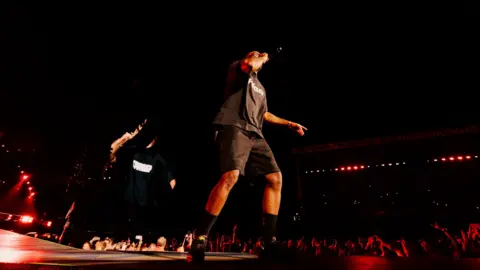
Oraka first shot to fame on BBC Introducing and played the Glastonbury Festival last year
Oraka said filming a video where he grew up had felt “a bit like a victory lap”.
“I’ve had such an amazing year and I’m still making music videos down the street that I grew up in,” he said.
“I’d be nothing without this council estate. I’d be nothing without this city.”
Oraka said Hull had made him thick-skinned, honest and passionate.
“It’s made me have something to really stand for,” he added.
Oraka said because rap had not been a popular genre in Hull when his career was on the rise, he had always had to win over a crowd.
“It’s actually been the making of me because now I can walk into any sort of environment and I feel like I can win them over because if I can win over the Hull public, then I can win over anybody,” he said.
Even with his recent success, the former teacher said he had managed to stay humble because he was surrounded by the “very honest” people on the council estate where he grew up.
“They’d be the first to tell me ‘you’ve changed’ and that would break my heart,” he said.
“I owe these people so much, that’s why I did the music video because I wanted to say thank you and I wanted to show the next generation you don’t need to be committing crime, you can actually do something positive.”
 Anna Lee Media
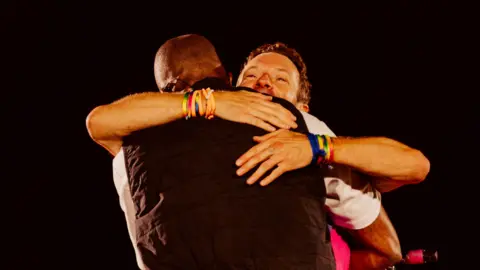
Oraka described supporting Coldplay as the “two best days” of his life
Oraka described supporting Coldplay on their tour as the “two best days” of his life.
“It was everything I imaged it to be plus a little bit more. The crowd were amazing, so receptive. It was mad seeing people with signs with my lyrics on,” he said.
During one of his performances, the crowd laughed as Oraka said: “Remember, Coldplay are closing the show for me.”
Before the musician ended his set, he shared some words of wisdom: “If you’ve ever got a dream, never give up.”
Oraka told the BBC: “I felt like a superstar for two days and then obviously with me performing with Coldplay on stage, that topped it off.
“I just felt that was my moment to shine and there’s no way I’m not taking advantage of it.”
Since supporting Coldplay, Oraka said his life had changed “massively” and he now had a sustainable career in music, eight years on from leaving his job as a teacher.
“I just gambled and the gamble, I think, is finally paying off,” he said.
After winning a Northern Music Award at the beginning of the year for Best Newcomer and then supporting Coldplay, Oraka said the past two years had been his “best years musically”.
“I just hope 2026 can top it.”