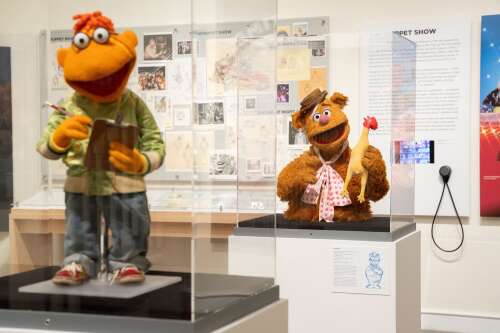
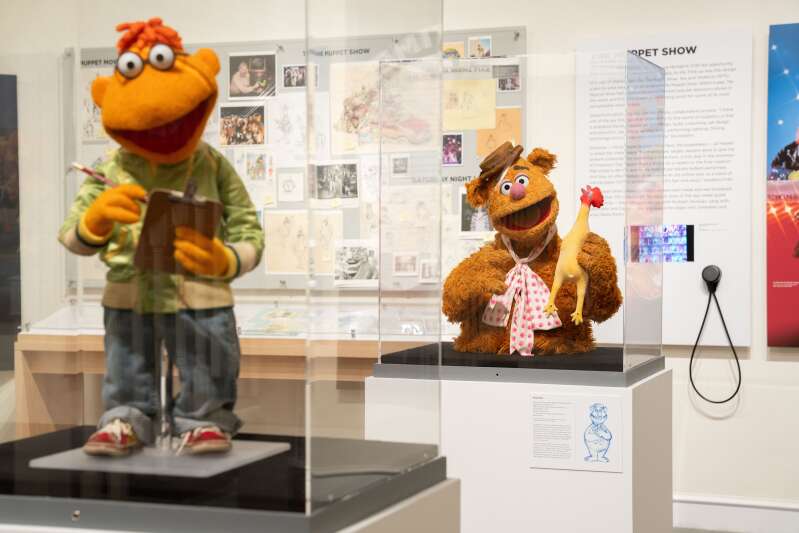
Fozzie Bear puppet, to the rear, at the From Pencil to Puppet exhibition, celebrating the work of Michael Frith, at the Bermuda National Gallery (Photograph courtesy of the Bermuda National Gallery)
Usually, when I visit an exhibit, I expect to feel challenged, impressed, or, on rare occasions, disappointed. I did not expect, however, to be starstruck when I visited the Bermuda National Gallery for its most recent exhibit. But when I entered, I saw him. In the flesh. Or, well … the fur. Fozzie Bear, the legendary Muppets’ funnyman, holding court over an astonishing array of drawings, puppets and videos outlining the career of Michael Frith. Curated by Eve Godet Thomas, the exhibit, aptly titled From Pencil to Puppet, reveals the evolution of a creative process guaranteed to inspire any budding artist.
Bermuda-born and raised, Frith is behind some of the 20th century’s favourite iconic figures. Besides Fozzie, his drawings were the genesis of Dr Teeth, Scooter, and the characters that populated Fraggle Rock. From Pencil to Puppet is the first retrospective view of Frith’s career, and the gallery finds a space for each of his creative eras.
The exhibit begins with Frith’s teenage years in Bermuda, when he illustrated ads for Masters Limited, the title sponsor of the exhibit, and drew caricatures for the Mid-Ocean News and The Royal Gazette, all while he was still a teenager. From there, he attended Harvard University, where he was president of the Harvard Lampoon. He then moved on to a job at Random House in 1963, where he acted as art director for Theodor Geisel, better known as Dr Seuss. Concept drawings, layouts, proof sheets, and final publications installed in the galleries attest to Frith’s rising star.
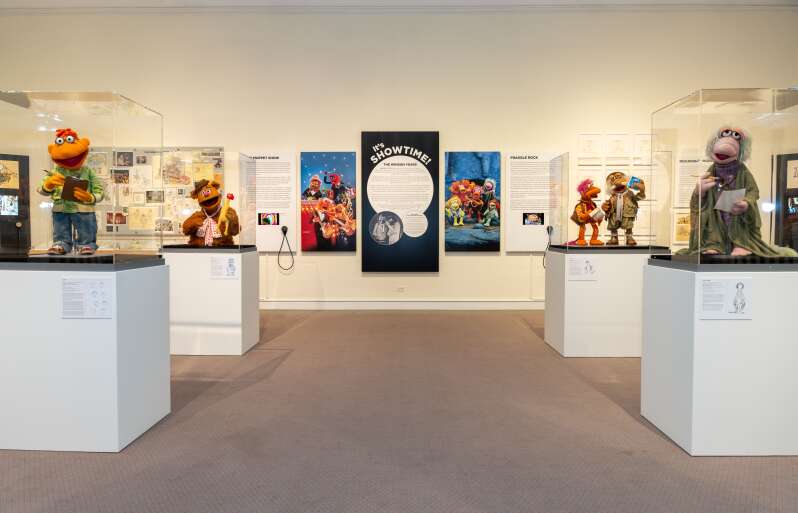
Displays at the From Pencil to Puppet exhibition, celebrating the work of Michael Frith, at the Bermuda National Gallery (Photograph courtesy of the Bermuda National Gallery)
The main gallery exhibits the most recognisable of Frith’s work, done after he joined Jim Henson Productions (1975-1995). As head of “creative services”, he essentially oversaw the artistic teams that produced characters, logos, sets, books, toys, and virtually any visual element related to The Muppets and Fraggle Rock. The gallery includes many of his designs in various stages, including a float design for Big Bird’s appearance in the Macy’s Thanksgiving Day Parade, Miss Piggy calendars, and set designs for both films and television shows.
Notably, among the drawings are Frith’s earliest sketches for Fraggle Rock, which aired between 1983 and 1987. He completed the drawings during the first planning meeting on stationery from the Hyde Park Hotel in London, where Henson had gathered a group to brainstorm a new series. Frith’s initial sketches of Mokey, Red, and Gobo, exhibited in the gallery, ended up remarkably similar to their final forms after the puppet makers brought them to life. Moreover, the gallery displays an early drawing of the Fraggles’ cave dwelling. Anyone who’s ever seen the show knows how central the Fraggle subterranean world is to its concept. As he worked, Frith realised his vision was based on Bermuda, specifically the Crystal Caves. He thought back to the story of the caves’ discovery, the two boys chasing a cricket ball, and was inspired by the notion of encountering a hidden world below the surface.
Frith expounds on his Bermuda references in one of the videos running in the gallery. “Bermuda is a magical place,” he says. “You can find in it an energy, a beauty, a mystery, and possibilities.” These “possibilities” are precisely the magic of this exhibit. The BNG installs dozens of drawings that allow the viewer to witness the transformation from memory or idea to a living, physical personality. To help trace this path, Frith’s notes are sprinkled throughout the displays to describe his process or his memories related to each project.
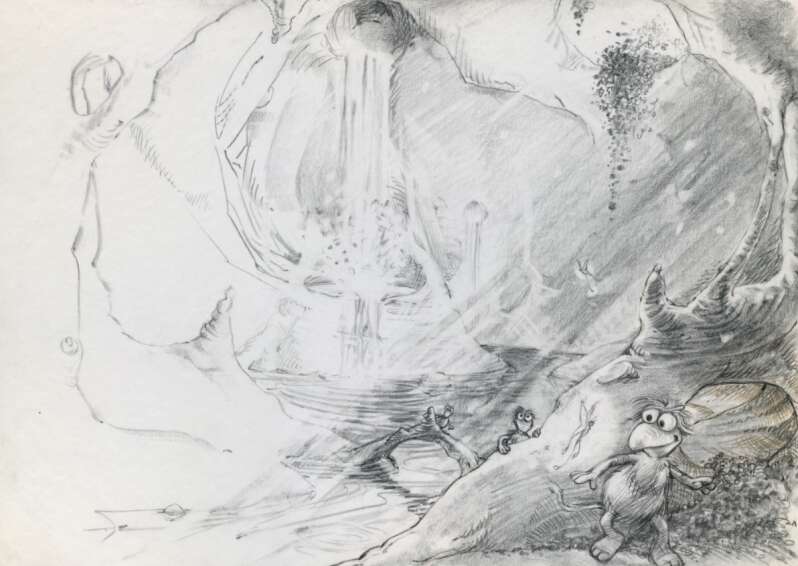
A sketch of the Fraggle cave at the From Pencil to Puppet exhibition, celebrating the work of Michael Frith, at the Bermuda National Gallery (Photograph courtesy of the Bermuda National Gallery)
Case in point, his story behind Dr Teeth, Frith’s first character design and frontman to the Muppet band The Electric Mayhem, reveals his own enchantment with the process. In 1974, while still at Random House, he was collaborating with Henson on The Sesame Street Storybooks. Henson had begun to request character designs from Frith, and the first to be built was Dr Teeth. Frith visited the Muppet Shop where Henson surprised him by bringing D. Teeth to life, turning to him and asking, “Well, Mike, what do you think?” Frith remembers, “And that was it. I told Jim I’d be leaving Random House at the end of the year.”
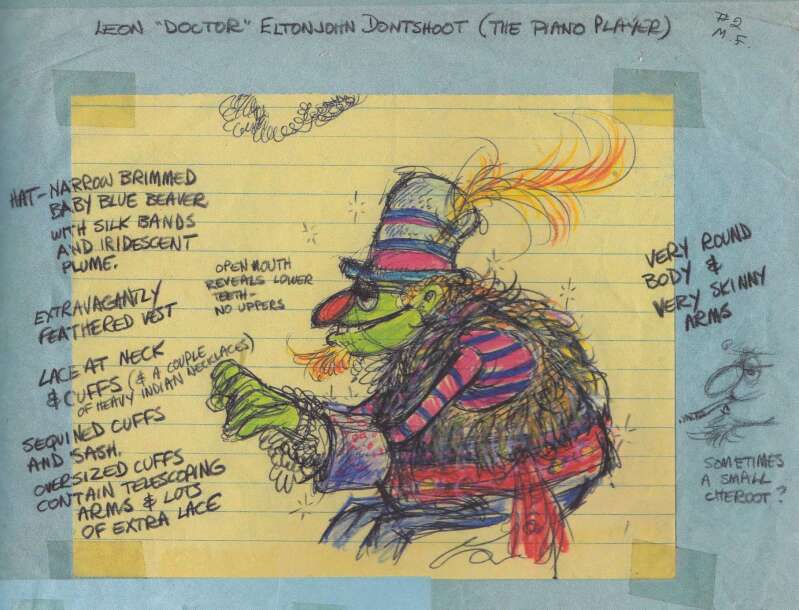
A drawing of Dr Teeth at the From Pencil to Puppet exhibition, celebrating the work of Michael Frith, at the Bermuda National Gallery (Photograph courtesy of the Bermuda National Gallery)
The story is engaging, to be sure, but such anecdotes further explain the creative process and the joy of seeing the concept become tangible. The exhibit allows the viewer the same epiphany as Frith when he saw Dr Teeth. From Frith’s rough or initial drawings — sometimes on napkins or yellow legal pads — to their layout, construction, or ultimate identity on film or in books, the exhibit tracks the path towards sentience and personality, illuminating the miracle of the creative act. From Pencil to Puppet shows visitors more than a cast of much-loved characters. It instructs and enlightens them about artistry, inspiration, and the course from concept to conclusion.
The post-Henson years are also on view. In 1996, Frith, his wife, Kathryn Mullen, and others formed Sirius Thinking, which gave viewers Between the Lions, the educational series that inspired young readers through the family of librarian lions. And, yes, the leonine youngsters Lionel and Leona are on view, busy reading in their nook in the upper galleries.
The most recent works on view come from No Strings, a humanitarian collaborative started by Frith, Mullen, and Irish aid worker Johnie McGlade. No Strings was formed in response to the bombing of Afghanistan in the early 2000s. The puppets and storylines here illustrate a concept always important to Frith and Henson, the role of the puppet in reaching underserved audiences with messages of compassion and public safety. This was Henson’s aim with Fraggle Rock, which aimed to encourage ideas of coexistence and sustainability. Frith, beginning in 2002, adopted this approach for No Strings, creating culturally specific puppets to perform in areas of conflict or struggle.
Frith and Mullen initially aimed to perform directly for audiences in Africa, Haiti, Afghanistan, and elsewhere. They understood that traumatised children sometimes find it easier to speak to puppets. Ultimately, they had to shift their approach to film in many cases due to regional instabilities. In all, their efforts have reached 13 different countries, tackling crucial issues from landmine safety to HIV/AIDS to natural disaster preparedness. And, again, Frith drew from his well of Bermuda memories for his Rara Band, which, in a series of three films from 2011, addressed trauma and public health for a Haitian audience. One character of the trio is based on Johnny Barnes, and the costumes draw from his visual knowledge of the Gombeys.
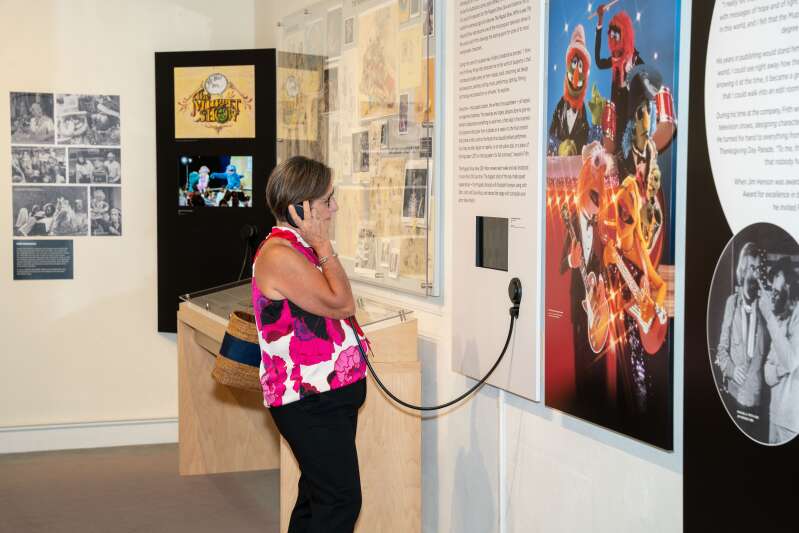
A visitor interacts with the From Pencil to Puppet exhibition, celebrating the work of Michael Frith, at the Bermuda National Gallery (Photograph courtesy of the Bermuda National Gallery)
BNG, according to director Jennifer Philips, has seen an uptick in visitors, many taking selfies with Fozzie, reminiscing in front of the video performances, or exploring the wizardry behind the curtain. Even for children visiting the gallery, who are new to the greatness of Fozzie Bear or the Fraggles, the value of an unbridled imagination is unmistakable. And, in a world of YouTube where theMuppets, the Fraggles, and the librarian Lion family live on, the same thrill of recognition is still possible even for the youngest visitors.
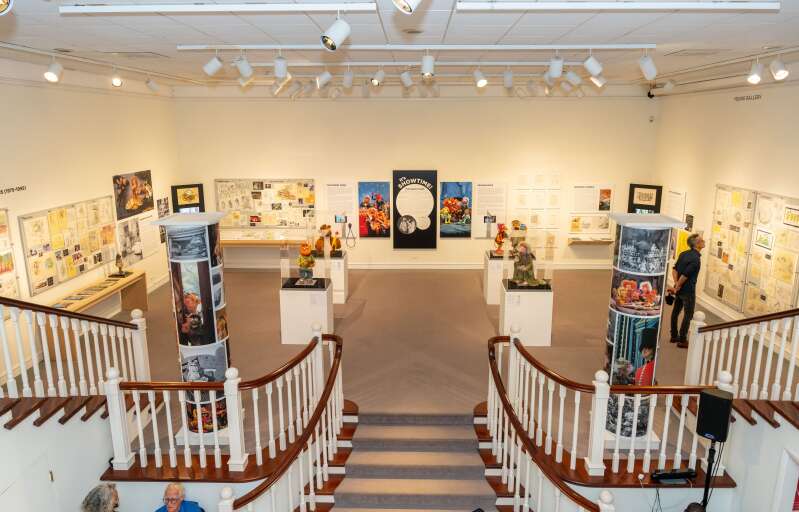
Displays at the From Pencil to Puppet exhibition, celebrating the work of Michael Frith, at the Bermuda National Gallery (Photograph courtesy of the Bermuda National Gallery)