For an agency shooting for the moon and onward to Mars, NASA in 2025 has been on a roller coaster ride of proposed budget cuts, personnel layoffs, and potential elimination of science missions.
A key question: Have these various traumas changed NASA dramatically, and potentially permanently?
Battle lines are being drawn and now Congress has to spin up their views as to the space agency’s overall stability and, indeed, its future. As for what’s ahead, it’s all sausage making — political style. The outcome for NASA is literally a to-be-determined matter of time and space.
You may like
Corporate/agency history
“Clearly, things have changed,” said Henry Hertzfeld, a research professor of space policy and international affairs at George Washington University’s Elliott School of International Affairs, noting that his observations are from afar, not from within the space agency.
“A lot of very experienced people with a lot of ‘corporate/agency history’ are now gone from the agency. Some may have retired soon anyway, but that is not an excuse or explanation of the changes,” Hertzfeld told Space.com.
Since the whole policy office at NASA was eliminated, said Hertzfeld, many of those people and functions are gone. Whether, for example, economics and other policy offices will be missed or not is arguable, he said.
“But I do think not having them is a significant loss of talent and input into NASA programs and decisions,” Hertzfeld said.
Long-term loss
Like many suggest, if Congress doesn’t act with funding, the real loss is in the science area.
“There will be fewer new initiatives and many cuts in the work that now won’t be done across the board,” said Hertzfeld.
“The science part of NASA is relatively small but it is the one true research area that has produced significant learning and information over the years. And, it will be a long-term loss since the agency will likely face more difficulty in hiring and keeping highly trained and skilled scientists,” Hertzfeld said. “They will go elsewhere … and elsewhere is not the government.”
You may like
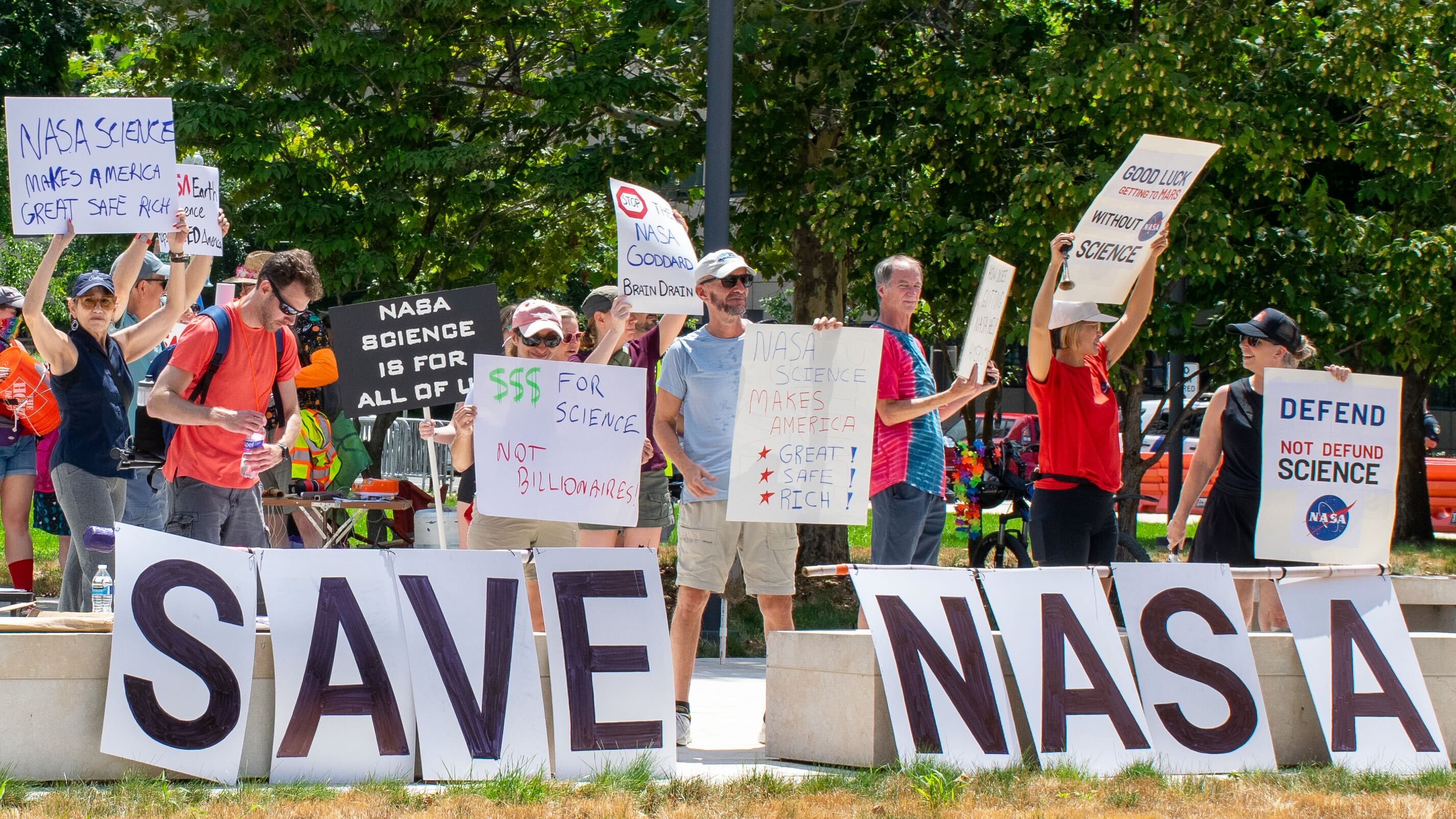
People hold signs outside on a sunny day in protest of NASA budget cuts, July 20, 2025. (Image credit: Space.com / Josh Dinner)Investment dollars
Hertzfeld said that one less well understood impact is the rapid funding of various defense and security space efforts.
“We read about the significant increase in private sector investment activity oriented toward space. But what is really happening is that the Department of Defense spending on buying more from companies is the main driver of these investment dollars,” said Hertzfeld. “NASA programs and needs are no longer the main stimulus for ‘commercial’ space activity.”
The resulting innovation and products for new space activities, Hertzfeld added, will primarily benefit the security aspects and not so much the civil space programs. “Thus, the aggregate commercial and government space sector will benefit, but quite differently from what we experienced in history,” he said.
Heightening concerns
Keith Cowing is founder of the private NASA overseer website, NASA Watch. He is passionate about the space agency’s revered history and its future.
“While every NASA field center saw workforce reductions of around 20%, perhaps no center was more drastically affected by budget cuts than NASA’s Goddard Space Flight Center,” pointed out Cowing.
There was a long term plan in place that would have morphed Goddard over the course of nearly a decade to better adapt it to future NASA needs, Cowing told Space.com. That plan was co-opted by Administration personnel in place at NASA Headquarters, he said, to accelerate and expand Goddard facility closures that will result in half of the center’s buildings and laboratories being mothballed, he said.
“These cuts are a standout when compared to changes elsewhere at NASA,” Cowing said, “so much so that the House Oversight and House Science, Space and Technology committees sent repeated inquiries to NASA asking for an explanation.”
The result is that “NASA has been slow to respond, thus heightening concerns about the overall impact on NASA science programs as presented by the White House in its FY 2026 budget request,” Cowing said.
Tremendous challenge
Marcia Smith is founder and editor of the informative SpacePolicyOnline.com
NASA is not “crippled,” Smith said, but time will tell the effects of the loss of personnel.
“I certainly don’t know the names and positions of all the 4,000 or so people who left, but of the people I personally know, they were the best of the best,” Smith advised. “Now, surely, a lot of terrific people are still there, but how they’re going to manage to execute whatever programs remain with so many excellent colleagues gone will be a tremendous challenge.”
Both what’s happening at the NASA Goddard field center and given layoffs of Jet Propulsion Laboratory (JPL) talent, “is extremely worrisome to American leadership in space science,” said Smith.
Smith observed that it may well be the effect on morale is the most dramatic effect.
“People who have spent their lives keeping America as the world leader in civil space science and technology basically being told their work is valueless and can be erased with the wave of a ‘DOGE wand.’ That’s tough,” Smith said.
DOGE stands for the Department of Government Efficiency, a special commission put in place by President Donald Trump, established to slash federal spending.
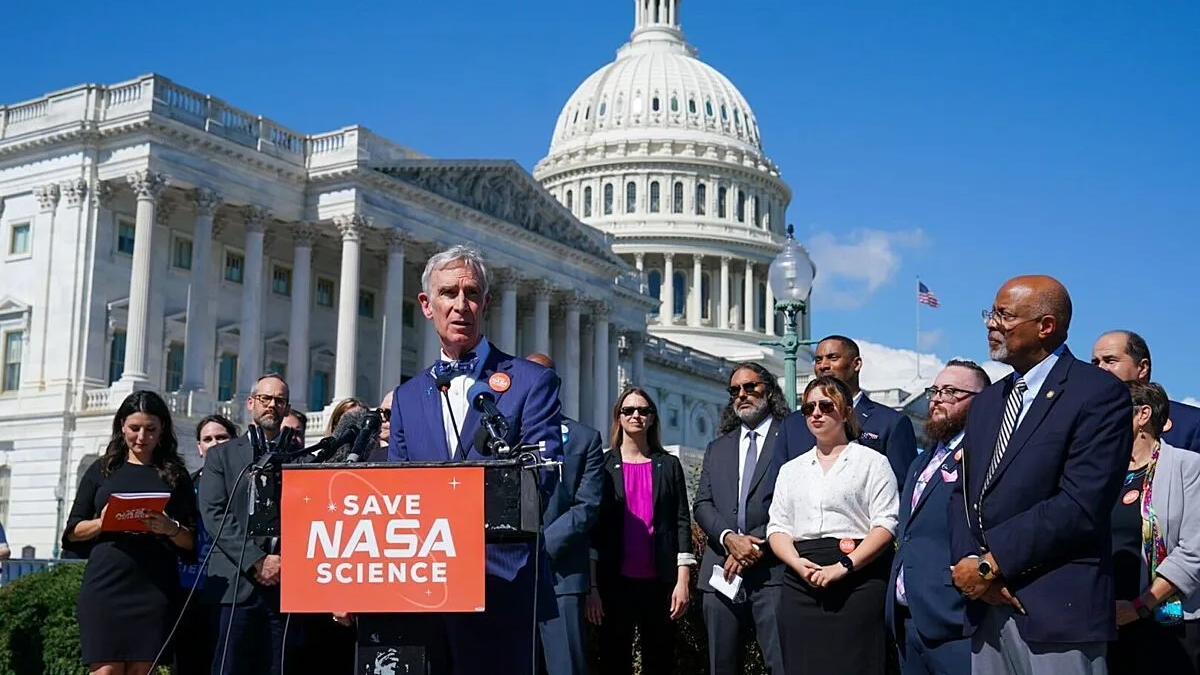
Planetary Society CEO Bill Nye addresses press and supporters on Capitol Hill on Oct. 5, 2025. (Image credit: Planetary Society)Years to rebuild
NASA does what no other organization — public or private — can do, said Jack Kiraly, director of government relations for the Planetary Society, a member-funded nonprofit organization based in Pasadena, California that’s dedicated to advancing space science and exploration.
“The agency has led the world in the exploration of space, redefining our understanding of the universe, and inspiring countless innovations in science and technology,” Kiraly told Space.com.
Kiraly sees the events of 2025 as a profound shock to NASA and the space community.
“The agency will begin the new year with a civil servant workforce smaller than what it had at the dawn of human spaceflight in 1961. Nearly 4,000 scientists, engineers and space professionals have left the agency through pressured resignation and layoffs amid rapid reorganizations and funding uncertainty,” said Kiraly.
That action represents a loss of specialized expertise and institutional knowledge that will take years to rebuild, added Kiraly.
Pivotal moment
Beyond the immediate impacts, said Kiraly, the termination of NASA awards valued at more than $315 million and the reduction of future research opportunities have disrupted the science, technology, engineering, and mathematics (STEM) pipeline that trains the next generation of scientists, engineers, and innovators.
Because NASA’s activities involve every state and more than 75% of congressional districts, these effects will be felt nationwide, Kiraly said.
“The damage is real, but it doesn’t have to be permanent,” Kiraly said. “Congress has, in a bipartisan way, signaled to the White House and the public that they intend to fully fund NASA in 2026, rejecting the worst of the cuts proposed earlier this year.”
And given the confirmation of Jared Isaacman to be NASA’s Administrator “brings new leadership and momentum at a pivotal moment for the agency,” Kiraly concluded.