
Just as Indikator turns touch into sound, objects like the concept modular pen NEWRON engage users’ fingertips to stimulate creativity and new ideas. The pen, conceived by Toshiyuki Kawada, can make people think of new ideas by stimulating their fingertips with protruding shapes. The object comes in three parts: top, middle, and bottom. Twisting the parts together assembles the full body of the tool. The pen comes in, and at last, the crown at the top seals the object. Once everything is in place, users click the top, allowing them to use the writing tool and begin thinking.
Design-wise, the parts of the instrument are 3D printed. Their shapes range from having multiple stacked discs and a flowy, paper lantern-like exterior to semi-pointed, geometric tips, like the ones used in massage tools. There are 12 grips included in the concept modular pen NEWRON. The grip puts enough pressure on the users’ fingertips as they write and draw. The project aims to help activate the users’ thinking hats for new ideas through this action.
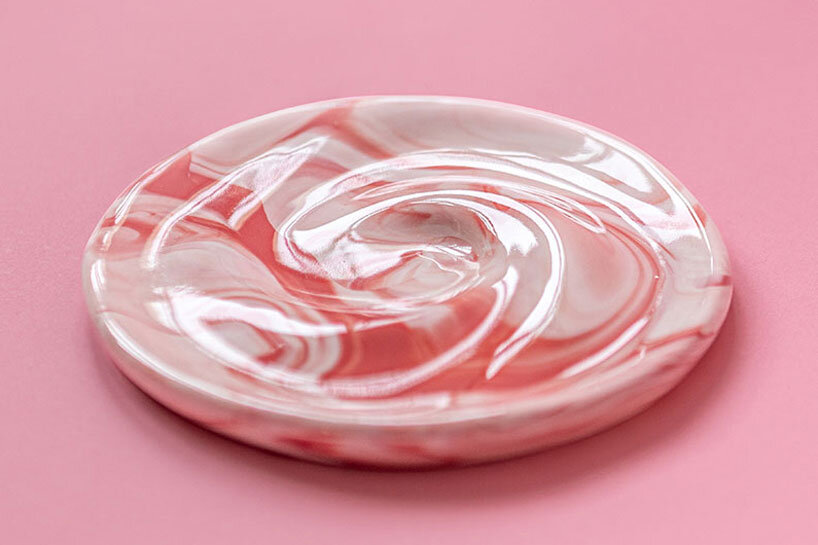
image courtesy of HAK Studio
Extending our focus on sensory-driven design, other objects apply tactile and visual cues to influence perception, shaping how we experience taste. HAK Studio introduces UMA, a tableware collection developed through research in gastrophysics, a field of neuroscience exploring how sensory stimuli shape taste perception. The series includes a swirling porcelain dessert plate and a rough, unglazed, salty bowl. a Designed to support individuals experiencing reduced taste sensitivity, such as older adults or those who have lost their sense of taste following COVID-19, UMA uses color, texture, and form to enhance the perception of flavor. Studies by Professor Charles Spence at the University of Oxford demonstrate that the brain forms taste expectations before food reaches the mouth. Elements such as color, texture, and shape can intensify or alter taste experiences, enabling healthier eating by reducing the need for sugar, salt, or other additives.
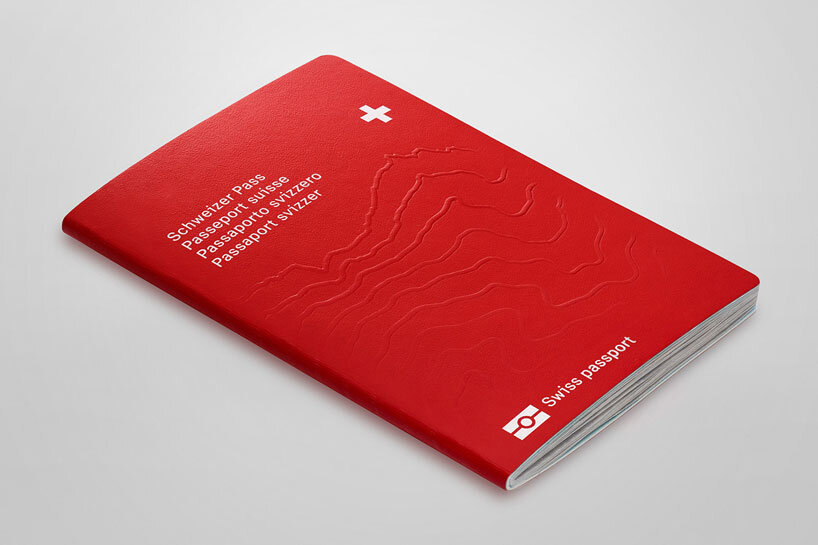
image courtesy of RETINAA
Tactile design is also used to guide perception and meaning in everyday documents, where touch reinforces identity, and navigation. Designed by RETINAA, Switzerland’s next-generation passport, issued in fall 2022 by the Federal Office of Police, continues the country’s legacy of innovation in graphic arts combined with advanced counterfeit protection. In partnership with Thales and Orell Füssli, the Geneva-based studio was commissioned to create a concept that reflects Swiss identity while integrating state-of-the-art security features, revitalizing the red passport that has been regarded as one of the world’s most sophisticated and secure travel documents since 1959.
The concept reinterprets cartographic traditions, honoring the country’s natural and built landmarks through 3D-modeled landscapes. The pages depict an imagined journey along Switzerland’s waterways, from the Alpine peaks down to the valleys, through the 26 cantons, and out to the world beyond. The first page features Pizzo Rotondo, a summit in the Saint-Gotthard Massif, located at the crossroads of the country’s linguistic regions. Under ultraviolet light, contour lines emerge to reveal the topography, enhanced with architectural landmarks that reflect cultural heritage and history.
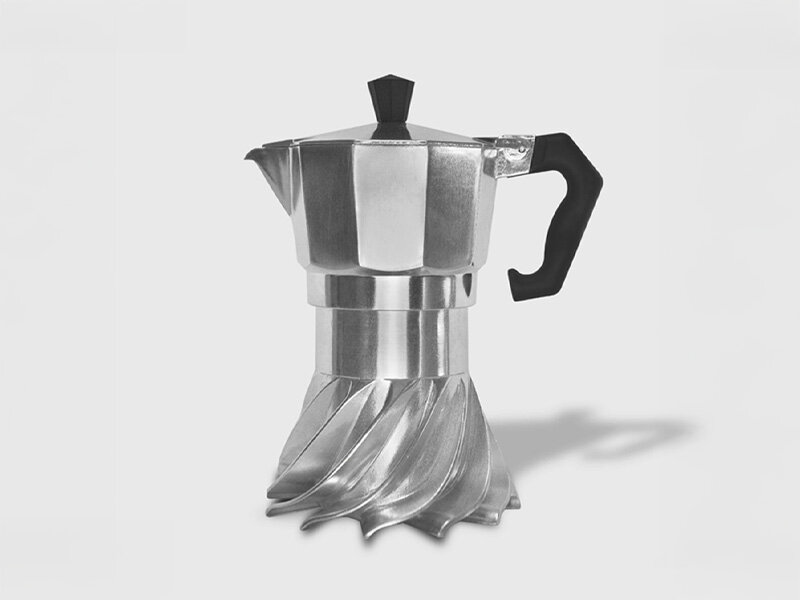
image courtesy of Turbo Moka
Designers are also reworking iconic, everyday objects, preserving their familiar identities while reinterpreting them through contemporary technologies and performance-driven innovation. Turbo Moka, designed by Matteo Frontini, reinterprets the moka pot, originally invented in 1933 by Alfonso Bialetti and Luigi De Ponti. While maintaining the recognizable form and function of the classic design, the project introduces significant technical and material innovations aimed at improving energy efficiency and performance.
At the core of Turbo Moka’s redesign is its helical spiral base, inspired by aircraft turbine geometry. Engineered according to principles of fluid dynamics and thermodynamics, the spiral structure increases the surface area in contact with the flame by 93% compared to a traditional moka pot. This enhancement allows for greater heat capture and more uniform energy distribution during coffee brewing. The configuration also prolongs the contact time between the flame and the boiler, improving thermal efficiency and reducing energy consumption by up to 50%.