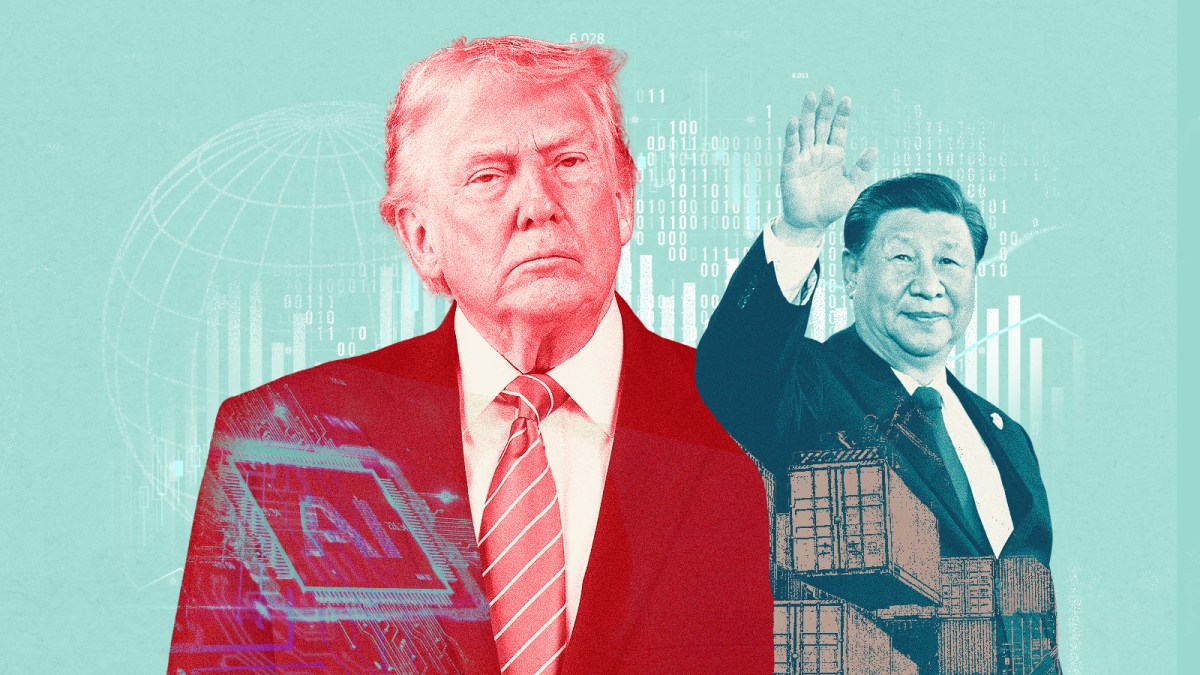
As the world prepares to cross the threshold into 2026, the global economic map reveals a series of nations bruised by tariffs, concerns about a possible AI bust and tentative hopes of a turnaround. We look at the prospects for some of the leading economies in the year ahead.
Germany is shuffling into 2026 with the world-weary air of a mouse that has been told so many times the cheese is around the next corner that it has ceased to believe in the existence of cheese.
Back in the early summer, it was still possible to muster something almost resembling optimism if you tried hard enough. The DAX was forging ahead with its hot streak as one of the world’s strongest big stock indices.
In Friedrich Merz, the new Christian Democratic Union chancellor, the country had its first leader with meaningful business experience since Ludwig Erhard in the 1960s. Even before taking office, he contrived to open the fiscal floodgates with a €500 billion slug of borrowing for infrastructure and a mechanism that permits theoretically unlimited defence spending.
Yet business sentiment has effectively stagnated since then, more or less trundling along at the same nadir it had reached in 2024, according to monthly polling of executives by the Ifo economic research institute in Munich.
• Stock picks: who will be the big winners in 2026?
After two years of recession and another of standstill, growth is at least expected to return in 2026, but most forecasts suggest it will be a meagre fraction of a percentage point.
“Companies are taking a sober and concerned view of economic development,” said Klaus Wohlrabe, Ifo’s head of surveys. “The euphoria from the start of the year has already faded again.”
This has much to do with structural drags on the economy that are already grimly familiar: a tight labour market, eye-wateringly expensive energy, overweening bureaucracy, low investment, weak demand for Germany’s exports and geopolitical instability.
Increasingly, though, companies and economists are troubled by what they see as political deadlock and an unwillingness to grasp the country’s many nettles.
A pledge to reform the welfare state has fizzled out with nugatory savings on unemployment benefits and a public pensions system that will continue to eat an ever greater share of output after Merz’s Social Democratic coalition partner saw off a very modest attempt to rein it in.
The debt-funded infrastructure splurge has largely turned out to be an accounting wheeze for regional governments to pursue investments they were already planning.
Veronika Grimm, one of the “Five Sages” who advise the government on economic strategy, recently warned that at this rate Germany would end up spending its entire tax take on welfare, debt interest and the armed forces by 2029.
“The government is pursuing a policy that is manoeuvring this country into the abyss at the cost of the little people,” Grimm told the Augsburger Allgemeine newspaper.
United States
The biggest question for the American economy for 2026 seems to be: Is there an artificial intelligence bubble? And if there is, when and how will it burst?
The US has gone all-in on AI, with huge investments in data centre infrastructure helping to boost GDP.
• The best shares to buy in 2026
In the first half of the year, AI-related capital expenditures contributed 1.1 per cent to GDP growth, outpacing the US consumer as a contributing factor.
Scott Bessent, the Treasury secretary, has said he expects the US will end the year with 3 per cent GDP growth, up from 2.8 per cent last year.
Optimism around AI has also propelled US stocks to record highs. The S&P 500 index of America’s biggest listed companies is up 18 per cent so far this year, although this is lower than the past two years’ returns of over 20 per cent.
The impact of President Trump’s sweeping tariffs has been less severe than economists had feared, as many businesses have been able to reorganise their supply chains to help mitigate the effects, and consumers, particularly in the highest-earning brackets, have been able to absorb higher costs.
However, economists are worried about the pressure on lower and middle-income consumers as jobs growth has slowed and inflation has remained persistent. Many analysts now say the US has a “K-shaped” economy, where the highest earners continue to see their wealth increase while the poorest struggle.
• The business year in charts: golden highs and London lows
A divided Federal Reserve cut interest rates by a quarter percentage point in December for a third straight meeting, leaving rates at a three-year low of between 3.5 per cent and 3.75 per cent as the US central bank seeks to shore up a weakening labour market. But the Fed signalled borrowing costs were unlikely to drop further in the near term as it awaited more economic clarity.
Tariff uncertainty is rearing its head again, as the US Supreme Court is evaluating the legality of the president’s decision to impose sweeping tariffs. Aruling is expected in early 2026. If the court declares the tariffs unlawful, the Trump administration might need to return revenues received from the increased levies.
If they remain in place, some economists believe prices will continue to rise for imported goods at the start of the year, putting renewed pressure on consumers.
China
China enters 2026 still staggering forward, bloodied but unbowed from its dramatic confrontation with President Trump’s tariff wars.
Growth remains strong at around 5 per cent up on last year — suspiciously strong, according to those sceptical of Chinese statistics. However, there has been no implosion of the economy, or pushback against President Xi’s leadership.
Exports have continued to rise, and China’s manufacturing machine looks more invincible by the day.
Even now, there is a sense of “what was that all about?” in Beijing. On “Liberation Day” in April Trump imposed total tariffs on China of 54 per cent, a figure which fluctuated wildly for months amid a spate of counter-measures, interim deals and tantrums on all sides, at one stage reaching 145 per cent.
A meeting between Trump and Xi in South Korea in October left the basic import tax on Chinese goods into America at 45 per cent, certainly resetting the terms of trade but not the disaster many in Beijing feared at one stage.
• What now after 2025’s times of turmoil?
In the meantime, Beijing’s attempts to prepare the ground for a shift away from reliance on the American consumer seemed to be working, as trade volumes held up overall. By November, its overall trade surplus had already risen to a record $1 trillion for the year.
How sustainable is this? That is the question that is increasingly dividing economists around the world.
Critics say that by displacing its trade surplus from the US to other countries, Beijing is merely triggering the same hostility to its mercantilist policies that had already riled Trump. If a full, worldwide trade war breaks out, China as the world’s leading exporter is at most risk, at a time when non-manufacturing contributors to GDP such as real estate and retail are doing poorly.
The European Union was already preparing trade counter-measures a year ago, and has imposed tariffs on, for example, electric vehicles. But even China-friendly countries such as Brazil and southeast Asian neighbours such as Indonesia, a recipient of Belt and Road Initiative loans, are starting to complain about unfair competition.
China claims to be keen on rebalancing its own economy away from production and towards consumption, something that would in theory also reduce its dependence on exports.
However, its 15th five-year plan, which remains a key component of the ruling Communist Party’s economic strategy, very much focused on continuation over revolution when it was unveiled in October.
By insisting that “modernised industrialisation” remained key, the document showed that establishing dominance in production, of everything from AI systems to green tech to textiles, was still Xi’s favoured route to economic success.
For cheerleaders of the Chinese model, like Justin Yifu Lin, former chief economist of the World Bank now back at Peking University, its “catch-up” policies still have enough wind in their sails to last another decade.
In a lecture earlier this year, he predicted continued annual growth of at least 5 per cent to 6 per cent, helped by an America that after the damaging fall-out of this year’s chaotic events realises it cannot really longer afford its dream of “decoupling” from Asia.
Australia
The Australian economy is at a crossroads heading towards 2026. Optimists for the year ahead can point to a macroeconomy rebounding after the lull of the past few years. The economy grew at the fastest annual pace in two years in the third quarter, fuelled by business, government and consumer spending. Real GDP expanded by 2.1 per cent year on year in the quarter, from 2 per cent in the second quarter.
Business investment experienced its largest leap in four years in the September quarter, mostly due to accelerating spending on data centres. House prices are soaring, so much so that the banking regulator has imposed new limits on high debt-to-income mortgage lending to reduce risks to the financial system.
Three interest rate cuts this year and income tax cuts that began in July last year have encouraged households to spend more. Unemployment is low at 4.3 per cent and the labour market remains tight.
Alas , the outlook is not quite as rosy as these trends might suggest. Chief among the emerging concerns is inflation. And low levels of business investment are troubling some economists.
The first interest rate rise in more than two years is on the horizon in 2026, after inflation rose to 3.8 per cent in the year to October. It was driven by higher electricity and food costs in a blow to the Albanese government’s efforts to contain cost of living pressures.
Underlying inflation also increased 3.3 per cent in the same period, above the Reserve Bank of Australia’s forecast of 3.2 per cent for the December quarter, prompting leading economists, along with the bond market, to bet the central bank will raise interest rates rather than cut them in 2026.
The Reserve Bank of Australia’s deputy governor, Andrew Hauser, recruited from the Bank of England, is candid about the headwinds facing Australia.
• How you’ll be using AI in 2026: note-taking rings and robotaxis
Last month, he highlighted that a lack of investment by businesses was holding back the economy. “Real business investment has been flat over the past 18 months, and capital expenditure intentions suggest little or no growth over the 2025-26 financial year,” Hauser said in a speech. “And private investment, which also includes housing investment, remains well below its peak of the mining boom as a share of GDP.”
If Australia’s economy was to take a leap, businesses needed to expand productive capacity and make further business investments, Hauser said. Creating more supply capacity was key, he said: “If we fail to do so, we may find ourselves boxed in on the rail.”
New Zealand
New Zealand is used to playing second fiddle to its larger neighbour Australia, especially when it comes to economic performance.
Under a new central bank governor Anna Breman, a Swedish banker, and finance minister, Nicola Willis, the nation is trying to turn around a sluggish economy that has seen thousands of its better-qualified citizens flee for a more buoyant Australia.
Breman’s predecessor, Adrian Orr, raised interest rates to 5.5 per cent to stem a jump in post-pandemic inflation that peaked at more than 7 per cent, with food inflation hitting 12.5 per cent. It resulted in a recession last year in which the unemployment rate rose to 5.1 per cent.
The Reserve Bank of New Zealand has cut interest rates nine times since August last year to 2.25 per cent in November, and the economy is finally responding. Indicators of retail spending, manufacturing and construction all began to improve. Spare capacity means the renewed growth isn’t expected to add to inflation pressures over the next year.
GDP advanced 1.1 per cent in the three months to the end of September, above forecasts of 0.9 per cent expansion. That has enabled the centre-right prime minister, Christopher Luxon, a former Air New Zealand chief executive, to claim some economic green shoots before the 2026 general election.
The New Zealand treasury is forecasting stronger growth, with real GDP rising from 1.7 per cent in 2025-26 to 3.4 per cent in the 2026-27, which would be the strongest economic activity for years.