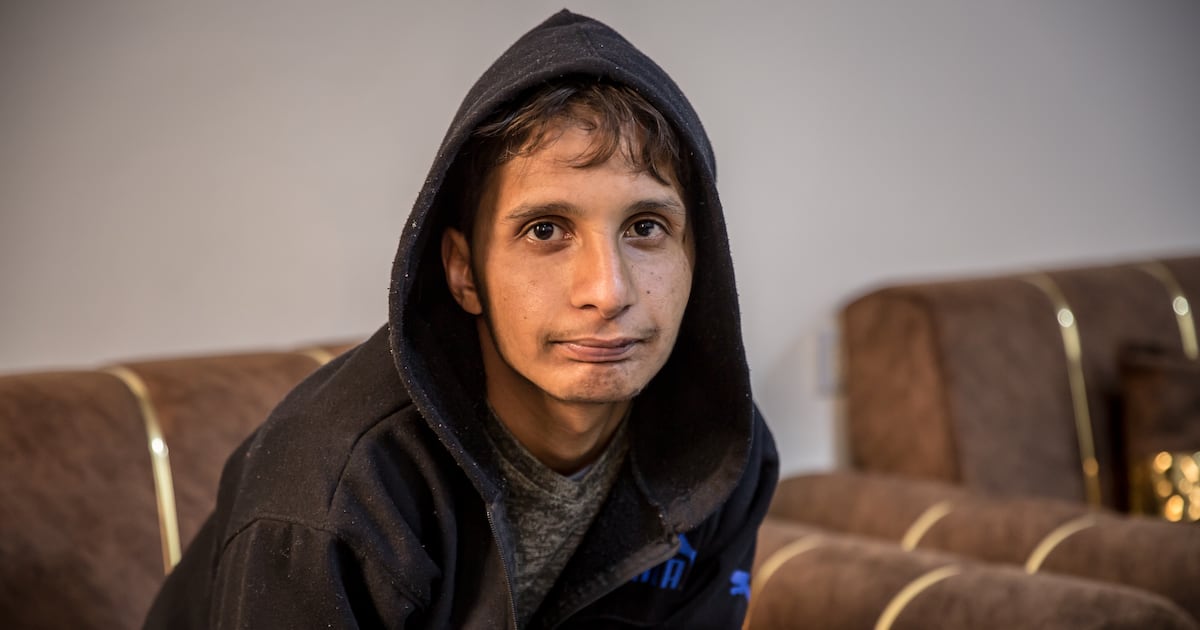
In an upstairs room in a remote and guarded property in northeast Syria last February, Hamza Ben Abd leaned forward, his hood up, as he began to rap:
“The worries are many and never end
I grew up carrying burdens on my head
I didn’t grow up like others,
I grew up in a foreign land …
I’ve seen marginalisation from all sides
I cried until I had no more tears left to cry.”
Then aged 22, the French citizen – who has also had his name spelled as Amza Benabed – said he had been in custody since he was 15, after he left Islamic State territory. “I don’t know when I’m going to go out of this nightmare,” Ben Abd said. “It’s been seven years with no contact with the French embassy and I don’t know what I’m going to do.”
He was a child when he was taken to Islamic State territory with his siblings by his mother – though his parents were separated at the time and his father stayed in France. He says his mother later died: “I love her, I miss her … but I’m paying the price for the huge mistake she made.”
Nearly seven years after its fighters made a final stand in Syria, tens of thousands of people accused of affiliation with Islamic State (also known as IS) are still incarcerated in prisons and camps across the country’s semi-autonomous northeast. Some have been held completely incommunicado since. Panorama prison, which The Irish Times visited this year, has been described as “Guantánamo on steroids,” due to factors including the lack of a judicial process for detainees.
A major issue is what will happen to children whose parents brought them to Syria or Iraq when they were still very young – with lawyers accusing some western countries of washing their hands of their own citizens.
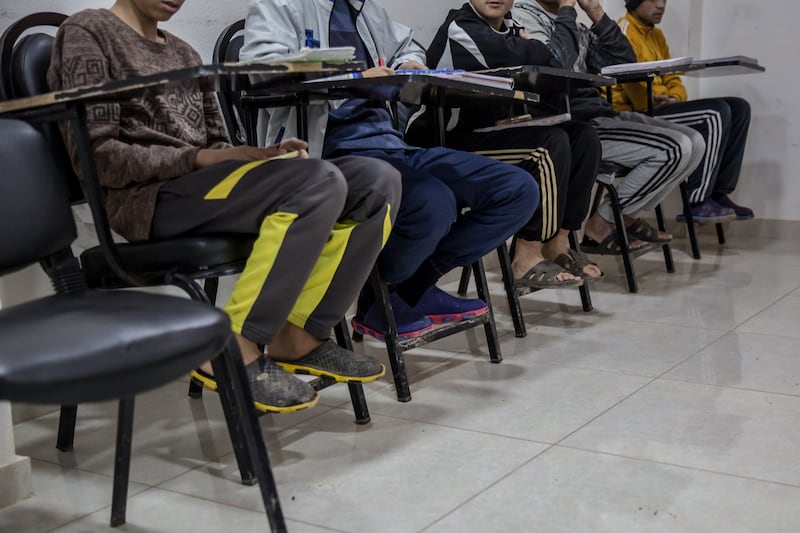 Boys in the Orkesh rehabilitation centre in northern Syria.
Following a 2023 trip to the region, Fionnuala Ní Aoláin, the former United Nations special rapporteur on the protection of human rights while countering terrorism, said she was “most profoundly concerned by the mass indefinite arbitrary detention of children … premised on the alleged threat they pose to security and based on their – or their parents – alleged prior links to [Islamic State].”
“States of nationality have a sustained obligation to repatriate their nationals held in multiple detention facilities in northeast Syria,” she wrote.
In November, she told The Irish Times that “children remain punished for the sins of their parents, ending up in a “black legal hole”.
The Irish Times met and interviewed Ben Abd in the Orkesh centre last February, near the city of Qamishli. About 145 boys and young men were being held there, often after being removed from their families. Local authorities say this is for their protection, though these forced separations have also been heavily criticised.
French national Hamza Ben Abd (23), whose mother joined ISIS in Syria when he was still a child, performs a rap about his life experience. Video: Sally Hayden
Those taken were actively going through a deradicalisation programme, but there was little planned for what would happen next.
Welat Salah (32), a staff member at Orkesh, said the biggest challenge comes once they turn 18. “It doesn’t make sense to bring them to the camp or prison: the answer is to repatriate them.”
He said they had up to 20 Europeans, including dual nationals, in the centre. “Maybe I can deliver a message that we need to help these children, they are innocent victims,” he said.
Instead, Ben Abd has since been transferred to Iraq, where he is believed to be now imprisoned indefinitely in dire conditions his lawyer believes will eventually kill him.
Originally from Toulouse, Ben Abd told a film-maker that he was a child fighter – one of what Islamic State called the “cubs of the caliphate” – and that he trained and fought with Islamic State for a few months. He also appeared in a 2014 propaganda video glorifying French jihadist and killer Mohammed Merah, when he was 11 years old. The video shows two small children walking down a street, carrying Kalashnikovs and answering questions including where in France they come from.
Ben Abd said he eventually tried to escape Islamic State territory himself, but was wounded by a mine. He still has injuries to his head, is blind in his left eye and his shoulder is broken. He cannot get the operation he needs to fix it.
Ben Abd said in February that he was willing to go through the French justice process, even if it led to his imprisonment. “I’d rather be in prison in France than here,” he said.
All of his living family are in France, he added, including a sister who was repatriated from Syria in 2019. “I would go back to France running … I just want to live my life as a normal person.”
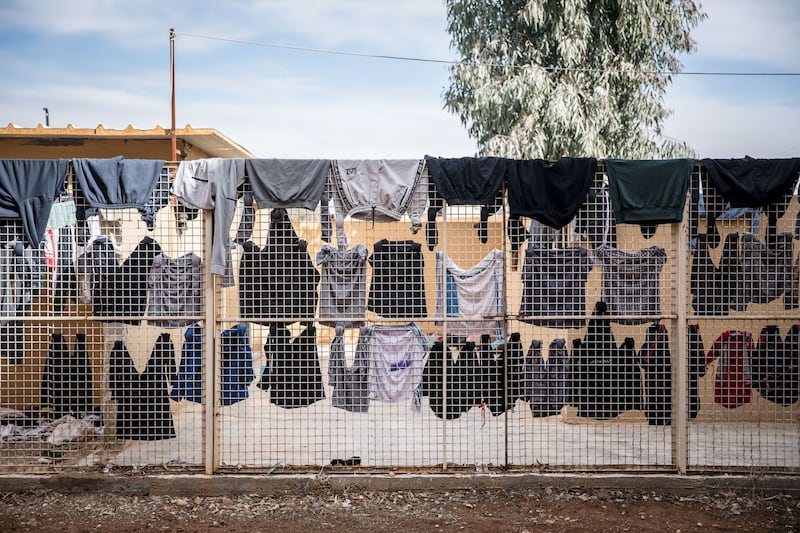 Clothes belonging to boys in the Okresh rehabilitation facility in northern Syria are hung out to dry. Photograph: Sally Hayden
A staff member with the NGO Purity, which has worked on rehabilitation programmes in the Orkesh centre, said the prior teaching some of the boys and young men underwent is troubling – “how to fight, how to kill, how to behead”. He is worried some might be waiting for “a revival” of Islamic State – but “keeping those children here without any future, it’s not the right thing to do”. He said the young people need vocational training, and, most ideally, repatriation.
As a humanitarian organisation “we deal with them as victims” as they “haven’t been in any legal process or court,” said the man, who did not want to be named for fear of reprisals.
When asked about Ben Abd’s case by The Irish Times last April, a French diplomatic source said it did not comment on personal situations but agreed “French children have not chosen to join a terrorist organisation.” The source said France had organised “several complex repatriation operations” since 2019 but “this is a war zone which France has no control over”.
The source said all French women or mothers of French children remaining in detention camps were offered to return to France with their children. However, the source did not specify the policies around French children who have since reached the age of 18, and authorities did not respond to a more recent request for comment.
This month, a French court ordered the country to re-examine the situation of Ben Abd and two other young men within two months.
Lawyer Marie Dose said she had been requesting their repatriation for years. “The French authorities are fully aware of the catastrophic situation in which they are being held. France continues to ignore my requests and refuses to respond to them.”
She said she believes a 2022 European Court of Human Rights legal ruling, which condemned France for failing to justify the non-repatriation of women and children linked to Islamic State in northeast Syria, “must also apply to young adults … Otherwise, what would that mean? That it would be sufficient to abandon all these children in camps and prisons until they reach adulthood, only to then claim that this ruling no longer applies to them because they are no longer minors?”
This is “gross inhumanity” by France, she said. “Young adults who were taken to Syria at the age of 10 or 11 are being made to pay for the deadly choices of their parents. They are victims – nothing but victims.”
Ní Aoláin said there are no definitive numbers on how many European young people are detained in northeast Syria, but there used to be four French citizens in the Orkesh centre. One was repatriated, according to Dose. Of the others, Youssef Boudouaia is “in a catastrophic condition”, the lawyer said, while Adem Clain – the son of Fabien Clain, the French jihadist who claimed responsibility for the 2015 Paris attacks – has been moved to Alaya Prison in Qamishli. Adem Clain has previously said that he considers his father a terrorist and remains angry at him. Adem Clain was never in combat, according to both him and the Kurdish authorities.
Of the three young men, Boudouaia, “whom France has quite literally abandoned, and whose family was repatriated without him, is the most severely affected. He is going to die, and this is not my assessment; it is what the guards at the Orkesh centre say. He suffers repeated epileptic seizures, is disabled, and can barely walk. I do not know how he is still alive.”
Dose said that Ben Abd faints very frequently, but was kept going by the hope of finally returning to France.
Instead, 47 of the 51 French nationals imprisoned in Syria were transferred to Iraq last summer, joining 12 French nationals who had been sentenced to death, commuted to life imprisonment in Iraq “following sham trials,” she said.
“Iraq knows nothing about Hamza, has never investigated him, and [his expected] trial will necessarily be a sham.”
Human rights organisations have previously criticised similar transfers, with Human Rights Watch saying that international law “prohibits the transfer of detainees to countries where they are at serious risk of torture and mistreatment”.
Dose said Ben Abd’s mother has been extensively investigated by French counterterrorism prosecutors, and there is an arrest warrant for Ben Abd. If repatriated he would be put under formal investigation and held in pretrial detention for deeds he might have carried out while still a minor. “Yet even [with] that, France denies him, preferring instead to see him tortured in Iraq … It is pitiful, and of an extraordinary cruelty.”
She said Ben Abd’s transfer to Iraq was carried out with the approval of France. In Iraq, she said, “I have seen the conditions in which the men are detained: they are crammed together like animals, receive no medical care and are subjected to violence. Hamza will suffer the same fate.”
Of the young men, Dose said: “They will eventually all die, and one is led to believe that this is precisely what France hopes for.”
Before his transfer to Iraq, Ben Abd was still practising French with the other French citizens being held in Orkesh centre, and writing raps. His raps were about “the misery, all the suffering I went through. Daesh [Islamic State] have taken everything from me, they stole my past and stole my future. Now France is holding me responsible,” he said.