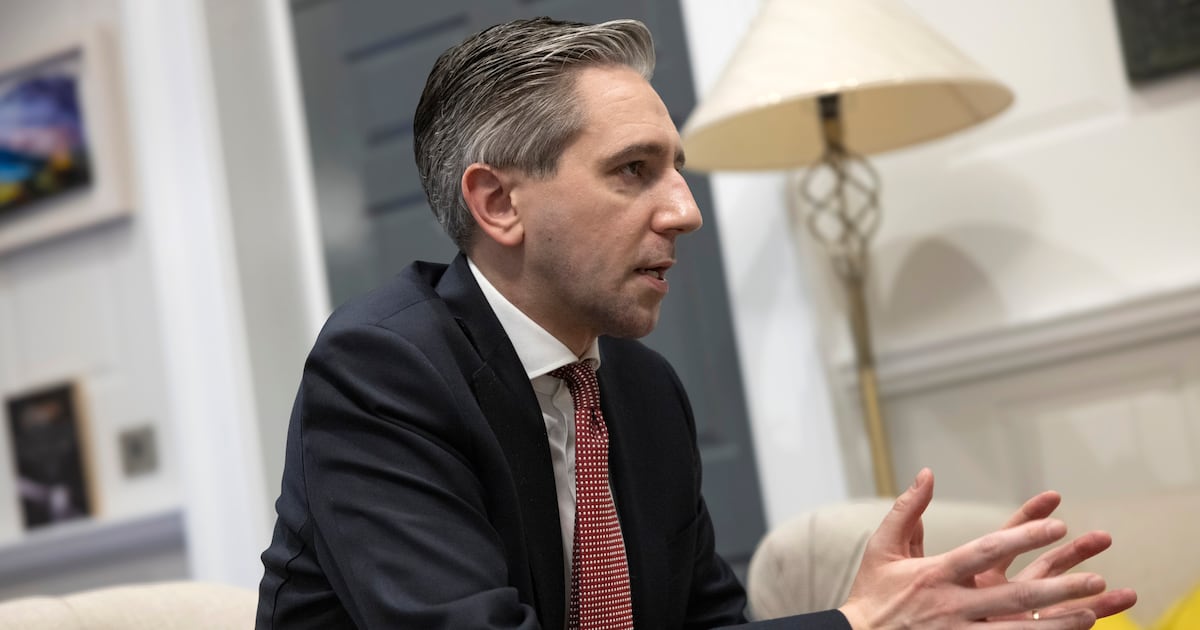
Simon Harris says he considered resigning from politics and public life earlier this year after a series of disturbing and violent threats were made against his wife and his two small children.
The Tánaiste said he came “a lot closer” to walking away from politics than most people realise after a “sustained” and “unrelenting” campaign of abuse that the Fine Gael leader says he felt powerless to stop.
“I came a lot closer than probably anybody thinks I came to actually walking off the pitch. It was just so sustained. I guess, when people go for your children … ,” says Harris in an interview with The Irish Times.
Was there a point when he felt he had to resign and that the abuse was too much? “Yeah,” he says. “Yeah, it was that sense of powerlessness.”
Earlier this month a woman received a six-month prison sentence for sending social media messages to Harris.
Sandra Barry (40), of Tor an Rí, Balgaddy, Lucan, had branded Harris a “murderer” and said, “I hope somebody does something to your family”.
The messages from Barry, sent in August, were among a number of incidents directed against Harris and his family this year.
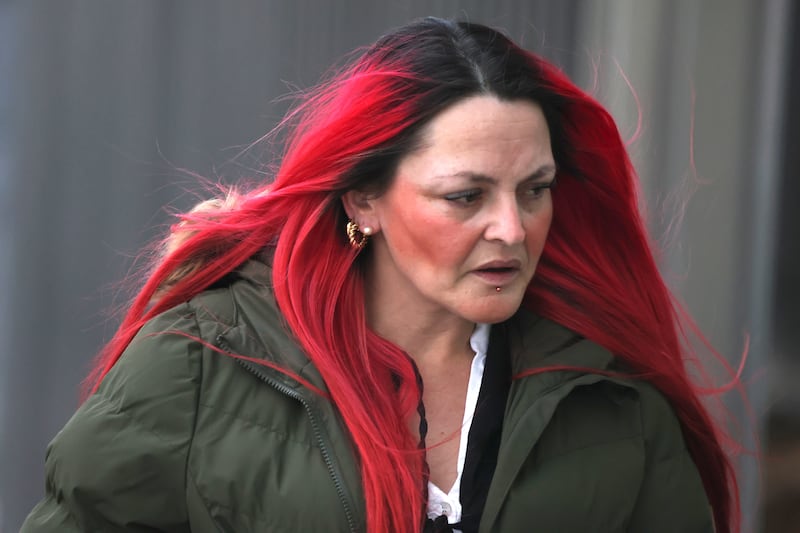 Sandra Barry at Dublin District Court. Photograph: Collins Courts
The Tánaiste said he had suffered a bomb threat on his home, a threat to kidnap his children and a threat of sexual violence against a female family member.
“It had gotten to the point during the summer months where it just seemed unrelenting,” he says. “It targeted my children in a way that had never happened before.”
The incidents had unfolded in the days leading up to the Fine Gael think-in in Mullingar, Co Westmeath, in early September.
“I was shook, is the God’s honest answer,” says Harris.
The Tánaiste had conversations with his family about leaving politics. He tried to appeal to the logical side of his brain, to remember that Ireland was a democratic country with laws.
“But all logic was out the window, at least in your own head for a period of time, when somebody comes for your children,” he says.
“This was people threatening to do physical harm, vile harm, some of the harm which isn’t known in the public, towards my children, towards my wife and towards me.
“And I didn’t know how to make it stop, you know? I didn’t know how to make it stop.”
Speaking in his office in Government Buildings, Harris says he does not want to describe how the abuse has changed his family life, “for reasons of telling bad actors too much information”.
“Of course, it has an impact,” he says.
He says that while he has an armed Garda presence when he is in public places, “that’s not the case for everybody in my orbit, everybody in my family”.
Harris says he was “shut down” after he said in November that Ireland’s “migration numbers are too high”.
Some felt the comment, which he made on his way into a Cabinet meeting in October, was incongruous compared with his previous remarks on migration.
Others noted that the remarks came days after a presidential election where there had been a record high number of spoiled votes, many of which expressed an anti-immigration sentiment.
“I can understand that, now that you say it like that,” says Harris, but he was “genuinely taken aback that so quickly there was an effort to shut down the debate”.
He says some of the responses, including critical columns in The Irish Times, were asking interesting and fair questions of him. But he feels claims he was touting a Nigel Farage or dogwhistling style of politics were “bizarre”.
[ Simon Harris is deliberately spreading disinformation on immigrationOpens in new window ]
“And it kind of proved the point. The point is that there’s certain political issues where there’s just either a cosy consensus around them, or there’s just a political kind of shrugging of the shoulders: ‘Let’s not get involved, because it brings too much [hassle],’” he says.
“It’s important for the political system to listen to people, many of whom perhaps vote for them, or used to vote for them, who feel they’re not being listened to or shouted down.
“And I tell you, if I’m the Tánaiste of this country, and if I was so quickly shouted down in an attempt to shut me up and stop the debate, how do you feel if you’re a citizen living in rural Ireland who’s concerned about losing the local hotel?”
 Tánaiste Simon Harris during this interview. Photograph: Chris Maddaloni
He says when he became taoiseach last year as part of the rotation of the leadership role in the last coalition government, he had come up against a “siloed mentality” within government agencies over who bore responsibility for clearing away tents that had been erected on Mount Street in Dublin city centre by people seeking international protection.
“Is this an issue for IPO [the International Protection Office]? Is this an issue for OPW? Is this an issue for Dublin City Council? I just couldn’t hack it any more,” he says.
In a reference to the number of migrants who are homeless, Harris said: “What I’m saying here is not attempt to be in any way controversial at all, but obviously you have to have a right to housing in Ireland to be housed, right?
“And a lot of this is a genuine policy challenge. A lot of people who are in emergency homeless accommodation, or certainly some people who are in emergency homeless accommodation, don’t have a housing right in Ireland.
“That’s not to say, by the way, they we don’t have a duty of care. It’s not to say we shouldn’t look after them. It’s not to say any of that.
“But if you look at the breakdown in housing figures that are published every month … There are a significant number of people in emergency housing, emergency homeless accommodation that don’t have a housing right.”
So it shouldn’t be controversial to put children ahead of single men, including migrants, for housing? Harris replies: “No.”
He singles out child homelessness as a reason why “the social housing allocations system is just not working right”.
“If we’re providing more social homes than we have at any time since the ’70s, and we need to provide more, but … how are we not, as a country, making inroads in relation to child homelessness?” he says.
“That bit I’m struggling with.”
There are more than 5,000 homeless children in Ireland.
[ Number of homeless people in Ireland reaches new record high in OctoberOpens in new window ]
The Government’s new housing plan includes a policy that could see local authorities put families with children at the top of the social housing list. But what about single adults, who constitute the majority of people on social housing lists?
“We obviously all want to tackle homelessness, but the idea that there are some children who will spend their second Christmas in emergency accommodation isn’t acceptable to any of us, regardless of our political background and persuasion. And you can’t say everything’s a priority.
“I’m saying we have to prioritise children in the first instance – children and families who are in long-term homelessness.”
Harris says he was warned by the “system” that such a policy could “create a perverse incentive for somebody to become homeless” with their children in order to secure a home.
“It offends every fibre of my being,” he says.
Who in the system believes that? “The system,” he says. “I’m not talking about individual people.”
Ahead of last year’s general election, Harris participated in an Instagram question-and-answer session with followers where he said an election promise to reduce childcare fees to €200 would be included in Budget 2026. He told one follower: “I think we could have it in for January 2026.”
The proposal will instead be delivered over the lifetime of the Government.
“I think I said [the policy] could be delivered early in the lifetime of the Government. Perhaps I said 2026, I don’t recall that bit,” he says.
He feels the social contract with young people has been “fractured” because of the number of people who have had to put off starting a family because of housing and childcare issues.
“I just know from talking to people, I know from knocking on doors, that childcare is not just a social issue – though it is one – and it is an issue that’s continuing to disproportionately impact women,” he says.
Fine Gael suffered a bruising defeat in the presidential election. He says Heather Humphreys was a good candidate but suggests that in future more parties might “coalesce” around one candidate – “more about a contest of ideas … rather than what’s your party label”.
He is also open to a proposal to lower the threshold for becoming a candidate for a presidential election, from four councils to a specific number of councillors, maybe about 80.
Claims were made by some conservative commentators at the time of the election that Fine Gael had moved too far to the left.
Does Fine Gael feel hostile to conservatives? “I hope not,” he says.
“I do think in general, we all have to be – all of us in politics, and I don’t recuse myself from this – a little bit more tolerant and a little bit more willing to engage in debating the ideas and not kind of all demonise each other.
“I think there’s way too much of that in political discourse. I’m sure you can find examples of where I have inadvertently done it. I do think there’s just too much of a rush to shut down debate and discussion.”
[ The Irish Times view on the political year: lagging behind realityOpens in new window ]
He says criticism of his social media presence – for which he was nicknamed the “TikTok Taoiseach” – might be “the old green-eyed monster”.
“For all the media and all the politicians who like to comment about my social media presence, a hell of a lot of media organisations and political parties and politicians [are] trying to do more on social media.”
As for his new role in Government, he says criticism of his appointment to the Department of Finance, specifically his lack of an economics degree, shows “a slight lack of understanding of how the political system in this country works”.
“You don’t need to be a doctor to be Minister for Health. You don’t need to be an economist to be Minister for Finance. In fact, most haven’t been. In fact, some of our most successful haven’t been either.”