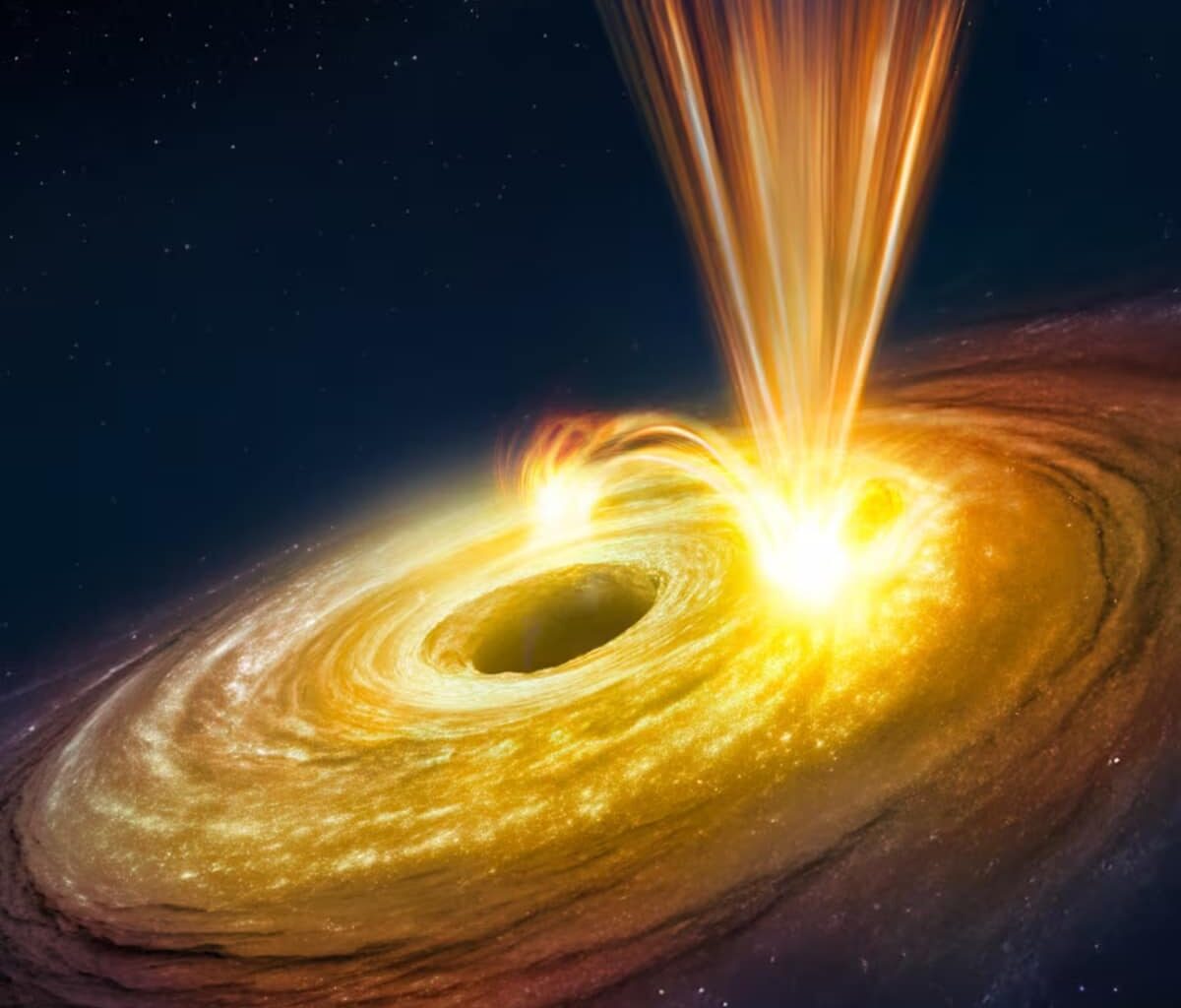
Black holes are among the most extreme objects in the Universe — so dense that not even light can escape their pull. But when they erupt, the results are beyond anything we can easily imagine. In a groundbreaking new study, astronomers have observed a supermassive black hole blasting out winds at mind-bending speeds — reaching 60,000 kilometers per second, or one-fifth the speed of light.
Published in Astronomy & Astrophysics, the discovery offers an unprecedented look at the powerful forces shaping galaxies — and shows that black holes might have more in common with stars than we once thought.
An eruption like no other
The discovery was made using data from two space observatories: XMM-Newton and XRISM, a cutting-edge X-ray mission led by JAXA with contributions from ESA and NASA. Together, they captured an extraordinary outburst from a black hole in the spiral galaxy NGC 3783.
This cosmic explosion produced ultra-fast winds of charged particles streaming outward at speeds equivalent to one-fifth the speed of light. The event, researchers say, resembles the kind of energy release we see in solar flares — only scaled up to galactic proportions.
Unlike the winds on Earth, these are massive plasma jets — similar to the Sun’s coronal mass ejections, where superheated gas is thrown into space. But even the most violent solar events pale in comparison to this. If the Sun ever released energy at such speeds, Earth would be unrecognizable.
The star of the show 🌟
This @NASAHubble captured NGC 3783, a bright barred spiral galaxy, but in this image, the eye is equally drawn to the very bright object in the lower right. This is the star HD 101274.
Learn more about this galactic duo HERE >> https://t.co/jIEkTw7Go9 pic.twitter.com/aBJk4BFgcG
— NASA Marshall (@NASA_Marshall) May 13, 2024
The monster at the heart of NGC 3783
At the center of NGC 3783 lies a supermassive black hole about 30 million times heavier than the Sun. This cosmic giant powers what astronomers call an active galactic nucleus (AGN) — a highly energetic region where matter spirals inward, heats up, and emits powerful bursts of radiation.
The recent eruption marks one of the most dramatic episodes ever observed from such an AGN, shedding new light on how black holes interact with their galaxies.
The fastest winds ever seen
“We’ve never witnessed a black hole produce winds this fast,” said Liyi Gu, lead researcher at the Netherlands Institute for Space Research (SRON). “For the first time, we’ve seen how a short burst of X-rays can instantly unleash ultra-fast winds that form in just one day.”
The team believes the eruption was triggered when the AGN’s magnetic field suddenly “untwisted,” releasing an enormous amount of energy. “It’s similar to a solar flare,” explained Matteo Guainazzi, XRISM project scientist at the European Space Agency (ESA), “but on a scale that’s almost impossible to comprehend.”
A key to understanding galaxies
These extreme winds don’t just make for spectacular physics — they play a vital role in shaping galaxies themselves. By blowing gas and dust away from galactic centers, they can regulate star formation and influence how galaxies evolve over billions of years.
According to the researchers, unraveling the mechanisms behind these winds will help scientists piece together the broader story of how galaxies — and the black holes at their cores — have grown and changed throughout the history of the Universe.

Rémy Decourt
Journalist
Born shortly after Neil Armstrong’s first steps on the Moon in 1969, my journey into space exploration has been entirely self-taught. A military stay in Mururoa sparked my formal education in space sciences, and early sky-watching experiences in an astronomy club ignited my passion. I founded flashespace.com, transitioning from sky observation to a deep interest in space missions, satellites, and human and robotic exploration. Since 2010, I’ve been part of Futura’s editorial team, covering space news and working as a freelance writer with extensive international field experience in space-related sites.