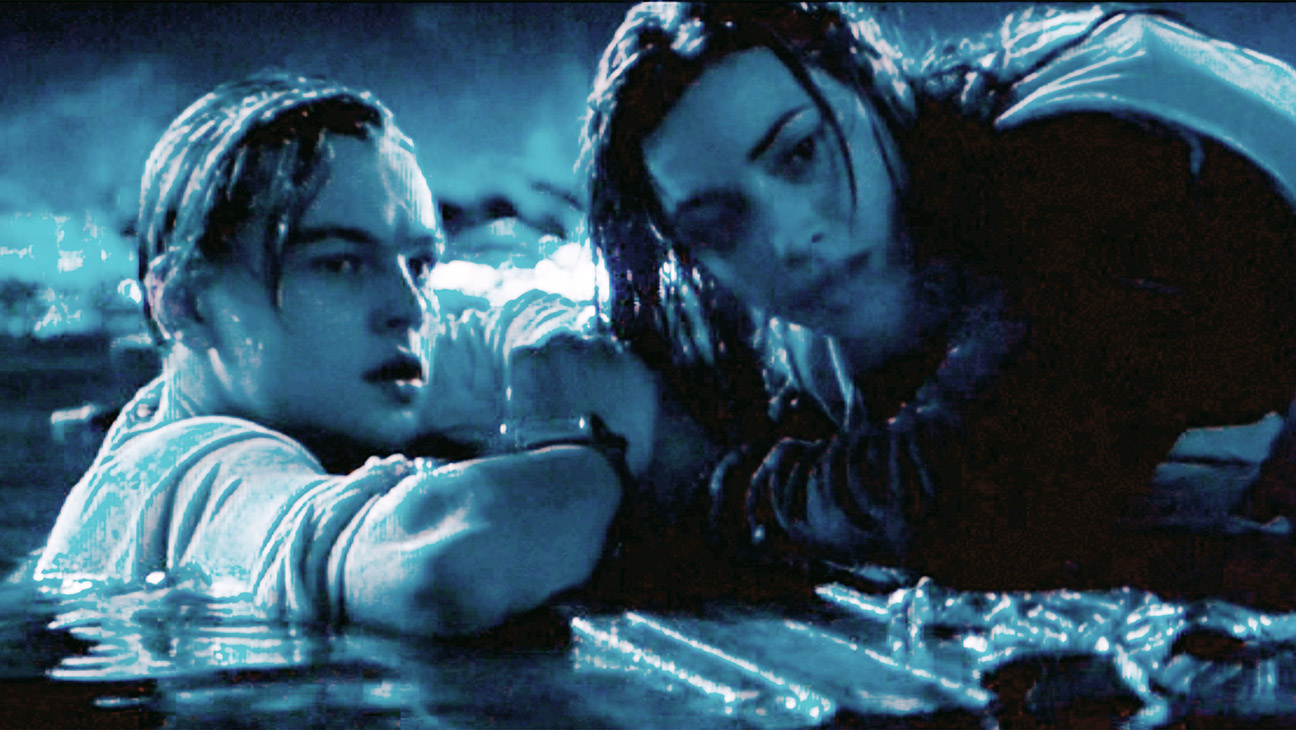
Titanic is the most popular disaster-survival film of all time.
But if you found yourself on the “ship of dreams” on the night of April 15, 1912, what could you have done to survive its sinking?
We asked the film’s Oscar-winning writer-director James Cameron during our interview for last week’s Hollywood Reporter cover story and the ever-resourceful filmmaker gave a rather clever answer.
First, our phrasing of the question was specifically chosen: “If you were traveling by yourself as a second-class passenger on Titanic when it hit an iceberg, what would you have done?”
“Traveling by yourself” because a man traveling with his family is presumably going to prioritize their survival instead of his own. And “second class” because we all know from watching Cameron’s film that some third-class passengers found themselves trapped below decks and were pretty much doomed, while first-class passengers had the best shot at securing an easy seat on the lifeboats (even though Second Officer Charles Lightoller mistakenly took the captain’s order of “women and children first” to mean “women and children only,” which resulted in some boats not being filled to capacity).
Turns out, Cameron has played this game himself.

Kate Winslet, Leonardo DiCaprio and James Cameron on the set of ‘Titanic.’
20th Century Fox Film Corp./Courtesy Everett Collection
“I think there were interesting ways to what-if or second-guess the whole thing,” Cameron says. “One I like to play with my Titanic experts is — with what we know now, and if you had the captain’s ear — how could you save everybody? The other is: What if you’re a time traveler, you go back and want to experience the sinking, and your little time-travel thing that gets you back fails, and you’re like, ‘Oh f–k, I’m really on the ship, I’ve got to get off it.’”
Assuming you couldn’t get a seat on a lifeboat the normal way, Cameron says that your best move would be to stand on the side of the Titanic and wait for a lifeboat to launch during the early part of the evacuation. Then you jump off the Titanic and swim to the newly launched boat. As long as the boat wasn’t too far away, you’d survive the brief plunge into the 28-degree water — and the lifeboat passengers would likely pull you aboard given that people would be watching from the rails of the ship.
“Most people wouldn’t have had the courage to jump into the water,” Cameron says. “They couldn’t quite believe that the ship was really going to sink. But if you knew for sure it was going to sink and you weren’t on a lifeboat, you jump in the water next to the boat the second it casts off. Once they rowed away, you were screwed. Are they going to let you drown when Titanic is still there and everybody is watching? No, they’d pull you in, and the officers would go, ‘Well, f–k, there’s nothing I can do about that.’ Boat four would be a good one for this.”
In the 1997 film, of course, Cameron’s hero, Jack Dawson (Leonardo DiCaprio), reasons the best move is to stay on the ship as long as possible. Which made sense given the amount of information he had at the time — not knowing rescue from another ship wouldn’t arrive until roughly two hours after Titanic sank. An even better move would have been for Rose (Kate Winslet) to stay on the lifeboat, giving Jack a better shot at survival on that floating door. But that’s all part of the movie’s appeal; there’s a play-along factor where the audience can ask themselves what they would have done at various turning points.
Cameron’s latest, Avatar: Fire and Ash, is now in theaters.
For more from James Cameron’s wide-ranging and deep-dive interview with THR, read this week’s cover story: James Cameron Is Ready to Move Beyond Avatar: “I’ve Got Other Stories to Tell.”