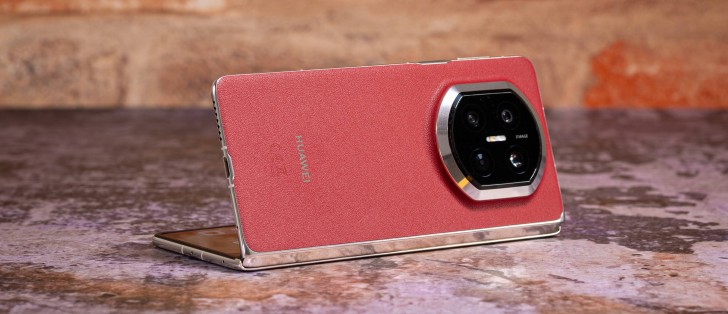
Camera
With the Mate X7, Huawei has focused on delivering a great camera experience as usual. Compared to the Mate X6, the phone arrives with an updated main and telephoto cameras.
With this generation, the 50MP primary cam gets a new and improved sensor, while retaining the variable aperture. The new telephoto camera is 50MP in resolution and has a 3.5x zoom lens with a larger f/2.2 aperture. The 40MP ultrawide camera with autofocus remains the same. So do the two 8MP selfie cameras.
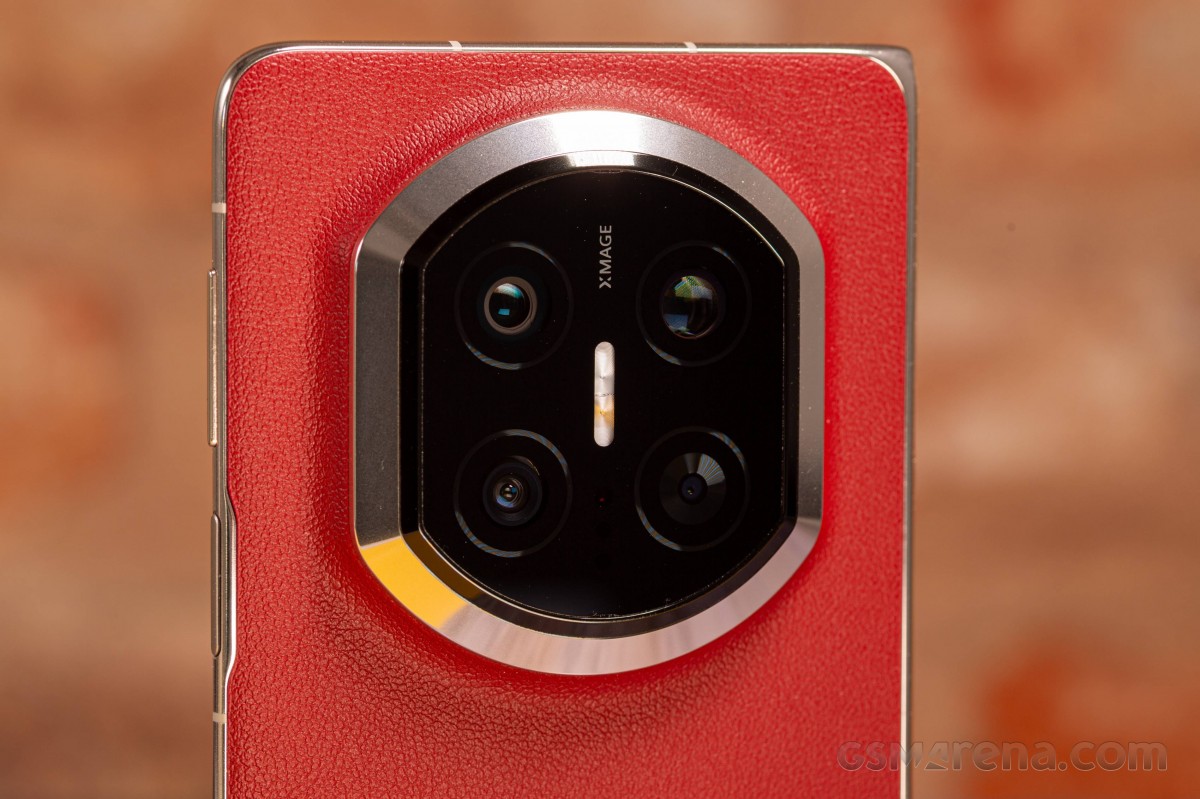
The camera bump has been redesigned since the Mate X6, where it was round. Fun little fact – Huawei is calling this new design the Time Space Portal.
- Wide (main): 50MP, 1/1.28″ 0.89µm, f/1.5 – f/4.0, 24mm, PDAF, Laser AF, OIS; 4K@60fps
- Ultrawide: 40MP, f/2.2, 13mm, PDAF; 4K@60fps
- Telephoto 3.5x: 50MP, f/2.2, 84mm, PDAF, OIS; 4K@60fps
- Spectrum sensor (2n Gen Ultra Chroma Camera): 1.5 million spectral channels
- Cover selfie camera: 8MP, f/2.4, 26mm, fixed focus; 4K@30fps
- Internal selfie camera: 8MP, f/2.2, 26mm, fixed focus; 4K@30fps
The main sensor is quite large, measuring 1/1.28″ in size. Huawei promises a 100% improvement in dynamic range compared to the Mate X6. It is paired with a lens with variable aperture – f/1.5-f/4.0. A version with a significantly smaller 1/1.56″ f/1.4-f/4.0 main camera exists in China, but we are not reviewing that one.
The telephoto unit gets an upgrade, too. It uses a similar 50MP sensor as before, and it’s also RYYB, but it appears to be a bigger sensor than what the Mate X6 had. The optical zoom has been reduced to 3.5x from 4x last year, but it has a much larger aperture at f/2.2.
An interesting bit about the new telephoto camera is that it uses a vertical periscope structure that improves the light intake and reduces the size of the module by 44%. The camera can also focus from really close, just as before.
The 40MP ultrawide shooter along with the two 8MP selfie cameras appear to be unchanged from the Mate X6.
Thanks to the second-generation LOFIC CMOS sensor on the main camera and the second-generation Spectrum sensor, the phone can record Ultra HDR videos with reportedly improved dynamic range compared even to what we saw with the Pura 80 Ultra.
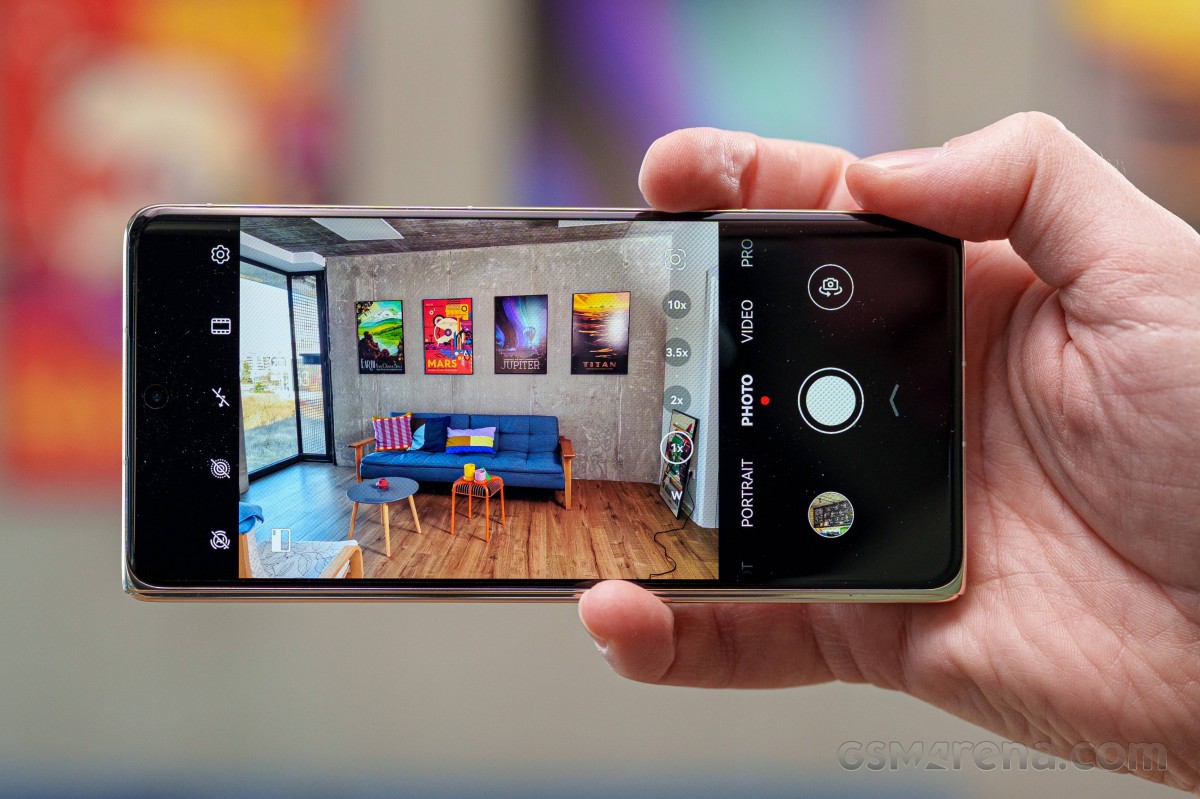
The camera app hasn’t changed much in the last few years. The viewfinder has zoom toggles and a macro one. You can use the rear cameras for selfies with the cover screen acting as a viewfinder, too.
Daylight photo quality
Main camera
The 50MP main camera takes some great 12MP photos. The resolved detail is plenty and the colors are lively. The dynamic range is quite good as well.
We can’t say we see the promised 100% improvement in dynamic range compared to the Mate X6. The image rendition appears similar as well. Our only gripe with this camera is that its white balance can be a bit unreliable, sometimes adding a yellowish or greenish tinge out of nowhere. It might very well be something Huawei could fix with a software update.












Main camera sample (1x)
The variable aperture allows you to control the depth of field and the light that gets through naturally. This year it starts from f/1.5 at the largest end and goes again to f/4.0. The widest aperture allows the camera to capture more light at the expense of having less of the scene’s depth in focus. Smaller apertures are preferable when you require more of your subject to be in focus, which can be great for closer subjects that the large sensor can struggle to capture with good focus. Most of the daylight photos were shot at f/2.0, which was chosen by the camera algorithm.




Main camera (1x) background defocus sample: F/1.8 • F/4.0 • F/1.6 • F/4.0
There is an option to save 25MP photos instead of 12MP, just like on the Mate X6. We only tried this mode in good light and the results were quite good. It’s hard to describe, but you don’t really get more definition or detail out of the scene, but the higher resolution allows you to blow out the image further if needed without losing quality – and there is no tradeoff in the other image parameters, such as noise or dynamic range, so it’s well worth keeping it on by default. The resulting file size is only about 50% higher for the 25MP images.








12MP vs 25MP: Ultrawide • Main • 2x crop zoom • 3.5x telephoto
People shots with the primary camera come out very well, with well-developed facial features and a flattering rendition.
Some of our photos, which we shot in the regular Auto mode, however, have a strange color tinge, which was not present in Portrait mode. We really think it’s a bug with the white balance.








People shots (1x): Regular mode • Portrait mode
2x crop zoom
The 2x crop zoom is very good, and we love the image properties even if they are not entirely on the level of the 1x images. What’s surprising, however, is that the 2x mode on the Mate X6 produces equally good photos (at least in good light).












Main camera sample (2x crop zoom)
People shots in the 2x mode come out very nice, with well-developed facial features.



People shots (2x): Portrait mode • Regular mode
3.5x telephoto camera
The 3.5 zoom camera takes great photos. The images are very detailed – the clarity and definition are far superior to the Mate X6’s 4x zoom camera, even though that one had a higher level of magnification due to its longer focal length.
















Telephoto sample (3.5x zoom)
The camera app offers up to 10x hybrid zoom. Detail already starts looking artificial at this zoom, but the image definition is again better than the Mate X6’s 10x zoom.














Telephoto sample (10x zoom)
People shots with this camera again come out very nice.
Interestingly, we observed the same color tinge issue with the indoor telephoto shots as with the main camera. The Portrait mode photos were fine.




People shots (3.5x): Regular mode • Portrait mode
Ultrawide camera
Finally, the 40MP ultrawide camera now saves 12MP photos, instead of the 10MP photos the Mate X6 produces.
The level of detail is high for such a camera, and the dynamic range is great.
As we already mentioned, the X7 is a bit inconsistent with the white balance compared to the X6, and the ultrawide camera is where the issue was most apparent. The ultrawide camera is the same on the two phones, so we surprisingly prefer the color rendition on last year’s Mate X6.











Ultrawide sample
Close-ups
There are several ways to take close-up shots with the Mate X7, and they all produce great results. The first is to use the telephoto camera, which can focus from as close as 5cm. If you switch to 10x, the magnification is even more impressive (the last two photos below).
What we noticed is that the depth of field is notably shallower here than on the Mate X6, which confirms the fact that the telephoto camera has a larger sensor even though Huawei has not revealed the sensor size data. Technically, this makes the X6 better suited to taking nicer close-ups as it can capture a bigger part of your miniature subject in focus.








Telemacro sample: 3.5x • 10x
Alternatively, you can use the ultrawide camera for close-ups, as it supports autofocus and can double as a macro shooter.
If you approach a nearby subject with the main camera selected, the app seamlessly switches to the so-called Macro mode, which uses the ultrawide camera with a crop that matches the regular field-of-view of the primary camera.



Ultrawide close-up (24mm)
If you insist on shooting a close-up with the extra wide field-of-view that the ultrawide offers, you need to select the ultrawide cam in the camera app manually – this avoids the cropping of the macro mode.



Ultrawide close-up (13mm)
Selfies
The Huawei Mate X6 has two 8MP selfie cameras – one is inside a punch hole on the cover screen (F/2.4) and the other one is inside a punch hole on the inner display (F/2.2).
Both offer great-looking selfies with a nice subject rendition with good dynamic range and skin tones. In a sense, they punch above their weight.




Cover screen selfie cam
You can also take selfies with the rear cameras by using the cover screen as a viewfinder. This way, you will get high-res, high-quality shots with a naturally defocused background.




Cover screen selfie • Inner screen selfie • Main camera selfie • Main camera selfie (2x)
Low-light photo quality
Main camera
The Mate X7’s new, larger sensor on the primary camera really comes into its own after dark. This is where it really shines compared to the Mate X6.
You get very detailed textures, great definition and even a slight advantage in dynamic range, which we didn’t see in the daytime shots.










Main camera low-light sample (1x)
2x sensor crop
The low-light 2x zoom photos look great, too. The Mate X6 pales in comparison with its 2x zoom, at least when textures and definition are concerned. Other than that, the dynamic range and color saturation are comparable between the two phones.




Main camera low-light sample (2x crop zoom)
3.5x telephoto camera
We were impressed by the telephoto camera’s performance during the day, but it couldn’t keep up the great impression after dark.
The camera here clearly has a high-quality sensor and lens, but it fails to produce consistently good results for some reason. Whether it’s an OIS hiccup or an overly eager noise reduction algorithm that’s acting up, we can’t be sure, but after dark, we prefer the telephoto images by the Mate X6.







Telephoto low-light sample (3.5x zoom)
The 10x zoom mode cannot be recommended for low-light shooting. The image quality is well below our expectations.


Telephoto low-light sample (10x zoom)
Ultrawide camera
Finally, let’s look at some ultrawide photos. Those are quite nice with more than enough detail and a nice dynamic range; however, just like during the day, the white balance appears to be inconsistent from shot to shot, unlike the Mate X6’s ultrawide.







Ultrawide low-light sample
Photo quality verdict
The Mate X7 proved its bigger camera bump is not just for show. Compared to the Mate X6, the new main camera sensor has a better rendition of fine detail in low-light photos at 1x and 2x modes. The new 3.5x telephoto camera also takes much sharper daytime photos, and it can take great people shots and close-ups. We only wish it was more consistent in its performance in low light and that white balance, with all the cameras on the back in general, was less of a hit-or-miss. Besides that, the selfies were great as usual, and the ultrawide camera did not disappoint, even though it’s essentially the same as last year’s model. Overall, it’s a great showing from a foldable.
Video quality
The Huawei Mate X7 captures videos up to 4K at 60fps on all of its rear cameras, and there is an always-on stabilization, which works very well. The selfie cameras are able to shoot at 4K at 30fps, which is commendable for 8MP imagers.
You can check out the playlist below, which includes multiple video samples.
The daylight videos are very good. The resolved detail is enough, but we expected a bit more. Other than that, the dynamic range is wide, and the colors are accurate. In general, the primary camera’s video performance is on the same level as the Mate X6 in good light.
The same applies to the ultrawide footage as well.
However, we noticed a definite improvement compared to the Mate X6 when shooting video at the various zoom levels such as 2x, 3.5x, and 10x.




Video screengrab: Ultrawide • Main cam • 2x crop • 3.5x crop
The low-light videos are excellent – the main camera offers great clips with a great dynamic range and much better definition and contrast than the Mate X6. The same applies to the footage taken at 2x and 3.5x zoom.
The ultrawide footage is fine too, but quite expectedly, it’s on the same level as the Mate X6.
One area where the Mate X7 video recording falls behind the Mate X6 is the 10x zoom, which is not very good on the Mate X6 to begin with, but it’s still better than what the X7 can offer.




Low-light video screengrab: Ultrawide • Main cam • 2x crop • 3.5x crop • 10x crop
Video quality verdict
The Mate X7 captures pretty much the same videos as the X6 during the day with its main and ultrawide cams. However, we noticed a definite improvement when shooting daytime video at the various zoom levels, such as 2x, 3.5x, and 10x. Nighttime videos out of the main cam at both 1x and 2x zoom were also one of the highlights of the camera performance here.